

Sourdough bread is sour because microbes convert flour-derived sugars into organic acids, principally lactic and acetic acids, with lactic-acid bacteria doing the main acid-producing work. The balance between those acids, not pH alone, helps determine whether your loaf tastes rounded and gently tangy or sharply acidic.
You cut into a loaf expecting the pleasant tang of your last bake, but this one tastes almost vinegary. You used the same starter and followed the same recipe, so what changed? Usually, the useful question isn't whether fermentation happened, but how the dough fermented.
Table of Contents
- Why Sourdough Bread Is Sour
- How Sourdough Fermentation Creates Acid
- Lactic Acid Versus Acetic Acid
- How Fermentation Variables Change Sourness
- How to Control Sourdough Sourness
- Examples of Mild and Tangy Sourdough
- Use DBakerAid for More Consistent Flavor
Why Sourdough Bread Is Sour
A pleasantly tangy sandwich loaf and a sharply acidic sourdough can both come from healthy starters. Their different flavors don't automatically mean that one baker succeeded and the other failed. They may reflect different fermentation conditions and different flavor preferences.
The starter introduces a community of lactic-acid bacteria and yeasts into fresh dough. As that community uses compounds from the flour, the bacteria produce the principal acids responsible for sourness. Yeasts coexist with those bacteria, but they aren't interchangeable contributors to acidity.
The difference between tang and harshness
Think about the difference between plain yogurt and vinegar. Both taste acidic, yet you wouldn't describe their flavors in the same way. Sourdough has a similar range, from a soft background tang that leaves room for wheat flavor to a pronounced acidic edge.
The practical mistake is treating all of that as a single sourness setting. A baker might extend fermentation hoping for complexity and instead get a loaf whose sharpness overwhelms everything else. Another baker might shorten the process and lose the character they enjoyed.
A useful flavor target describes both intensity and character. Instead of recording only “too sour,” write “too sharp,” “pleasantly rounded,” or “not enough tang.”
Judge sourness by the bread you want to eat, not by how acidic you can make the dough.
What you can actually control
Temperature, time, flour, water, starter condition, and the amount of starter all belong in your baking notes. Their effects interact, so changing several together makes the result difficult to interpret.
Start with a recipe you can repeat. Keep the flour and starter routine consistent, then adjust the fermentation environment deliberately. That approach won't make different cultures behave identically, but it gives you a way to learn how your culture responds.
When someone asks, “Why is sourdough bread sour?” the useful answer therefore has two parts: microbes produce acids, and the baker influences the conditions under which they produce them.
How Sourdough Fermentation Creates Acid
Feeding a starter supplies fresh flour and water to its microbial community. Once that starter goes into dough, the microbes have another supply of flour-derived sugars to metabolize. Think of the flour as ingredients arriving in a shared kitchen: different organisms use those ingredients through different processes.
The process is easier to follow when you separate feeding, fermentation, acid production, and baking.
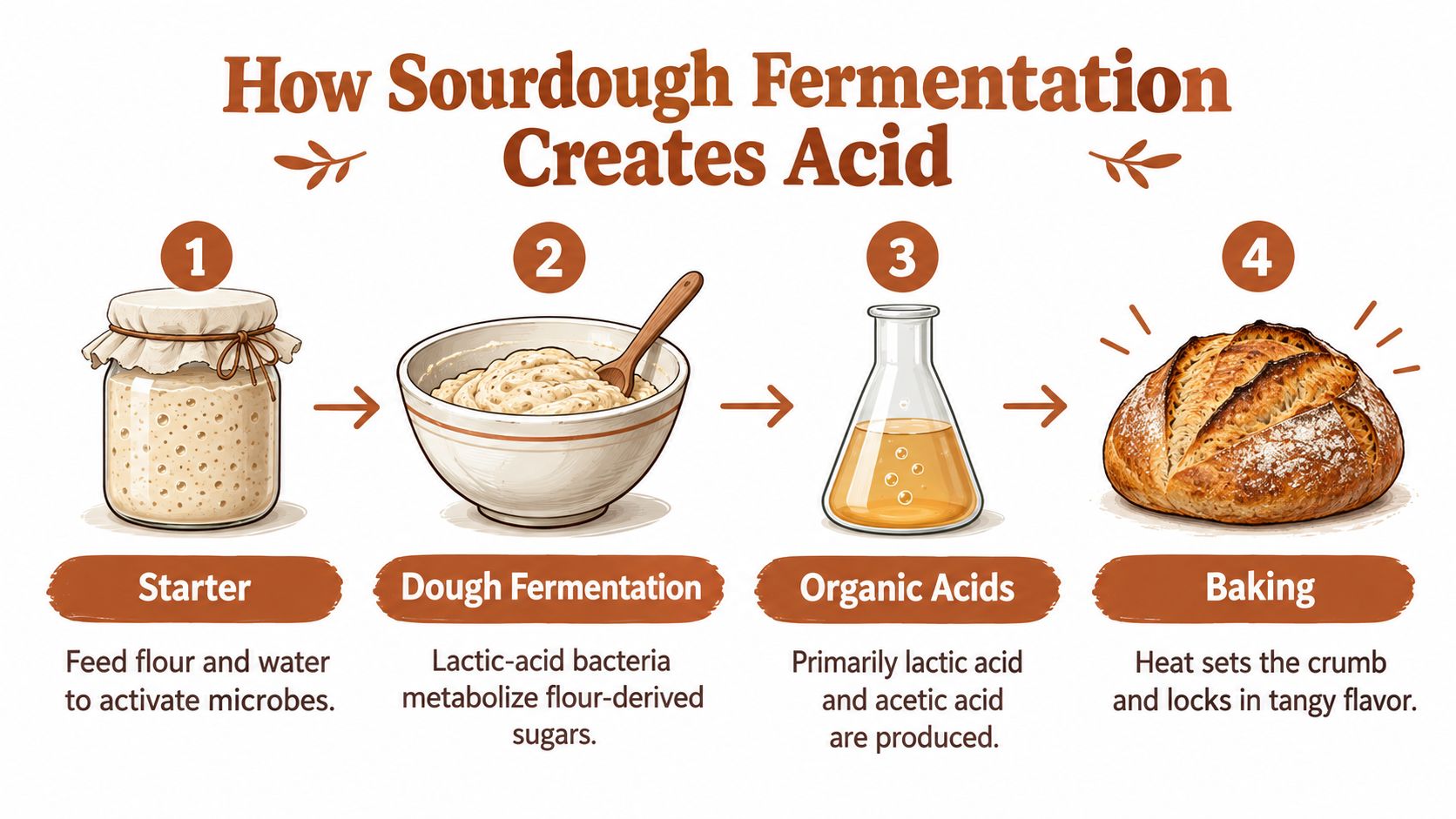
From microbial activity to measurable acidity
During fermentation, bacteria transform available sugars into organic acids. As acids accumulate, the dough's pH generally falls. In a controlled wheat-sourdough model, approximately 22 hours of fermentation produced a pH near 3.6 and 25–38 mmol/kg of lactic acid, illustrating that connection between microbial activity and acid accumulation (controlled wheat-sourdough fermentation research).
Those figures describe an experiment, not a recommended home-baking endpoint. Your starter, flour, and dough conditions may differ substantially.
Two measurements help explain what researchers observe:
- pH measures free hydrogen-ion activity. It's an indication of the dough's acidic state.
- Titratable acidity measures the acid reserve that must be neutralized during testing. It answers a different question from pH.
A kitchen analogy helps: knowing how hot a pan feels doesn't tell you how much heat its entire mass holds. Likewise, an acidity reading and the total acid reserve aren't the same measurement. The analogy isn't exact chemistry, but it helps prevent the assumption that a single number tells the whole story.
What a home baker should measure
A suitable food pH meter can help you compare batches, provided you follow its calibration and measurement instructions consistently. Titratable acidity requires a separate titration procedure, rather than another reading from the same meter. For meaningful comparisons, use the same sampling method and testing protocol each time.
Don't taste raw dough to evaluate either measurement. Assess the finished bread, and connect that sensory result to the fermentation notes you recorded.
The guide to fermentation science provides further context for relating microbial activity to dough behavior. For everyday baking, the most useful record combines temperature, elapsed time, dough condition, and finished flavor, with acidity measurements added when they help answer a specific question.
Baking gives you the finished crumb in which you evaluate that fermentation work. A technically interesting acidity reading isn't the goal. Bread with the flavor and handling qualities you wanted is.
Lactic Acid Versus Acetic Acid
Lactic acid generally contributes a smoother, yogurt-like acidity. Acetic acid contributes a sharper, vinegar-like note. Neither description means one acid is good and the other bad: a distinct vinegar-like edge may be exactly what you enjoy in a strongly flavored loaf.
The comparison below is useful as a sensory starting point, not as a set of guaranteed temperature rules.
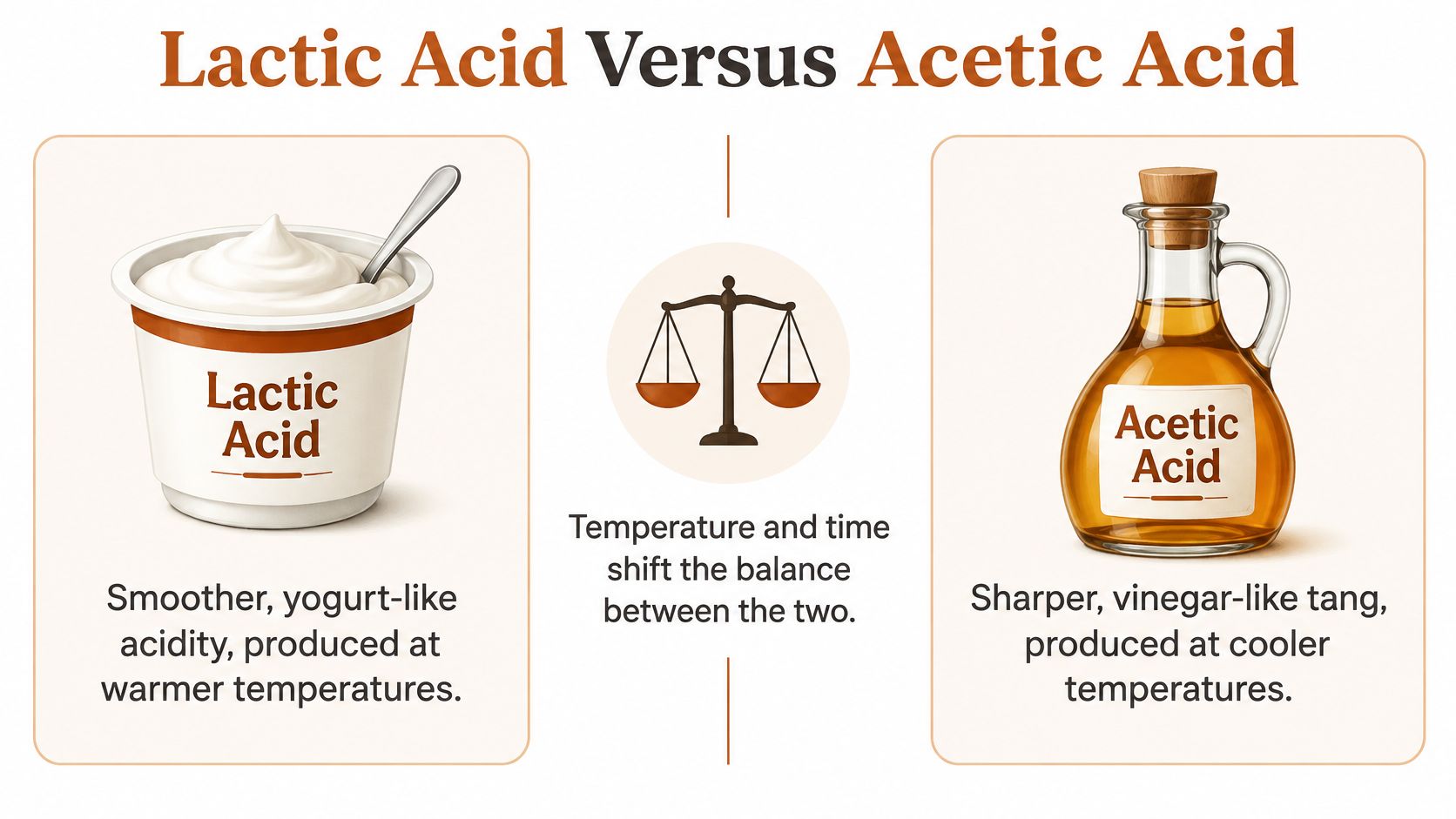
Different bacteria contribute different products
Homofermentative bacteria convert hexose sugars predominantly into lactic acid. Heterofermentative bacteria can also produce acetic acid, ethanol, and carbon dioxide. These terms describe different fermentation pathways, not separate grades of starter quality.
That distinction explains why copying another baker's schedule doesn't necessarily reproduce their flavor. You can match their flour and temperature without matching their microbial community.
| Acid | Useful sensory comparison | What it helps explain |
|---|---|---|
| Lactic acid | Smooth tang, similar to plain yogurt | Rounded acidity without a pronounced vinegar-like edge |
| Acetic acid | Sharper, vinegar-like tang | A more pointed acidic impression |
Why matching pH doesn't mean matching flavor
Two loaves can have similar pH readings yet taste noticeably different because their acid reserves and acid mixtures differ. Research discussed in a sourdough acidity and sensory evaluation paper supports using titratable acidity rather than pH alone when interpreting perceived sourness; a lower-pH fermented-water sourdough didn't receive significantly different sourness scores from conventional sourdough.
The takeaway isn't that pH is useless. It's that pH shouldn't stand in for tasting.
Taste a cooled slice plain before adding butter, cheese, or jam. Note whether the acidity feels soft and integrated or pointed enough to distract from the grain flavor. These are practical descriptions, not laboratory identification of individual acids.
A terminology caution also matters when searching online: trichloroacetic acid isn't the acetic acid being discussed as a sourdough flavor component. If your search crosses into drinking-water contaminants, you can find trichloroacetic acid filtration info from Water Filter Advisor, but that resource isn't a bread-fermentation guide.
For baking decisions, focus on the rounded-versus-sharp distinction and how much of either character you want.
How Fermentation Variables Change Sourness
Warmer dough can acidify faster without necessarily producing the most acidic result after a much longer fermentation. That's why “hotter means sourer” and “colder means milder” are both unreliable shortcuts.
In a temperature comparison, dough at 35°C reached an optimum pH near 4.28 in about 9.5 hours, compared with roughly 11 hours at 25°C. After extended fermentation, however, the cooler dough developed a slightly lower pH (temperature-dependent sourdough acidification research).
Rate and endpoint aren't the same thing
The warmer dough reached an acidic state sooner. That doesn't mean it would remain the more acidic dough under every later comparison. Temperature changes the pace of fermentation, while the final outcome also depends on duration and the organisms present.
The same caution applies to inoculation, meaning the amount of starter used. Less starter may require a longer process, but that doesn't guarantee a particular flavor. You're changing both the starting population and the time available for fermentation.
Hydration also belongs to the whole dough system. Changing water changes the conditions in which the culture works and the way you interpret dough handling. It isn't a reliable standalone switch between mild and sharp bread.
How Common Variables Affect Sourdough Flavor
| Variable | Likely Flavor Effect | What to Adjust |
|---|---|---|
| Dough temperature | Changes how quickly acidity develops | Measure dough temperature rather than relying only on room temperature |
| Fermentation time | Gives the culture more opportunity to develop acidity | Adjust duration while checking dough condition |
| Hydration | Can shift fermentation behavior and acid balance | Keep water consistent during initial comparisons |
| Starter condition | Changes the culture's starting acidity and behavior | Standardize feeding and readiness before mixing |
| Inoculation level | Changes the pace and practical fermentation window | Record starter quantity alongside time |
| Flour composition | Can change acidity and flavor under similar conditions | Treat a flour substitution as a meaningful change |
| Microbial community | Influences which fermentation products predominate | Compare repeated bakes with your own culture |
These are interacting variables, not independent controls. A flour change paired with a wetter dough and a longer proof can't tell you which adjustment caused the new flavor.
The cold-fermentation bread guide is useful when planning a cooler schedule. Still, a cooler process needs its own observations rather than just inheriting a warm recipe's endpoint.
Practical rule: Record dough temperature and fermentation time together. A clock without temperature gives you an incomplete description of the bake.
Rise is another observation, not an acid measurement. Use it alongside dough handling and your recorded conditions instead of assuming that equal expansion means equal flavor development.
How to Control Sourdough Sourness
Choose a target before changing your process: mild and tangy, balanced and complex, or sharp and vinegar-like. Without that target, it's easy to keep making bread more acidic without making it more enjoyable.
Use the following checklist as an experiment planner. Its directional suggestions aren't guarantees for every starter.
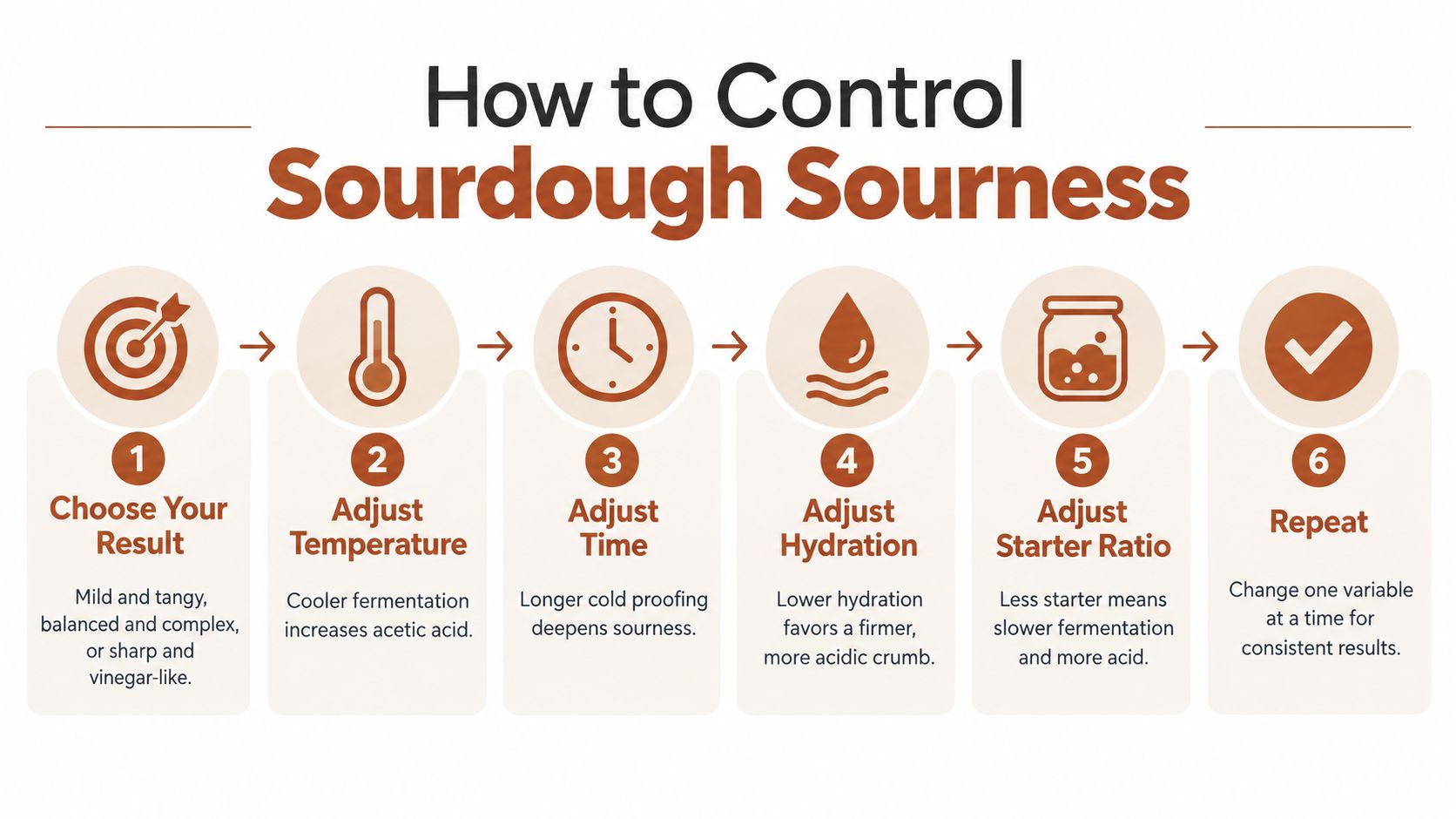
Begin with the least disruptive change
If your loaf is too intense, try shortening an unnecessarily extended fermentation while preserving adequate proofing. A cooler environment can help slow a process that runs ahead of your schedule, but cooling alone doesn't promise milder bread if you then extend fermentation substantially.
If the loaf tastes too mild, cautiously extend the process while leaving the formula unchanged. Don't simultaneously reduce hydration, switch flour, and change starter quantity. You need a result you can interpret.
For a more rounded profile, review whether you're starting with a well-fed culture and allowing the dough to ferment effectively without excessive delay. The starter-feeding ratio guide can help you make the feeding routine more consistent.
Keep the experiment readable
- Hold the formula steady. Use the same flour and hydration while investigating time or temperature.
- Write down the actual change. Record what you did, not just what the recipe instructed.
- Describe the finished flavor. Separate intensity from sharpness and note whether you still enjoy the grain flavor.
- Include dough handling. A flavor improvement isn't useful if the process becomes impractical for you.
Don't interpret the checklist's cooler-temperature, lower-hydration, or lower-starter suggestions as universal laws. Less starter doesn't automatically mean more acid, and wetter dough doesn't automatically mean less sourness. Culture composition remains important.
For a visual companion to the baking process, watch the demonstration below.
The most useful home-baking experiment isn't the most complicated one. It's the one you can repeat, compare, and explain.
Keep a useful stopping point: Stop extending fermentation when the dough can no longer support the bread you want, even if you hoped for more tang.
Examples of Mild and Tangy Sourdough
Consider an everyday loaf intended for sandwiches. You want enough acidity to give it character, but not enough sharpness to dominate the filling. A repeatable starter routine and a fermentation that doesn't drag on unnecessarily make a sensible starting approach.
A longer, cooler loaf represents a different goal. You might enjoy a more developed acidic profile, but you still need to watch how the dough handles rather than treating extra time as automatically beneficial.
Recognizable scenarios and sensible adjustments
These are representative baking situations, not reported case studies or guaranteed outcomes.
| Scenario | Likely Sensory Outcome | Dough-Handling Implication | Sensible Next Adjustment |
|---|---|---|---|
| Well-fed culture with a controlled, shorter process | Gentler everyday tang | Check that proofing is still adequate | Extend cautiously if flavor is too restrained |
| Longer, cooler fermentation | More developed acidity, depending on culture | Handling may change during the extended process | Shorten the extension if flavor becomes intrusive |
| Warm dough left fermenting too long | Potentially excessive acidity | Greater risk of weakened structure | Reduce the delay before shaping or baking |
| Whole-grain culture substituted for a white-flour culture | Different grain and fermentation character | Previous timing may no longer transfer | Re-establish a baseline before further changes |
Flour differences aren't merely cosmetic. Maximum total titratable acidity occurred at 48 hours in a 2024 comparison, with the strongest reported value reaching 27.4 ± 0.0 degrees for 100% einkorn dough fermented at 35°C (einkorn sourdough acidity comparison). That experimental maximum isn't a recommended proofing schedule.
Separate strong flavor from structural failure
A strongly sour loaf isn't automatically structurally damaged. Conversely, a loaf with disappointing oven spring doesn't prove that acidity alone caused the problem.
Excessive fermentation and acidity can involve trade-offs, including weakened dough or reduced oven spring. Research on fermentation temperature, duration, and sourdough acidity reinforces why time and temperature need to be considered together rather than extended indiscriminately.
For the next bake, write a short diagnosis: “pleasant flavor, difficult shaping,” or “good structure, too sharp.” Change the variable most relevant to that diagnosis. This keeps a successful part of the loaf from getting lost while you improve another.
Use DBakerAid for More Consistent Flavor
Repeatability starts with controlling what you can measure. A thermometer, a reliable timer, a temperature-managed proofing space, and a written baking log are all useful options. Precision equipment can reduce environmental variation, but it doesn't remove the need to understand your starter.
The setup below illustrates the role of dedicated bread-making equipment in a home kitchen.
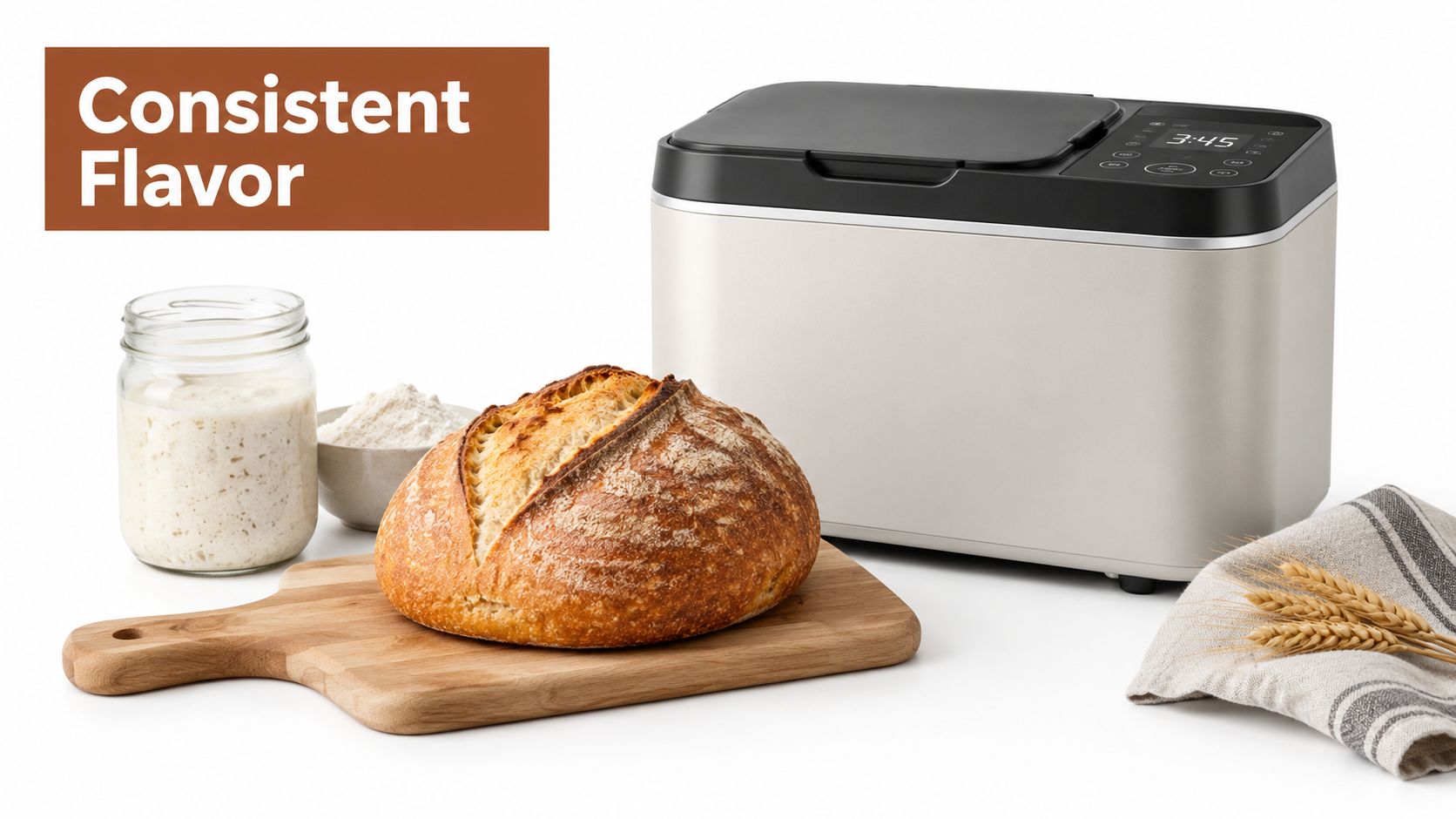
Control the environment without ignoring the culture
A controlled fermentation system helps you repeat a chosen time-and-temperature approach. That makes it easier to investigate another variable, such as a flour change, without also wondering whether a warmer kitchen altered the result.
Commercial yeast fermentation and sourdough fermentation aren't identical processes. A yeast-activation stage shouldn't be treated as a substitute for maintaining a healthy sourdough culture, and a preset shouldn't override clear signs that your dough needs attention.
The same distinction matters when moving into homemade high protein bread. A dedicated protein bread recipe is a separate formulation, not an instruction to add protein powder to your established sourdough and keep every setting unchanged.
A final diagnostic before the next bake
Use this checklist before changing your schedule:
- Desired flavor. Are you correcting excessive sharpness, insufficient tang, or seeking a different character?
- Dough temperature. Did you measure the dough, or assume it matched the room?
- Effective time. What happened throughout fermentation and proofing, including unplanned delays?
- Culture condition. Was the starter prepared consistently, with the same feed flour and readiness?
These questions turn an unpredictable result into a more useful observation. You don't need to chase the lowest pH or the longest proof. You need a process that produces the flavor you prefer while leaving the dough manageable.
For a separate baking project, See the high-protein recipes and follow the dedicated formulation rather than carrying sourdough assumptions into a specialty loaf.
DBakerAid™ offers a precision bread-making system with a Stage 1 yeast fermentation bowl, a Stage 2 dough proofing bowl, a hub controlling temperature and time, and an optional D'Steamer. For sourdough, use controlled conditions alongside your culture observations to refine a repeatable flavor profile. Visit the site to Shop D'BakerAid and explore the system and companion recipe app.