

You pull a dough bowl out of the proofing spot and it looks exactly the same as it did an hour ago. The recipe said it should be rising, your kitchen feels warm enough, and now you're stuck wondering whether the yeast is dead, the flour is the problem, or you just need to wait longer.
That moment is the heart of fermentation science in the bakery. It's not a lab lecture, it's the answer to a very ordinary kitchen question, what's happening inside this dough, and why does it sometimes rise like clockwork while other times it acts stubborn for no clear reason?
Table of Contents
- The Baker's First Question About Fermentation
- What Fermentation Actually Means in a Bakery
- Yeast and LAB and What Each One Makes
- Temperature and Time Windows That Actually Matter
- Ambient Proofing vs Precision Proofing
- How Fermentation Changes Dough Rheology
- Reading the Signs and Fixing Common Fermentation Problems
- Putting Fermentation Science to Work on Your Next Bake
The Baker's First Question About Fermentation
A baker checks a bowl and sees a dough that's barely moved. That's not just an annoyance, it's the moment fermentation becomes practical, because the question isn't “is the recipe right,” it's “what are the microbes doing right now?”
Fermentation in bread is the work of living cells turning flour sugars into the things bakers can see, smell, and taste. Gas inflates the dough, acids shape flavor, and enzyme activity changes how the dough handles under the hands. Once you learn to read those effects, the process stops feeling random.
Yeast and lactic acid bacteria are not interchangeable. Yeast is the main gas engine in most bread doughs, while lactic acid bacteria, especially in sourdough systems, build acid and complexity that change both flavor and dough behavior. They can work together, but they don't do the same job.
That's why two doughs made from similar ingredients can behave so differently. One may rise quickly and smell clean and bready, another may move slowly but develop a sharper aroma and a stronger tang. The difference usually comes down to the microbes, the temperature, and the amount of time you give them.
If you want a simple place to start, think of the next bake as a small experiment. Watch the dough, note the temperature, and treat the rise as a result you can control instead of a miracle you can only hope for. For a basic yeast-focused overview, this primer from D'BakerAid is a useful companion, yeast fermentation process.
What Fermentation Actually Means in a Bakery
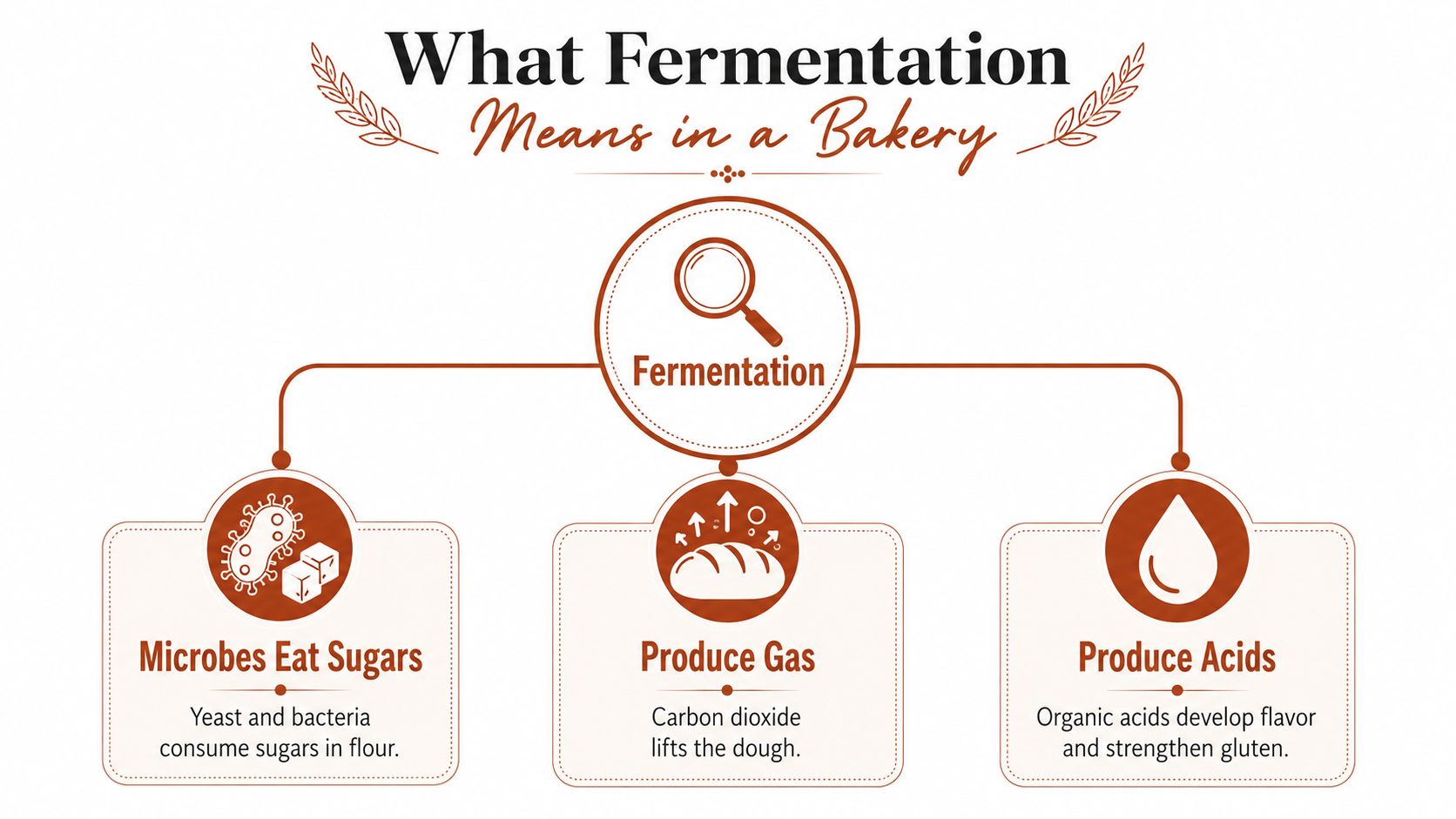
In bakery language, fermentation means microbes are eating sugars and leaving behind useful byproducts. In dough, those byproducts matter because they lift, flavor, and condition the crumb. The key thing is that fermentation isn't one reaction, it's a set of overlapping processes that happen at the same time.
The two microbial teammates bakers meet
Yeast and lactic acid bacteria show up in different ways. Yeast is the faster gas producer, the one most home bakers are thinking about when they talk about “the rise.” Lactic acid bacteria, often shortened to LAB, work more subtly, making acids that bring tang and shift dough structure.
That's a useful kitchen analogy. Yeast is the fast fry cook who keeps the order moving, LAB is the saucier who builds depth and balance. If either one dominates too much, the final loaf changes in a way you can taste and feel.
Some breads rely on spontaneous fermentation, which means wild microbes already present in flour, water, and the kitchen environment. Other breads use starter cultures, like commercial yeast or defined bacterial cultures, to make the process more predictable. Stanford Medicine notes that fermentation can happen with or without oxygen, and that some foods use spontaneous wild communities while others rely on starter cultures to control the process (Stanford Medicine).
Practical rule: if you can't explain which microbes are driving the dough, you're probably leaving the most important part of the bake to chance.
What the baker actually controls
The baker doesn't control every microbe in the bowl. The baker controls temperature, time, hydration, salt, and the microbial source. That's enough to push fermentation toward a lighter, faster loaf or a deeper, more layered one.
A broad definition of fermentation is the anaerobic breakdown of molecules such as glucose, and Britannica describes it as an enzyme-catalyzed, energy-yielding pathway involving anaerobic metabolism (Britannica). In bread, that energy release shows up as gas, aroma, and texture changes you can observe directly.
Yeast and LAB and What Each One Makes
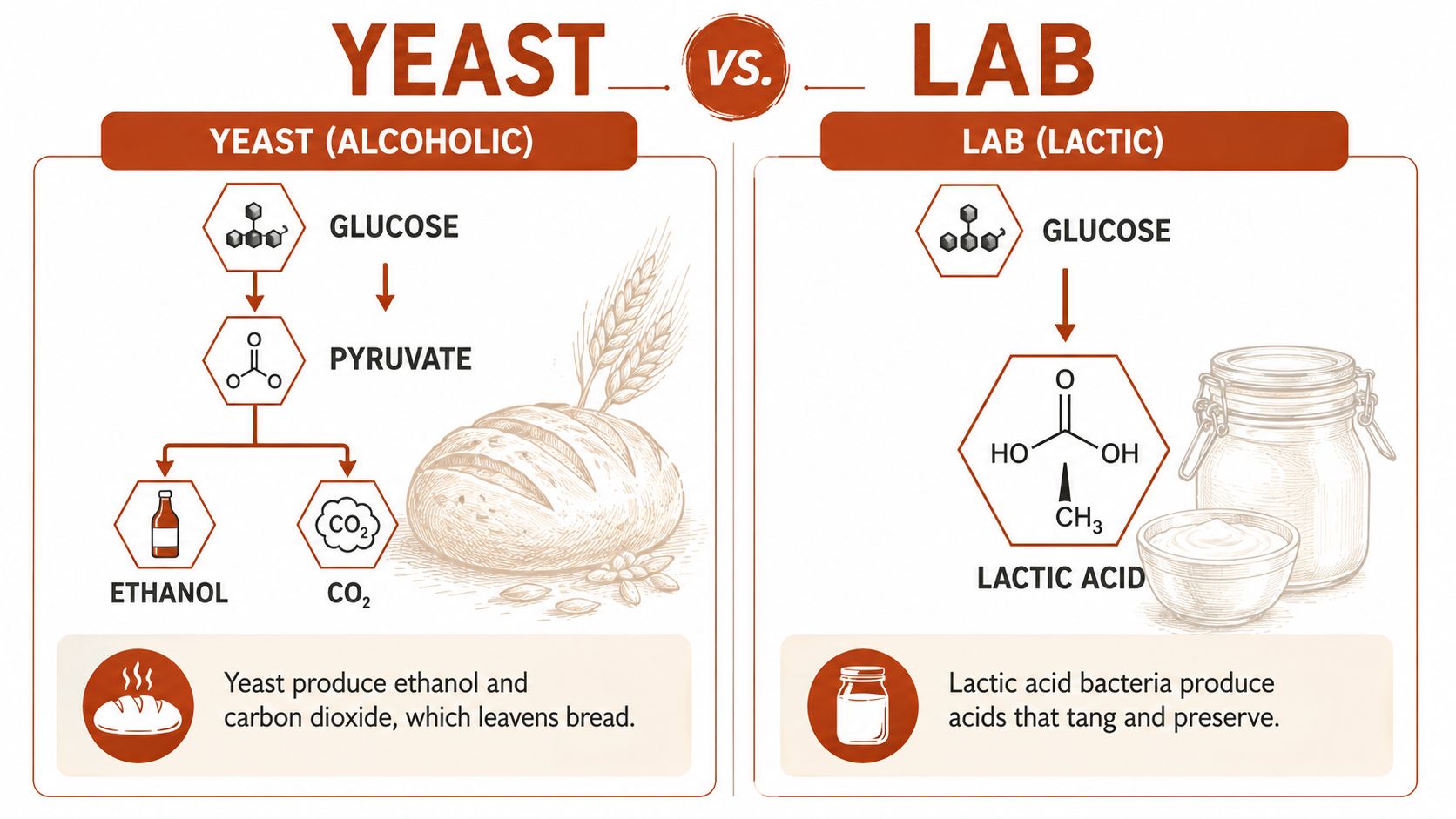
Yeast and LAB travel different metabolic routes, and the baker feels the difference in the finished loaf. Yeast follows the alcoholic fermentation pathway, where sugar is broken down and carbon dioxide is released along with ethanol. That gas is the part that matters most in bread, because it inflates the dough and helps set the crumb.
What yeast contributes
In plain language, yeast eats sugar, passes through pyruvate as an intermediate, and ends up making ethanol and carbon dioxide. The carbon dioxide stays in the dough long enough to expand the gluten network, and the ethanol mostly disappears during baking. The result is a cleaner, breadier aroma and a lighter fermentation profile.
That's why commercial yeast behaves like a monoculture built for speed and lift. It isn't trying to make a complicated flavor map, it's trying to produce gas efficiently and on schedule. For many loaves, that's exactly what you want.
What LAB contributes
Lactic acid bacteria work differently. Their main pathway makes lactic acid, and some strains also produce acetic acid, ethanol, and carbon dioxide. That acid changes the flavor and also changes how the dough feels in your hands.
LAB is why sourdough can taste tangy instead of just bready. It's also why starter-fed dough often feels more complex, because acid development shifts the balance of the dough while yeast keeps the lift going. A sourdough culture is less like a single worker and more like a two-person team that has learned to share the bench.
If the dough smells boozy, it's usually spending too long in yeast-heavy territory. If it smells sharply sour, LAB has pushed the balance the other way.
How the two pathways show up at the bench
Yeast-heavy fermentation gives a milder, cleaner aroma. LAB-heavy fermentation gives tang, sharper flavor, and a more layered finish. Neither is automatically better, the right balance depends on the bread style and the result you want.
That's the trick in fermentation science. Bakers aren't just waiting for dough to rise, they're deciding which pathway gets the upper hand. Earlier scientific milestones, from the proof that yeast is a living organism to the recognition that lactic acid fermentation is driven by living organisms, turned that decision into something measurable rather than mysterious (Rockefeller biochemistry overview).
Temperature and Time Windows That Actually Matter
Fermentation doesn't run at the same speed in every kitchen. Microbes have operating windows, and once you move outside them, enzyme activity and growth rate shift enough to change both rise and flavor. For bakers, the most useful band is the mesophilic range, roughly 25–37°C, because many starter microbes perform best there (Food Fermentation Technology).
Practical fermentation temperature windows
| Stage / Dough Type | Target Temperature | Typical Time | What Changes |
|---|---|---|---|
| Yeasted sandwich dough | About 25–37°C | Depends on flour and yeast level | Faster rise, cleaner flavor |
| Sourdough bulk fermentation | About 25–37°C | Depends on starter strength | More acid development, stronger aroma |
| Fruit and vegetable lactic fermentations | About 25–37°C, pH around 4.0–6.0 | Depends on substrate | LAB growth stays in its comfort zone |
| Solid-state fermentation | 40–70% moisture | Depends on substrate | Enough water for activity, enough structure for porosity |
The moisture piece matters more than most home bakers think. In solid-state systems, too much water reduces porosity and creates anaerobic pockets, while too little water slows microbial activity. In kitchen terms, dry dough feels sluggish and dense, while properly hydrated dough gives the microbes room to work.
Why time and temperature aren't interchangeable
A dough held at a cooler temperature for a longer stretch is not the same dough held warmer for less time. Even if the final volume looks similar, the byproduct balance can be different, which means the flavor and handling can change too. A colder dough often ferments more slowly, while a warmer dough accelerates and can overshoot before you notice it.
That's why home bakers get trapped by the clock. They assume “two hours” means the same thing every day, but the microbes only care about the environment in the bowl. The temperature window is the timer.
For a more detailed discussion of yeast behavior across temperature ranges, this D'BakerAid guide is relevant, yeast fermentation temperature.
Ambient Proofing vs Precision Proofing
Leaving dough on the counter works, until the room temperature changes just enough to change the whole bake. A cool night slows the microbes, a warm afternoon speeds them up, and the baker ends up reacting to the room instead of controlling the dough.
What changes when temperature drifts
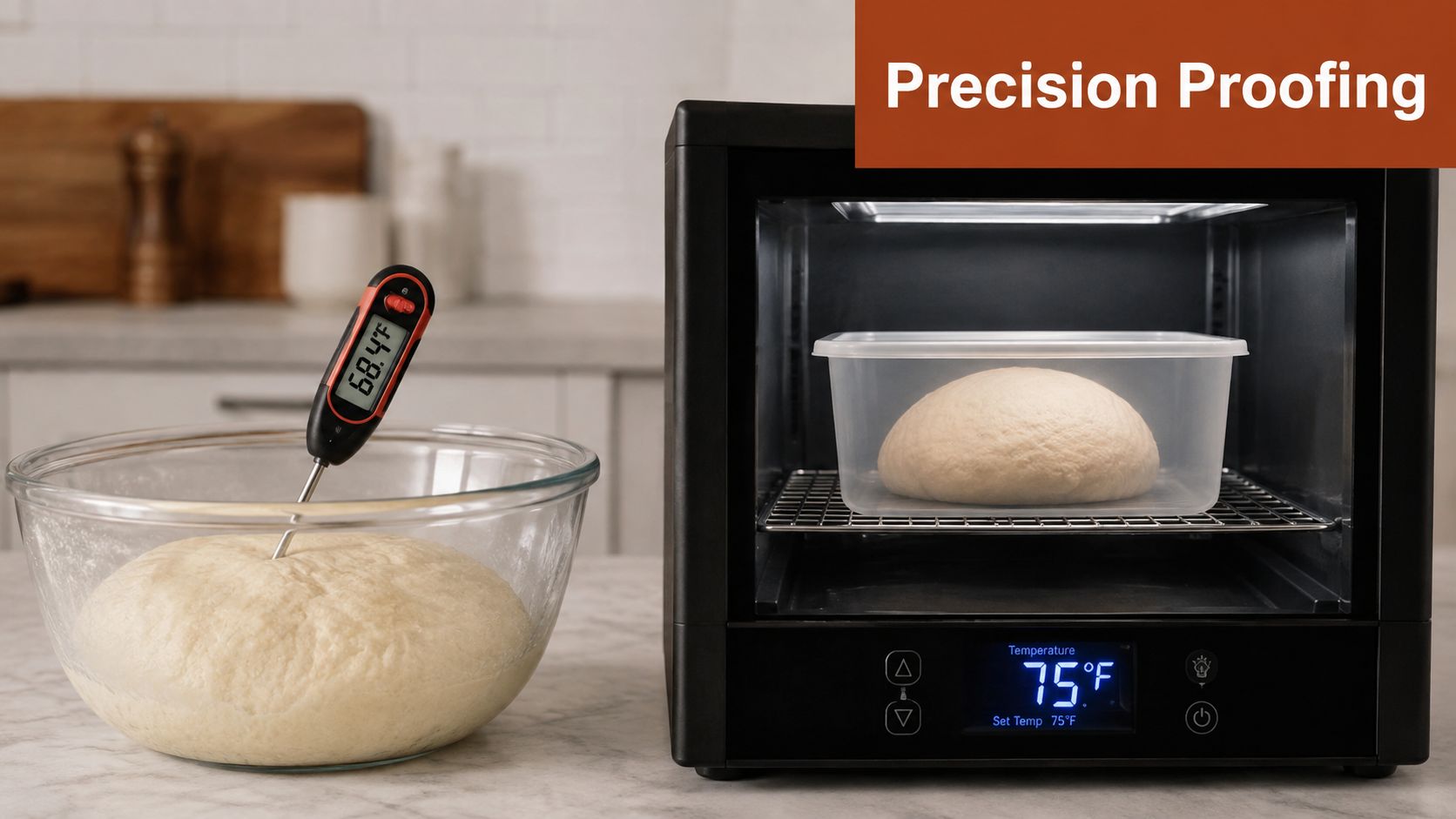
A small swing can matter more than it sounds like. A 3°C drop can lengthen proofing and shift the balance of microbial activity, while a 3°C rise can push dough past peak before you're ready to bake. That's how a loaf goes from nicely domed to over-proofed without much visible warning.
Precision proofing removes that guessing. D'BakerAid's SureDough system holds temperature within ±0.5°C and uses flour-specific proofing programs for different dough styles, including sandwich loaf, pizza, laminated dough, and croissant. The point is not complexity, it's consistency. Once the environment stays fixed, the dough becomes easier to read.
Why humidity matters at bake time
Steam is the other control point bakers often miss. During the first minutes of baking, 82–88% humidity helps the crumb open and keeps the crust thin enough to set properly. D'Steamer is designed to create that humidity inside a standard home oven, so the dough gets the same kind of early-bake support that a professional setup provides.
Practical rule: if proofing is about keeping the dough honest, steam is about letting the oven finish the job without sealing the crust too early.
The old habit versus the controlled one
Ambient proofing depends on luck and memory. Precision proofing depends on a target and a held condition. One method asks the baker to guess whether the room stayed close enough, the other keeps the dough inside a defined window long enough to behave the same way next time.
That's why controlled proofing is so useful for difficult doughs. The more sensitive the formula, the less margin you have for drift. For a machine-based example of this approach, DBakerAid™ keeps the variables tight with its proofing system and companion recipe library, see the high-protein recipes.
How Fermentation Changes Dough Rheology
Dough rheology is just a technical way of saying how dough moves, stretches, and holds shape. Bakers feel it every time they shape a loaf, because fermentation changes whether the dough feels tight, elastic, soft, or slack.
Gas, acid, and the feel under your hands
As yeast makes gas, the gluten network traps those bubbles and the dough becomes more aerated and extensible. As LAB makes acid, the pH drops and gluten tightens slightly, which can make the dough feel more pliable and sometimes a little tacky. Those shifts are normal, and they're part of why a fermented dough behaves better than an unfermented one.
The easiest way to think about it is a balloon inside a sock. The gluten network is the sock, the gas is the balloon, and fermentation is the slow inflation. If the sock is too weak or the balloon overfills, the structure fails.
What under- and over-fermentation look like
Under-fermented dough resists shaping and often bakes into a tight, dense crumb. Over-fermented dough loses strength, gas escapes, and the loaf can collapse or tear when you try to shape it. Neither problem is mysterious once you connect the feel of the dough to the amount of microbial work already done.
A properly fermented dough usually leaves a poke-test indent that springs back slowly over a few seconds. If it snaps back instantly, it needs more time. If the indentation lingers like a puddle, the dough has gone too far.
A loaf that feels alive in your hands usually has enough fermentation to stretch, but not so much that it gives up its structure.
Stretch-and-folds help here because they let the dough develop strength without forcing it. This guide from D'BakerAid is a practical companion if you want to see how handling changes dough behavior, stretch and fold technique.
Reading the Signs and Fixing Common Fermentation Problems
Most fermentation problems look dramatic, but the fix usually starts with one question, what changed in the environment or the timing? A dough that disappoints you once is not a failure, it's a clue.
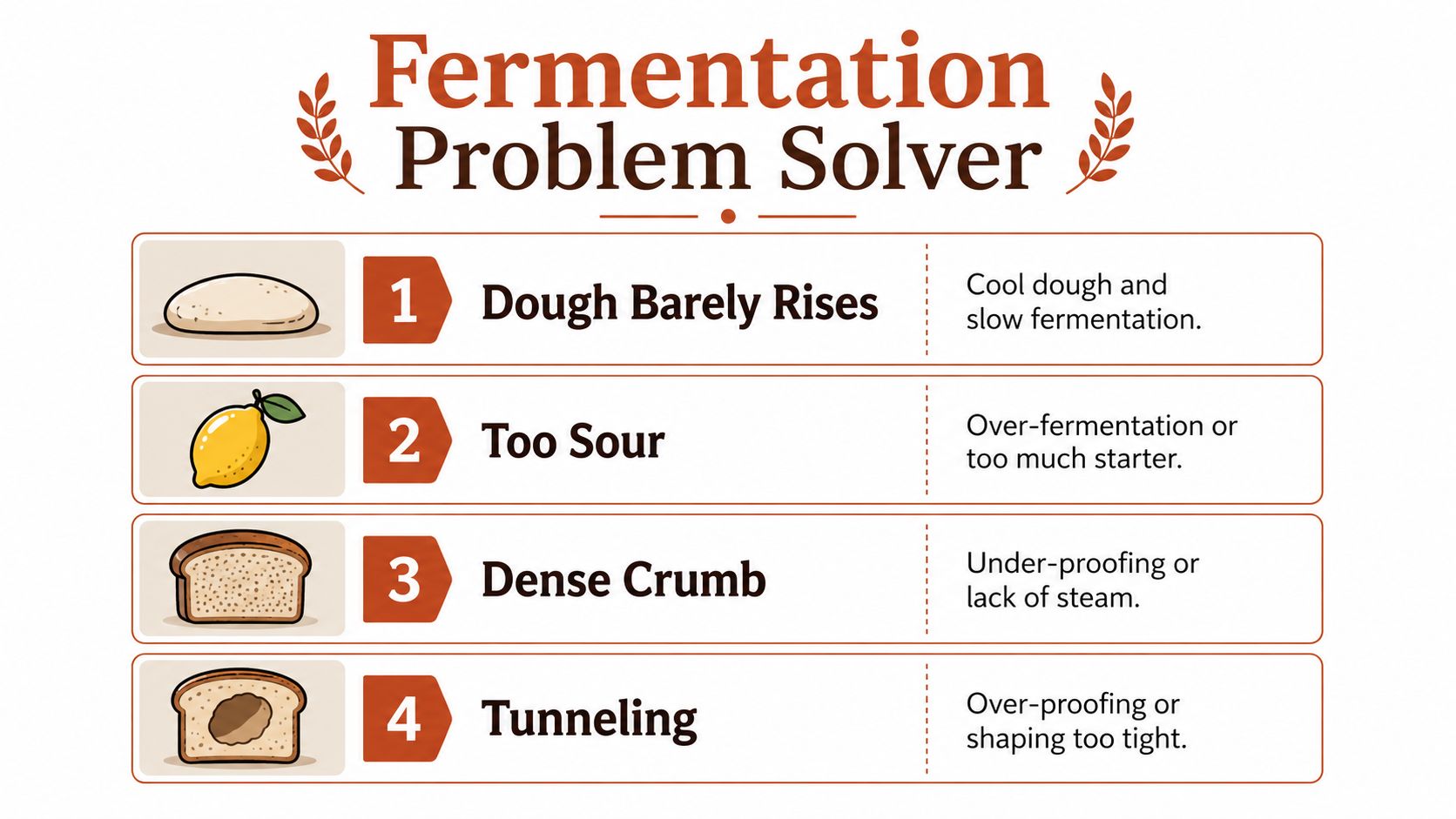
Symptom to cause mapping
- Dough barely rises in two hours: the dough is probably cool, or the yeast is moving slowly. A warmer spot or a longer proof usually helps.
- Too sour: LAB may have taken over, or the dough spent too long fermenting. Shorten the bulk and lower the temperature next time.
- Dense crumb: under-proofing is a common cause, and so is a bake that lacked enough steam early on.
- Tunneling: the dough may have been over-proofed, or shaped too tightly so the gas had nowhere to spread.
The tricky part is that one symptom can come from more than one cause. A weak rise might reflect cool dough, old yeast, low salt, or flour that can't support the structure. A collapsed loaf might be over-proofed, but it can also mean the dough was pushed too far before it had enough strength.
What to measure instead of guessing
A digital dough thermometer gives you the starting point. A time log tells you whether the dough is moving faster or slower than last time. A controlled environment reduces most troubleshooting to small changes instead of full restarts.
If you want a practical way to make those adjustments repeatable, use a method-development mindset. This step-by-step method development guide from Verbex is a useful way to think about testing one change at a time, step-by-step method development guide.
Putting Fermentation Science to Work on Your Next Bake
A good bake doesn't need more mystique, it needs a short list of decisions made in the right order. Measure dough temperature after mixing, set a target fermentation temperature, and give the dough a time window instead of a vague wait.
A simple workflow
Start with the dough temperature, because that's the number that tells you where the microbes are beginning. Then choose your target proofing range and let the dough work there until the window is nearly complete. A poke-test at about 75% of the expected time tells you whether the dough is on track, ahead, or behind.
If the dough is clearly under-proofed, give it more time. If it's soft, slack, and losing shape, bake sooner rather than later. Every earlier idea in this article shows up in that decision, the microbial pathway, the temperature window, the dough feel, and the troubleshooting signs.
Why precision tools matter for repeatability
That's where a controlled system earns its keep. D'BakerAid's 4.7★ rating, app-based recipe library, and controlled fermentation workflow are useful because they let you hold the same conditions while you learn what your flour and starter do. The unit also comes with a 30-day money-back guarantee, which matters if you're testing whether a precision approach fits the way you bake.
A fresh loaf gets easier to repeat when the variables stop drifting around your counter. The next useful steps are the high-protein bread recipes and the math behind cost per gram of protein, because those are the places where fermentation control turns into a real home-baking payoff.
If you want the machine-controlled version of these principles, with temperature held tightly and proofing set by dough type, visit DBakerAid™. It's built for bakers who want repeatable fermentation, clearer dough behavior, and a cleaner path from mixing bowl to finished loaf.