

A 1°C increase can accelerate yeast activity by about 10%, so 25–30°C is a practical sweet spot for yeast dough, while sourdough commonly works within 20–28°C, depending on whether you want more tang or more lift. The important point is that temperature changes more than speed. It can change which microorganisms dominate, how much gas the dough produces, and the flavor, aroma, and crumb of the finished bread.
That makes dough fermentation temperature one of the most useful controls in baking. A warmer dough may rise sooner, but it won't necessarily taste or behave like the same dough fermented more gently. Small changes can steer the biology of fermentation, much like changes in ambient conditions can affect other processes that depend on stability. PureHQ's explanation of temperature swings offers helpful context for why stable conditions matter beyond baking.
Table of Contents
- Why Dough Fermentation Temperature Is Your Most Powerful Lever
- Yeast and Sourdough Temperature Optima Explained
- How Temperature Shifts Sourdough Microbial Balance
- The Gas-Production Link Between Temperature and Volume
- Warm Proofing Versus Cold Proofing Trade-offs
- Precision Fermentation Control for Consistent Results
- Frequently Asked Questions About Fermentation Temperature
Why Dough Fermentation Temperature Is Your Most Powerful Lever
Temperature can redirect fermentation, not merely speed it up. Yeast, lactic-acid bacteria, and other sourdough organisms respond differently to warmth. Changing the dough's temperature changes the conditions in which they compete, cooperate, and shape the final bread.
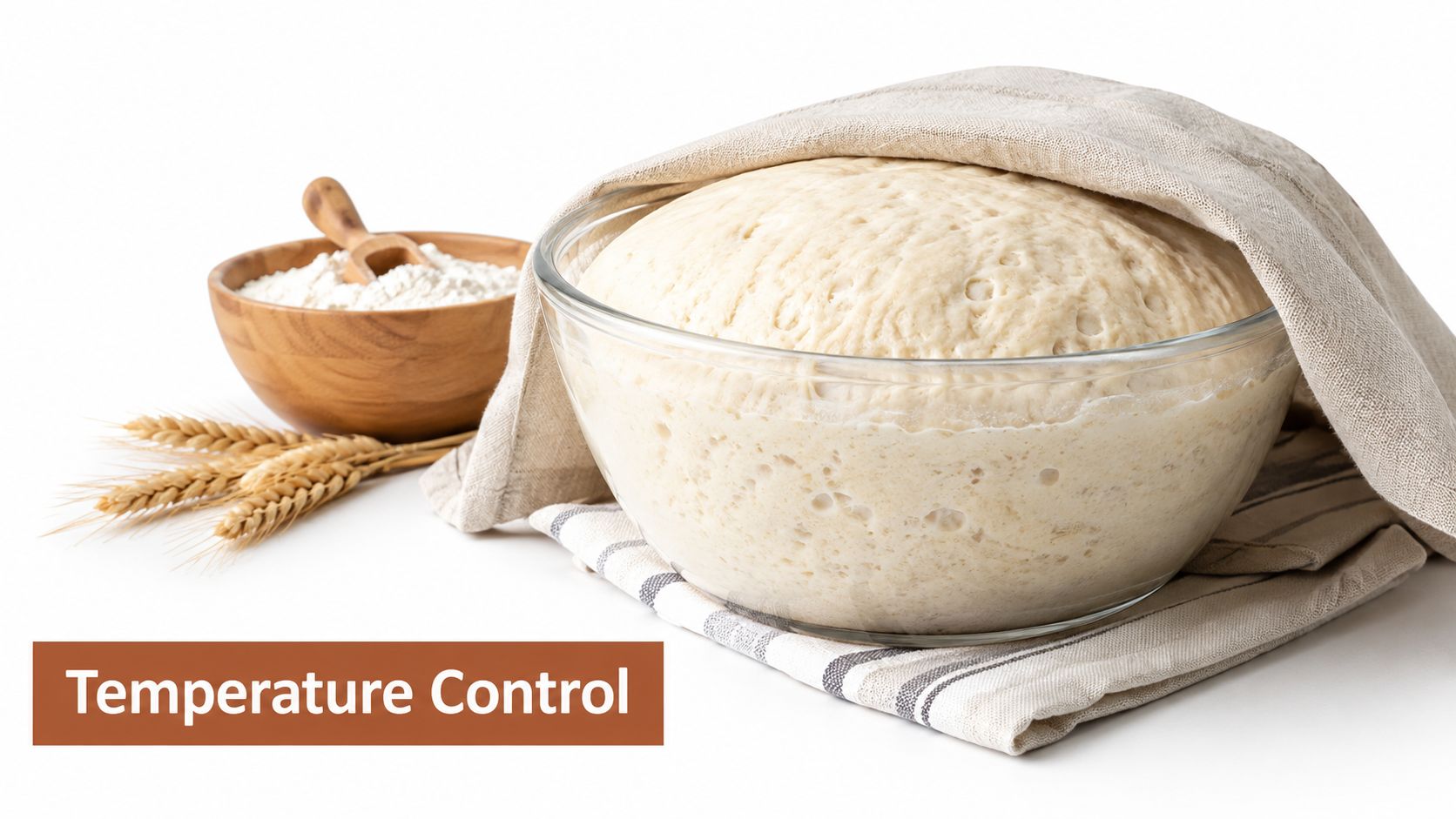
In yeast dough, temperature affects how quickly carbon dioxide forms. The gas expands through the gluten network and provides lift. A baking-industry review reports that a 1°C increase in dough temperature can accelerate yeast activity by about 10% and places the activity optimum at approximately 32–40°C. Commercial bakeries often ferment around 23–30°C, a practical compromise between activity and dough handling (baking-industry review).
The warmest setting is not automatically the best one. If fermentation moves too aggressively, the dough may pass its useful proofing window before shaping or baking. A cooler dough takes longer, yet gives you more scheduling control and can produce a different balance of aroma, acidity, and gas distribution.
Temperature changes the dough's ecosystem
Sourdough reveals the biological side of temperature especially clearly. Different refresh schedules and temperatures can favor different microbial communities, so the same flour and starter may develop a different character under altered conditions. The study discussed below provides a species-level example of that shift.
Yeast supplies much of the carbon dioxide needed for leavening. Lactic-acid bacteria influence acidity, flavor, aroma, and the wider dough ecology, while their activity also affects how the dough feels and ferments. Temperature is therefore a flavor and texture lever, not merely a timer.
Stable conditions make that lever easier to use. PureHQ's take on temperature swings explains why changes in surrounding conditions can affect processes that depend on consistency.
Practical rule: Judge fermentation by both temperature and dough behavior. A target temperature gives you a more reliable starting point than waiting for the dough to “look doubled” as kitchen conditions change.
Yeast and Sourdough Temperature Optima Explained
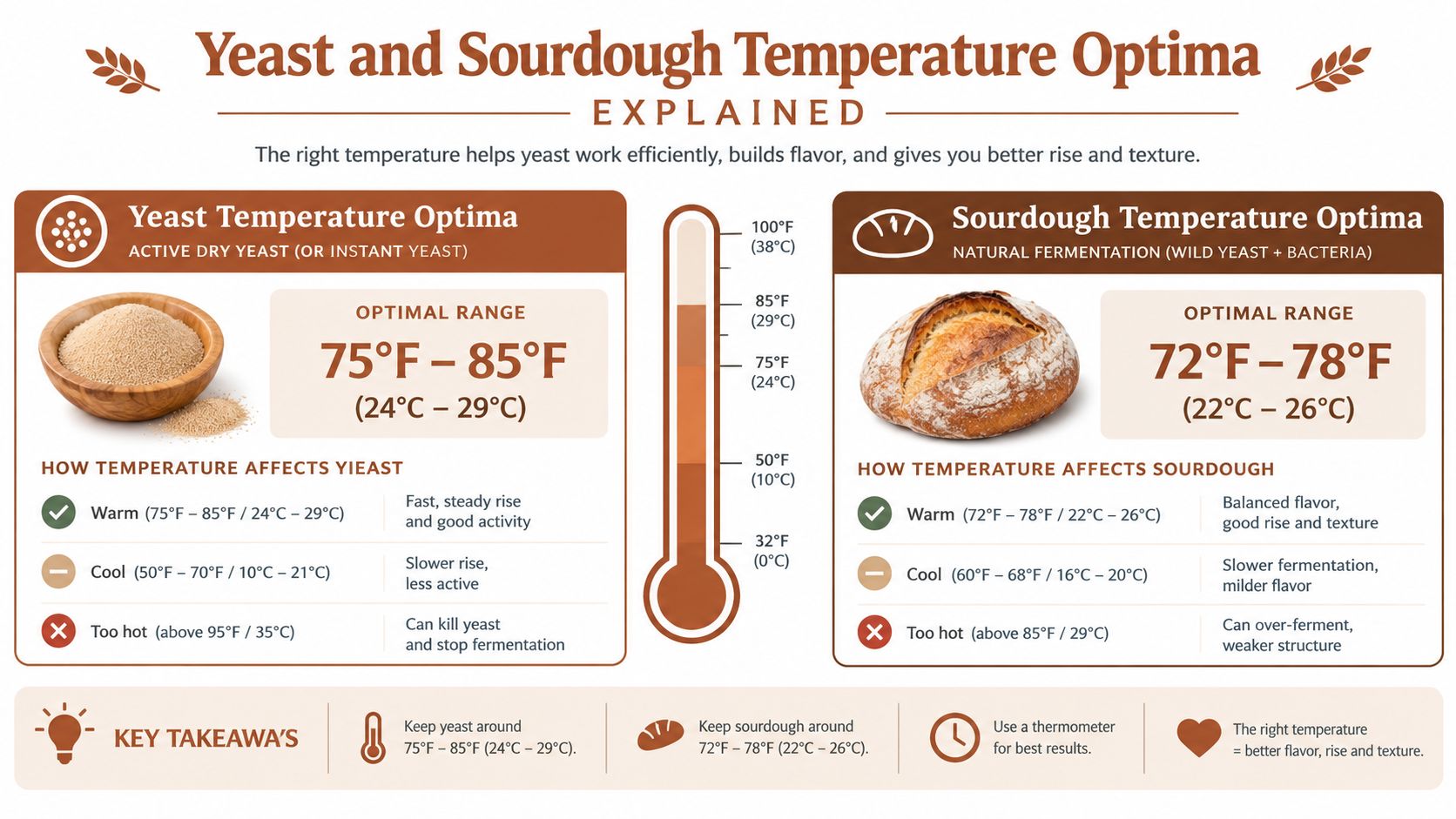
Yeast and sourdough respond to temperature through different biological priorities. Yeast-only dough has one main leavening organism, while sourdough contains yeasts and lactic-acid bacteria whose preferred temperatures do not always match.
Sourdough has competing optima
Sourdough commonly operates within 20–28°C, but its organisms favor different points in that range and beyond. A modeling study measured optimum growth temperatures of approximately 33°C and 32°C for two strains of Lactobacillus sanfranciscensis, while Candida milleri, a sourdough yeast, grew fastest at about 27°C. The research describes 20–28°C as a common operating range and identifies 20–26°C as more favorable to yeast growth than temperatures near 30°C (sourdough temperature modeling study).
Those differences make temperature a flavor control, not merely a speed setting. A cooler dough can give yeast more opportunity to contribute lift and may leave more time for observation. A warmer dough can favor particular lactic-acid bacteria, potentially shifting acidity and aroma as well as fermentation pace.
Use the ranges as practical choices:
- Around 25–27°C: a useful target when you want active yeast growth and good lift.
- Around 20–26°C: a cooler approach that can favor yeast relative to warmer conditions and provide more time.
- Around 30–33°C: a warmer environment that may give certain lactic-acid bacteria a competitive advantage.
These ranges are guides rather than guarantees. Flour type, hydration, starter condition, refresh schedule, and the existing microbial community also shape the result. A warm setting will not automatically create sharp acidity, and a cooler setting will not always produce a mild loaf.
For background on how yeast and bacteria interact, D'BakerAid's fermentation science guide offers a useful explanation. Choose the temperature according to the outcome you want, whether that is volume, a milder profile, greater acidity, or more control over timing.
How Temperature Shifts Sourdough Microbial Balance
Temperature changes which members of a sourdough community gain an advantage. Yeasts and lactic-acid bacteria share the starter, yet they respond differently to heat. Yeasts produce carbon dioxide and fermentation aromas, while bacteria produce acids and other compounds that influence sourness and flavor. Changing the temperature can therefore change both the pace and character of fermentation.
In one peer-reviewed study, wheat sourdough refreshed every 24 hours at 23°C developed a microbiota dominated by Leuconostoc citreum. Under the same refresh schedule, fermentations at 30°C and 37°C became dominated by Lactobacillus fermentum (sourdough microbiota research). The result illustrates microbial selection in action: the dough environment gives some organisms a better chance to multiply than others.
Cooler and warmer choices produce different priorities
A cooler process may give yeast a more favorable competitive position, supporting leavening and a milder flavor profile. The slower pace also gives you more time to observe the dough, adjust your schedule, and stop fermentation at the desired stage.
Warm fermentation can favor lactic-acid bacteria, especially organisms that tolerate higher temperatures. The flavor result still depends on flour, hydration, refresh timing, and the starter's existing community. Warmth may encourage acidity, but it does not guarantee a sharply sour loaf. Temperature works alongside the rest of the recipe.
Refresh timing changes the outcome, too. In the same study, 30°C fermentations refreshed every 48 hours contained a mixture of L. fermentum and Lactobacillus plantarum. Temperature and feeding interval act together, so changing one while holding the other constant can produce a different microbial balance.
Use temperature to select a style
For a lighter, yeast-forward loaf, begin in the cooler or middle part of your chosen sourdough range and monitor rise, aroma, and dough strength. For more pronounced acidity, a warmer setting may shift the community toward lactic-acid bacteria, provided the flour and starter respond well to it.
At 37°C with 24-hour backslopping, yeasts in the study became almost completely absent, while lactic-acid bacteria remained prominent. This extreme example shows why higher heat is not automatically better. A temperature that supports bacterial activity can also reduce the yeast population responsible for much of the dough's leavening.
Temperature is a steering wheel. Turn it gradually, then evaluate rise, aroma, acidity, and crumb together.
The Gas-Production Link Between Temperature and Volume
Temperature can change a loaf's final volume even when the flour, water, and yeast remain identical. It acts like a timing control for the biology of fermentation, determining how quickly yeast produces carbon dioxide and how long the dough has to capture it.
Rheofermentometer testing on 315 g hydrated wheat dough portions over three hours found that gas development was governed mainly by temperature, while dough consistency had a stronger effect on dough-development behavior (instrument-based wheat dough study). The result matters at the bench: a warmer dough can reach a target volume sooner, while a cooler dough may need more time to produce comparable gas.
Why identical recipes can rise differently
Yeast releases carbon dioxide as it metabolizes available sugars. Gluten stretches around that gas, forming pockets that expand the dough. Temperature therefore affects both gas production and the moment when the dough has enough strength to retain it.
For example, if the same dough reaches its intended rise in about three hours at 28°C, it may need longer at 24°C. The exact timing depends on the flour, yeast, hydration, and dough condition, so use the comparison as a practical example rather than a fixed rule.
Temperature also changes what happens after the dough rises. If fermentation runs too slowly, the dough may still be underdeveloped when shaping begins. If it runs quickly, the dough can pass its strongest point before baking, leaving less structure for oven expansion.
Read volume as a temperature result
A dough that has barely risen is not automatically short on yeast. Its actual temperature may be lower than the recipe assumes. Rapid expansion does not automatically indicate stronger fermentation either. A warmer environment may be accelerating gas production.
Measure dough temperature alongside rise and proofing time. This creates a clearer diagnosis: you can separate a temperature issue from problems involving mixing, flour, yeast activity, or shaping. Record those observations across batches, then adjust temperature or fermentation time rather than changing the whole formula at once.
Warm Proofing Versus Cold Proofing Trade-offs
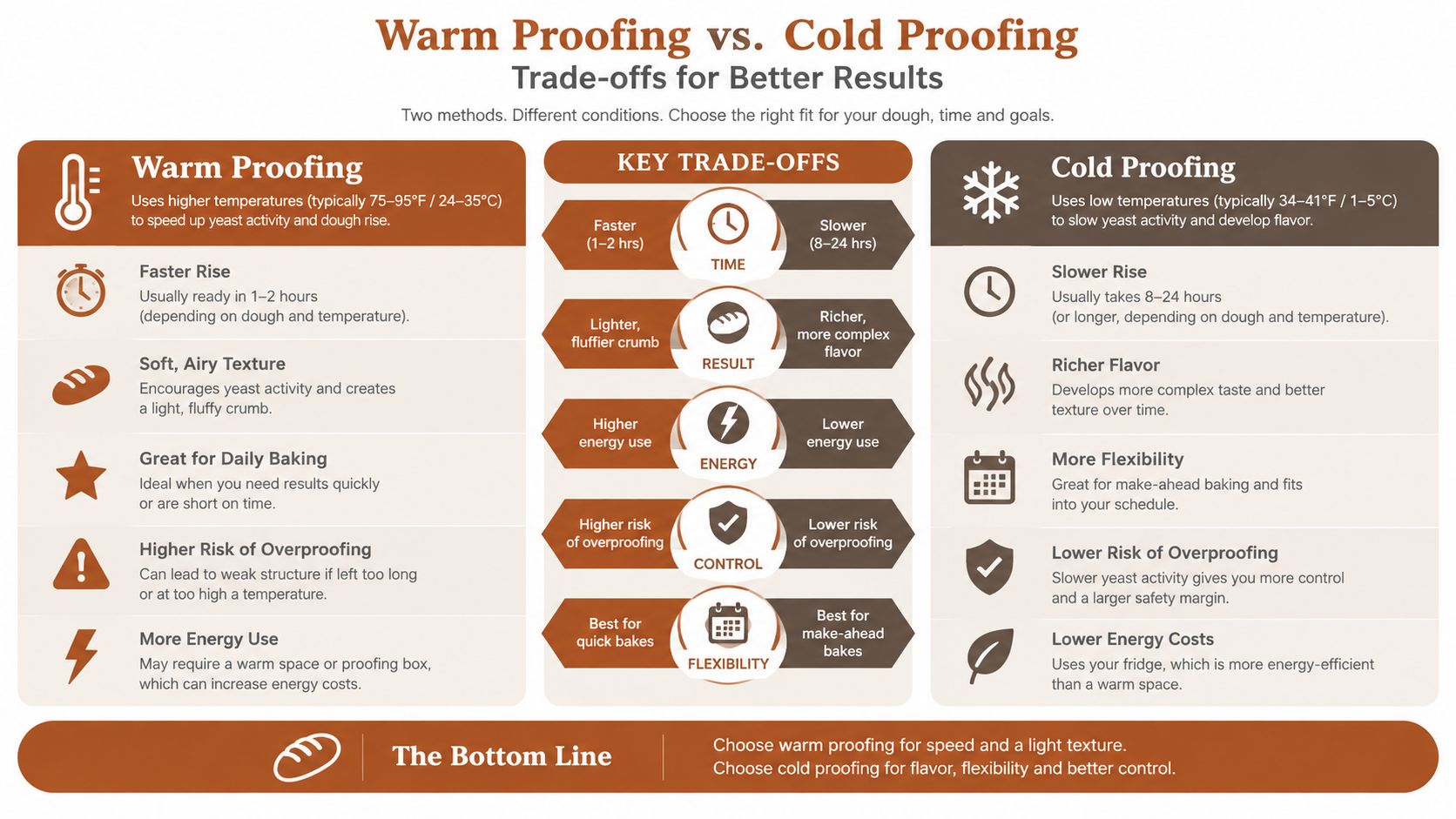
Warm and cool fermentation solve different problems. Warm proofing prioritizes speed and active gas production. Cold fermentation prioritizes schedule flexibility and slower development, but it requires patience and different expectations.
One bread study compared wheat dough held at 15°C for 12 hours with a control fermented at 30°C for 2 hours. That contrast shows how dramatically a cooler process can extend the schedule. A separate review reports acceptable bread-development temperatures around 27–35°C, with many yeasts showing stronger growth at 35°C than at 25°C (low-temperature fermentation study).
What warm fermentation gives you
A warmer dough generally reaches its fermentation milestones sooner. That suits same-day baking, but it leaves less room for delays. If the dough is ready while you're answering messages, preparing dinner, or waiting for the oven, it can continue moving beyond the point you intended.
Warm fermentation can also produce a more direct flavor profile because the process is compressed. That isn't a defect. It's a useful choice for sandwich bread, quick schedules, and bakers who prefer a clean, mild result.
What cooler fermentation changes
At 15°C, the cited study reported slower microbial activity, more even gas distribution, and a more uniform crumb. Another comparison found that a schedule using 1 hour at 23°C followed by 24 hours at 6°C improved sensory perception in sourdough bread, although yeast-dough reducing sugars declined (long and cool fermentation research).
Cool fermentation can therefore improve flavor perception and gas distribution, but it isn't a direct substitute for warm proofing. The dough may need more time to become ready, and the final loaf may prioritize uniformity and flavor over maximum speed or volume.
Schedule rule: If you lower the temperature, change your time expectation before changing every other ingredient. Temperature and time are linked controls.
Cold fermentation is especially useful when you need to mix dough ahead of a workday or delay baking until a convenient time. D'BakerAid's guide to cold fermentation explores that scheduling approach in more detail.
For a visual comparison of the two methods, watch the following demonstration:
Precision Fermentation Control for Consistent Results
Room temperature is a moving target. Sunlight, heating, airflow, the temperature of the flour, and the temperature of the mixing water can all change the dough's starting point. If you judge every batch by the room alone, the same recipe may rise on different schedules.
A more reliable process begins with the dough itself. Measure or estimate its temperature after mixing, select a target appropriate to the fermentation type, and adjust time around that target rather than treating time as fixed.
A practical control routine
- Choose the biological target. Use a moderate range for yeast dough when you want dependable lift. For sourdough, choose a cooler or warmer point according to the balance of yeast activity, acidity, and schedule you want.
- Stabilize the environment. Keep the bowl away from drafts and direct heat. Cover the dough so its surface doesn't dry while fermentation proceeds.
- Observe more than volume. Look at expansion, elasticity, aroma, and the way the dough responds to handling. A rise target without temperature context can mislead you.
- Record the outcome. Note the dough temperature, fermentation duration, and final crumb. That record turns a frustrating bake into useful process data.
Temperature control doesn't eliminate the need to understand dough. It removes one major source of variation, so your observations become easier to interpret.
For bakers who want an appliance-based approach, the D'BakerAid SureDough system controls temperature and time across a yeast fermentation bowl and a dough proofing bowl, with programs designed around different dough types. D'BakerAid's fermentation temperature control kit explains how this kind of setup can replace fluctuating room conditions with a repeatable process.
Frequently Asked Questions About Fermentation Temperature
Why does sourdough taste sharper at some temperatures?
If sourdough tastes sharper than expected, lower your fermentation target by 3–5°C and keep hydration, flour, feeding schedule, and fermentation length consistent. This gives you a cleaner comparison. Temperature changes which organisms contribute more activity, so it can alter flavor as well as speed. A cooler target may produce a milder result, though the final taste still depends on the whole process.
What should I do if a short warm fermentation rises too quickly?
Move the dough somewhere cooler and begin checking it sooner. Judge readiness by aeration, elasticity, aroma, and handling response rather than waiting for a fixed rise. For the next batch, lower the target or shorten the fermentation window.
How can I warm dough safely in winter?
Place the covered bowl in a draft-free room or switched-off oven with the light off. Avoid direct heat, which can warm the surface unevenly.
Does refrigeration stop fermentation?
No. Cold slows fermentation rather than stopping it completely. Allow extra time after chilling if the dough still feels dense.
D'BakerAid™ offers controlled fermentation and proofing through its temperature-and-time system. Visit DBakerAid™ to explore it.