

"Just ferment it longer" is the advice most bakers get when a loaf tastes mild. It's not wrong, but it's incomplete, and following it blindly is how you end up with a slack, harsh loaf that still doesn't taste the way you wanted. Learning how to make sourdough taste more sour starts with a different question. Do you want more total acid, or do you want a sharper kind of acid?
Those aren't the same goal. A long ferment can raise acidity while producing mostly smooth, rounded flavor. A cooler, stiffer preferment can taste sharper without pushing your dough to the edge of collapse. Once you separate acid amount from acid type, you can choose one lever, test it, and know why the flavor changed.
Table of Contents
- Six Levers That Make Sourdough More Sour
- Choosing Between Lactic and Acetic Sourness
- Reading pH and Acidity Without Overshooting
- Temperature and Timing Settings That Shift the Flavor
- How to Build a Long, Cool Levain for Sharper Flavor
- Confirm Your Sourness Plan Before the Next Bake
Six Levers That Make Sourdough More Sour
Start with the answer, then work through the reasoning. These six levers are ordered from the setting that most directly targets sharpness to the gentlest change you can make.
| Lever | Setting that adds sourness | Why it works | Trade-off |
|---|---|---|---|
| Cool, long levain | 22–25°C for 12–18 hours | Favors acetic acid and a sharper tang | Overextended cool stage weakens gluten |
| Overnight fermentation | About 30°C for 14–17 hours | Adds organic-acid output over one night | Very low pH slows microbial activity |
| Refresh interval | 48 hours at 30°C instead of 24 | Shifts the culture toward Lactobacillus fermentum and L. plantarum | Starter needs more planning |
| Starter maturity | Refresh until vigorous and rising predictably | Gives lactic acid bacteria more activity per gram of dough | A young starter stays mild |
| Levain hydration | Stiff, lower-hydration levain | Keeps the cool-stage levain concentrated, as in the cool preferment workflow | Stiffer levain is harder to mix |
| Flour type | Higher share of whole-grain or rye flour | More fermentable material for lactic acid bacteria | Denser crumb and heavier loaf |
Every row changes the same underlying process from a different side. You're either giving lactic acid bacteria more time, changing the temperature they work at, feeding them different material, or starting with a more active culture. That's why stacking all six at once rarely helps. You won't know which change did the work, and you'll hit the trade-offs faster than you gain flavor.
Choosing Your First Lever
Use the loaf in front of you as the diagnostic. If your bread rises well but tastes mild, extend the fermentation or try the cool levain. If your starter is sluggish and unpredictable, fix maturity first, because a weak culture can't produce much acid no matter how long you wait. If the bread already tastes harsh or thin, shorten the cool stage rather than adding time.
The flour row deserves a note. It has no quantified effect in the research behind these settings, so treat it as a small-step experiment. Raise the whole-grain or rye share a little, bake once, and log the result. All of these numbers are starting points drawn from fermentation research, not universal rules for your kitchen, flour, and culture.
Choosing Between Lactic and Acetic Sourness
Two acids do most of the work in sourdough, and they don't taste alike. Lactic acid gives a smoother, yogurt-like tang. Acetic acid gives a sharp, vinegar-like note that reads as more aggressive even at modest amounts. If you've ever wondered why sourdough bread is sour in one bakery and gentle in another, this balance is a large part of the answer.
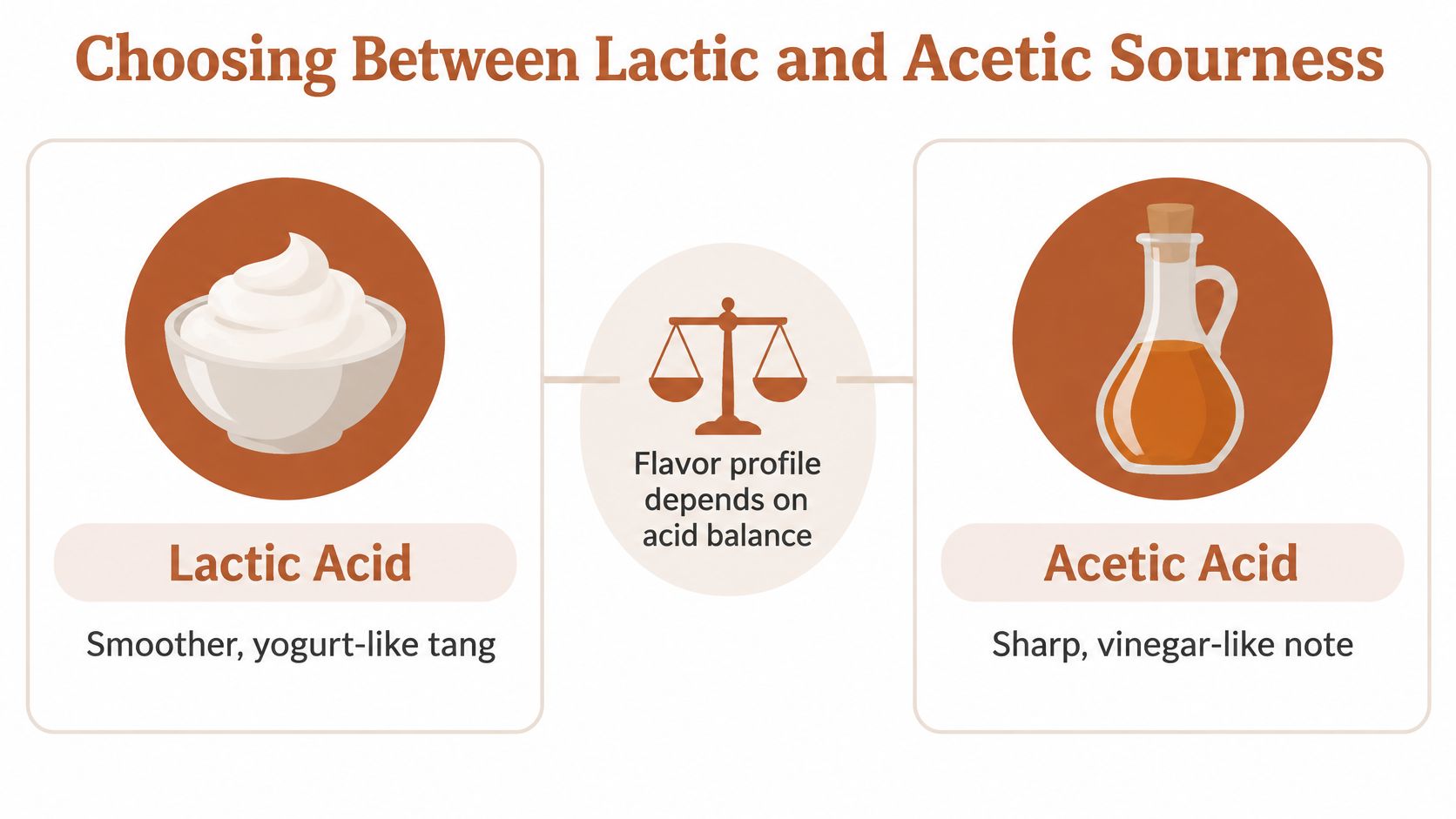
A technical review ties good sourdough flavor to a lactic-to-acetic ratio of approximately 3:1 to 4:1, which tells you something useful. A sharper loaf usually needs a larger acetic share, not more total acid. Push total acid while keeping the ratio lactic-heavy and you get a rounder, fuller tang, not a sharper one.
The sensory difference is stark. A 2024 review in PMC on sourdough flavor compounds describes acetic acid as sour, pungent, and sharp-vinegar, while lactic acid has a milder, less unpleasant odor, and it lists acetic-acid odor concentrations at up to 3.2 ppm compared with 0.00–0.03 ppm for lactic acid. Your nose notices acetic acid far more readily, which is why a small shift in its share changes perceived sourness so much.
Sharpness depends on acid type as well as acid amount. More fermentation doesn't automatically mean sharper bread.
That explains a common frustration. You extend fermentation, the dough clearly acidifies, yet the baked loaf tastes only a bit more tangy and maybe a little flatter. The extra time likely produced mostly lactic acid. The temperature, hydration, and culture choices are what tilt production toward acetic acid.
A Simple Taste Test You Can Run
Split one starter into two loaves on the same day. Ferment one cooler and longer, the other warmer and shorter, keeping flour, salt, and shaping identical. Bake both, cool both fully, then taste side by side and note aroma first, then the first bite, then the finish. You'll learn more about your own culture from that one comparison than from any generic timing chart.
Reading pH and Acidity Without Overshooting
A dough can taste only mildly tangy at a low pH, or sharply sour at a higher one. The reading and the flavor are answering different questions.
pH is a snapshot of hydrogen-ion concentration, the strength of the acid environment at that moment. Total titratable acidity, or TTA, adds up how much acid is present, which tracks sensory impact more closely. Two doughs can share a pH and still taste different, because one may hold mostly mild lactic acid while the other holds a larger share of sharp acetic acid. pH confirms that fermentation is moving. It does not name which acid you made.
A 2024 study covered in a PMC review of sourdough acidity found samples reaching pH values near 3.9 where lactic acid was predominant and acetic acid was present only in traces in most samples, while total titratable acidity varied substantially among starter combinations. Neither number alone captures aroma compounds, or how acidity interacts with salt, flour, and texture in the finished bread.
| Marker | Reference value from research | What it tells you |
|---|---|---|
| pH after 24 hours in one experimental study | Final pH 3.73–3.85 across tested strains | Strong acidification is reached within a day |
| Titratable acidity (TTA) in one study | 14.10–17.00 mL of 0.1 N NaOH per 10 g dough | Total acid reserve, closer to perceived sourness than pH |
| Operating pH range in a bread-production review | About 3.7–4.0 | Useful window. Lower values may inhibit lactic acid bacteria, higher values can over-break starch |
| Levain maturity benchmark | pH about 3.8–4.3 | Operational target that shifts with flour and culture |
Those figures for final pH and TTA come from an experimental study in the Anais da Academia Brasileira de Ciências, where nearly all tested strains lowered sourdough below pH 4.0 after 24 hours. Use them as reference points, not targets to beat. A meter only helps if the reading is trustworthy, and using a digital pH meter for kombucha spells out the calibration habit that keeps a sample reading honest. For dough, stay with the pH and TTA ranges above.
What Overshooting Actually Costs You
Push acidity too far and two things work against you. Very low pH slows the microbes making the acid, so extra time buys less sourness than you expect. Acidification can also activate wheat enzymes that break down arabinoxylans. When that fiber breakdown goes too far, volume and crumb strength suffer.
Record four things together: rise, aroma, dough strength, and finished taste. Treat pH as a process signal that checks those observations, the way a thermometer checks an oven without telling you whether the crust tastes right. The sharper loaf is the one that tastes right and still rises well.
Temperature and Timing Settings That Shift the Flavor
Warmer fermentation can acidify dough faster, while cooler fermentation may build more acidity over a longer period. The useful setting depends on the flavor you want and the time you have.
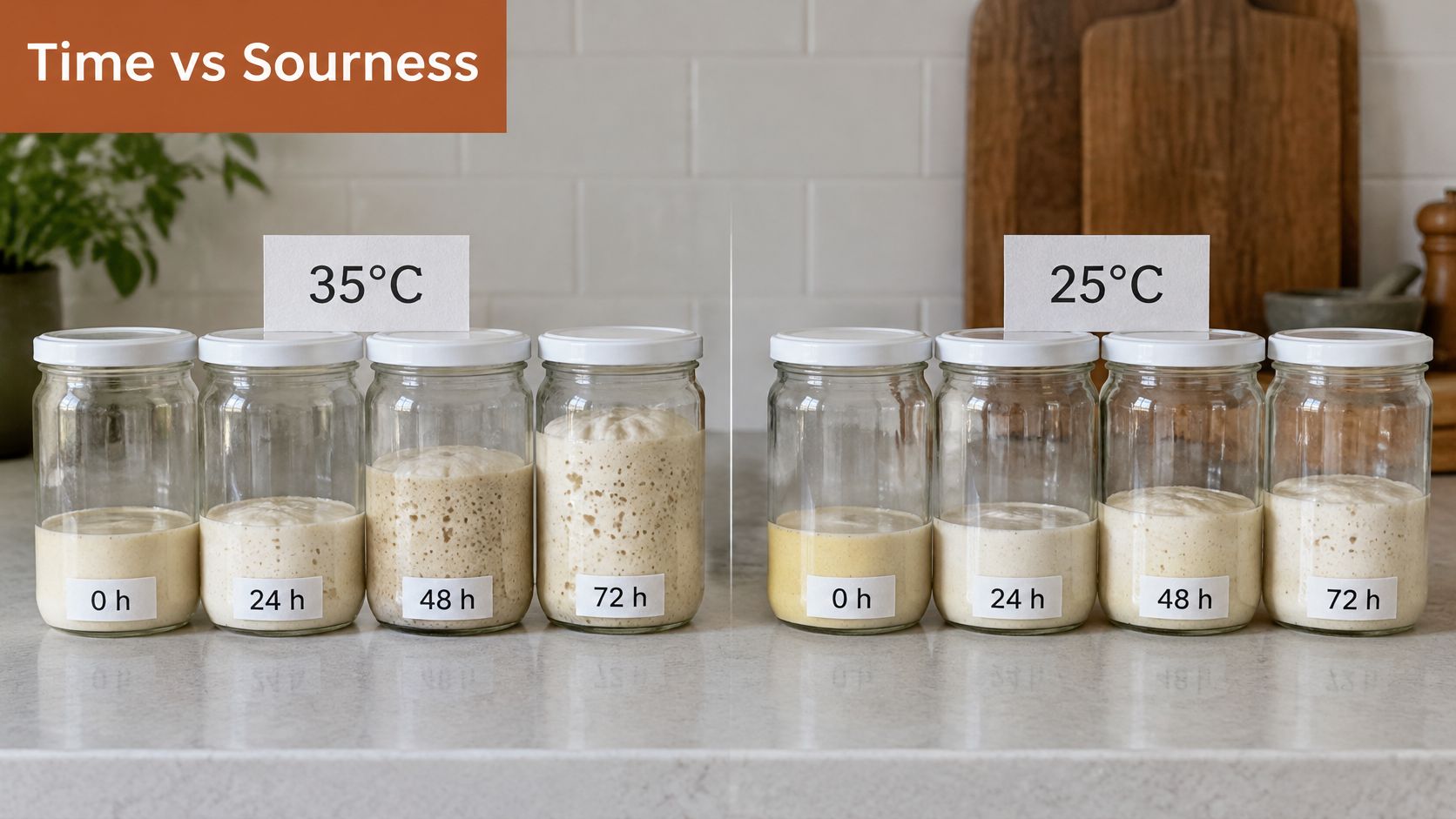
In a controlled comparison reported in the Czech Journal of Food Sciences, dough at 35°C reached its optimum pH after about 9 hours, compared with about 11 hours at 25°C. After 72 hours, however, the dough held at 25°C had slightly lower pH and higher acidity. Temperature shifts the pace; time changes how far the process goes. For a clear explanation of how fermentation temperature and timing interact, consider both rather than treating either as a fixed recipe rule.
Temperature can also favor different microorganisms. Researchers in Applied and Environmental Microbiology found that daily refreshments at 23°C were dominated by Leuconostoc citreum. At 30°C and 37°C, the dominant organism was Lactobacillus fermentum. With refreshments every 48 hours at 30°C, both L. fermentum and L. plantarum were present. Since different organisms contribute different acid balances, refresh timing can influence the character of the sourness, not just its intensity.
| Setup | Temperature | Time or interval | Documented result |
|---|---|---|---|
| Daily refresh, cool | 23°C | Every 24 hours | Dominated by Leuconostoc citreum, milder profile |
| Daily refresh, warm | 30°C | Every 24 hours | Dominated by Lactobacillus fermentum |
| Daily refresh, very warm | 37°C | Every 24 hours | Dominated by Lactobacillus fermentum |
| Extended refresh | 30°C | Every 48 hours | Lactobacillus fermentum with Lactobacillus plantarum |
| Side-by-side comparison | 25°C | 72 hours | Optimum pH after about 11 hours; slightly lower pH and higher acidity at 72 hours |
| Side-by-side comparison | 35°C | 72 hours | Optimum pH after about 9 hours; faster early acidification |
| Strain-specific high acetic acid | 34.1°C | 20 hours | Reported high acetic-acid formation |
| Strain-specific high acetic acid | 32°C | 30 hours | Reported high acetic-acid formation |
| Strain-specific high acetic acid | 27°C | 20 hours | Reported high acetic-acid formation |
Optimization work summarized in Acta Scientiarum Technology reported high acetic-acid formation for particular strains at 34.1°C for 20 hours, 32°C for 30 hours, and 27°C for 20 hours. These are strain-specific results, not universal settings for a home starter. Use them to understand how temperature and time can shift acid production, then judge your own dough by its aroma, rise, and flavor.
The video below demonstrates how to read dough cues during a long ferment alongside a probe thermometer.
Practical rule: Choose warmth when you need a faster ferment and a cooler, longer schedule when you want to explore deeper flavor. Record the dough's actual temperature so you can connect the result to the conditions that produced it.
How to Build a Long, Cool Levain for Sharper Flavor
This is the strongest lever from the table, turned into a workflow. If you're unsure what a levain is, it's a preferment built from your starter for one specific bake, which lets you tune its hydration and temperature without changing how you maintain your main culture.
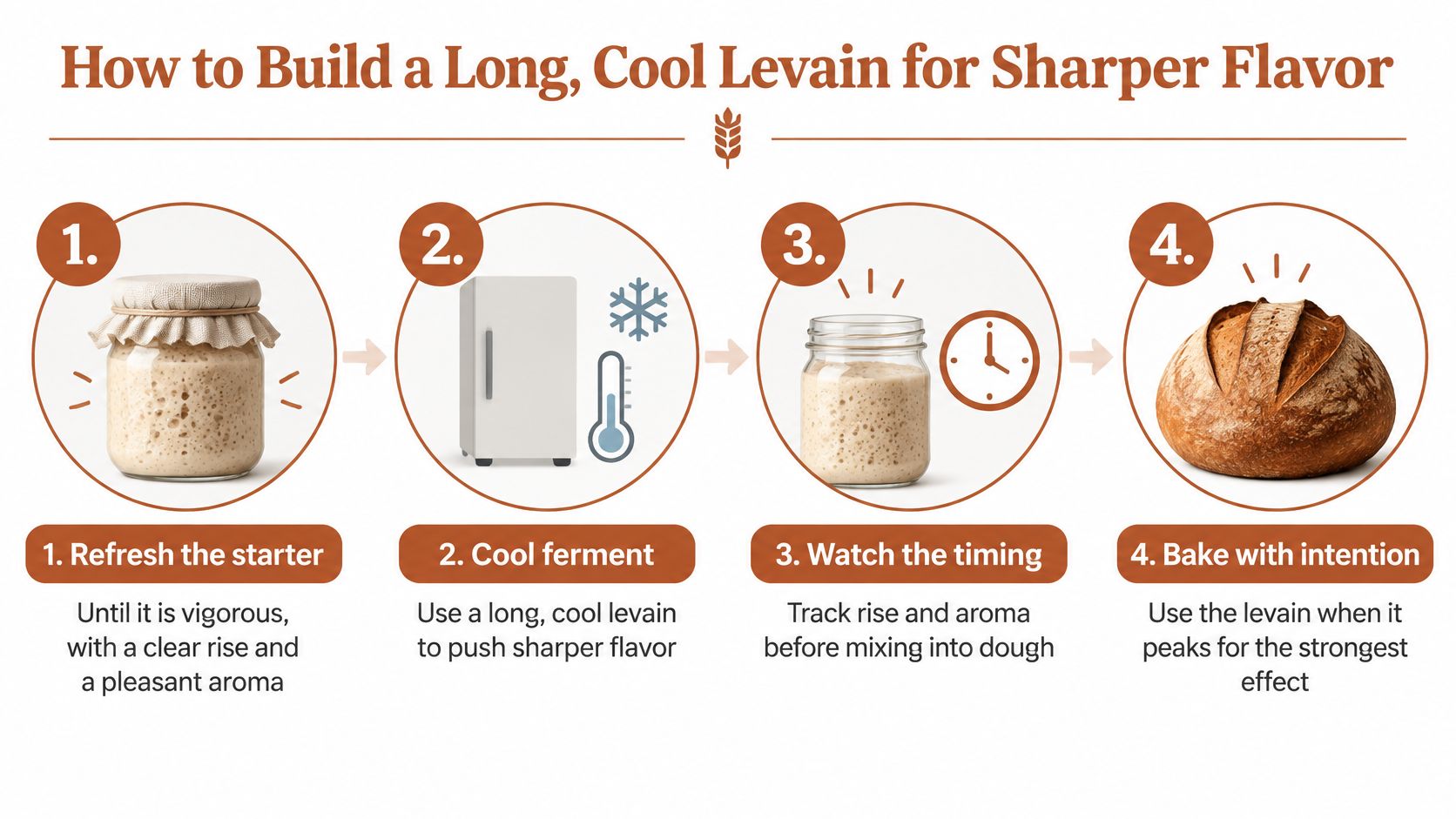
A review in PMC on sourdough fermentation parameters reports fermentation temperatures commonly spanning 22–40°C, with 30°C the most frequent value, and finished sourdough pH values centered near 4.1, commonly ranging from 3.4 to 4.9. The cool levain sits deliberately at the low end of that temperature span, because the lower-temperature, extended schedule generally shifts flavor toward acetic acid, while warmer fermentation tends to favor lactic acid.
The Five Steps
- Refresh the starter until it's vigorous. You want a clear, predictable rise and a pleasant, fresh aroma. A sluggish culture stalls in the cool stage and produces little acid, so this step isn't optional prep, it's the foundation.
- Mix a stiff levain at lower hydration. A stiffer mix keeps the culture concentrated through the long ferment. It'll feel firmer and take a bit more effort to combine than a liquid levain, and that's expected.
- Ferment at about 22–25°C for 12–18 hours. Let it expand and turn aromatic, but use it before it collapses. Time is a guide here, not the decision-maker.
- Mix the final dough and shape the loaf. Work the levain in evenly, build your usual dough strength, and shape with normal tension. Don't compensate for the long ferment by overworking the dough.
- Retard the shaped loaf overnight in the refrigerator. The cold rest holds the loaf while flavor continues to develop slowly, and it makes bake timing far easier the next day.
Reading the Peak
Judge maturity by volume and aroma first, then check against the pH benchmark of about 3.8–4.3 if you have a meter. A healthy peak looks domed, with bubbles across the surface, and it smells fresh and tangy rather than harsh or solvent-like. Flour and culture shift the exact reading, so a levain that looks and smells right beats one that merely hits a number.
The main slip is overextending this stage. Excessive acidification weakens gluten, reduces dough tolerance, and can create rancid or harsh notes, since low temperatures may also promote undesirable butanoic-acid aromas. If your levain smells sharp in an unpleasant way or the surface has fallen, you've gone past the useful window. Note the time, because that observation becomes your adjustment for the next bake.
Confirm Your Sourness Plan Before the Next Bake
Sourness you can repeat comes from a short checklist, not from memory. Run through it before you mix anything, while changing course is still free.
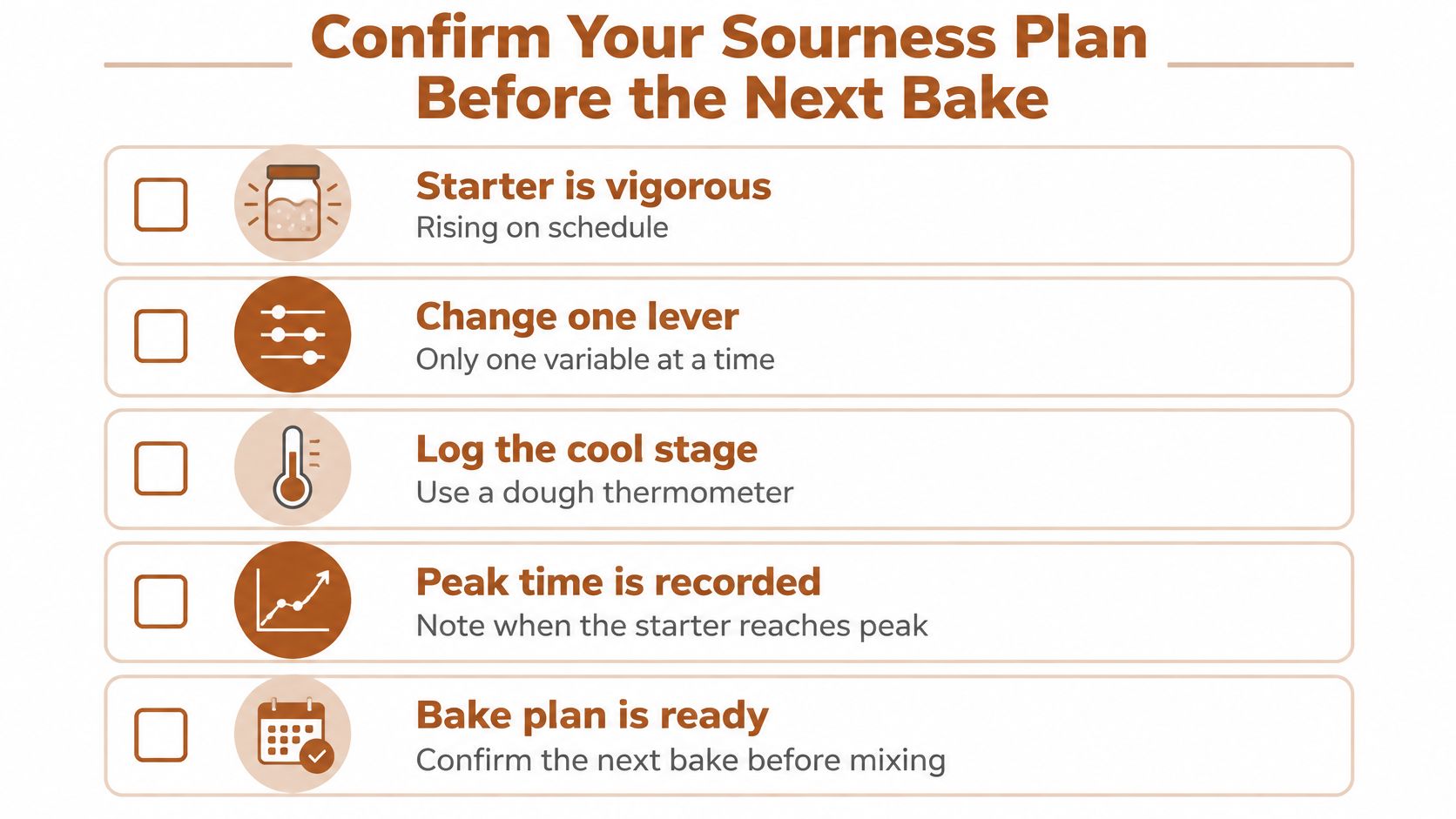
- Starter is vigorous: It's rising on schedule with a fresh, tangy aroma.
- One lever changed: You've picked a single variable from the table, not three.
- Cool stage is logged: A dough thermometer confirms the temperature you intended.
- Peak time is recorded: You noted when the levain peaked last time.
- pH checked if available: The reading supports, but doesn't replace, your other observations.
- Taste target is named: You can say whether you're after sharper or rounder, in one sentence.
The Decision Rule
- Mild loaf: Add about two hours to the cool stage or extend the fermentation, then bake again.
- Harsh loaf: Shorten the cool stage and check the levain sooner.
- Sluggish starter: Build a mature, vigorous starter before changing anything else.
Keep a short bake log with starter condition, temperature, time, rise, smell, and taste. Six lines per bake is enough, and after a month you'll see patterns your memory would've smoothed over.
Holding a steady temperature is the usual obstacle at home. A cool, draft-free spot works if you verify it with a probe. Our Sourdough mode holds 27°C steady, runs by design for up to 24 hours, and is safe for unattended overnight operation, which removes the guessing for long stages. If you're building a culture from scratch, we use Sourdough mode at 27°C with rye flour and water at 50:50 by weight, and most starters are bake-ready within 5–7 days.
Change one variable, bake once, and compare the result against your last log entry. That's the whole method, and it's how sourness stops being luck.
If holding a steady ferment is what's standing between you and a reliably tangy loaf, DBakerAid™ controls fermentation temperature and timing through its Sourdough program, so your cool, long levain runs the schedule you planned instead of the one your kitchen imposes. Visit us to see how the system fits your recipes, set your first sourness experiment, and log a result you can repeat.