

Can a flour contain more protein and still produce a weaker loaf? With heirloom wheat flour, the answer is often yes. That apparent contradiction explains why bakers who treat heritage grain like ordinary strong bread flour can end up with sticky dough, a flat loaf, or a crumb that doesn't match the label's protein number.
Heirloom flour rewards observation rather than assumptions. The variety, milling style, harvest, hydration, fermentation, and mixing method all matter. It can bring distinctive flavor and useful mineral and fiber differences, but it isn't automatically easier to digest or nutritionally superior. It can also be a practical way to explore older wheat genetics without treating “ancient” as a health guarantee.
Table of Contents
- What Heirloom Wheat Flour Actually Is
- Where Heirloom Wheat Comes From and Why It Matters
- Heirloom Wheat Varieties and How They Behave
- Heirloom vs Modern Wheat in Real Baking
- The Honest Truth About Nutrition and Digestibility
- Baking With Heirloom Flour at Home
- Using Precision Tools for Heritage Doughs
- Sourcing, Milling, and Storing Heirloom Flour
What Heirloom Wheat Flour Actually Is
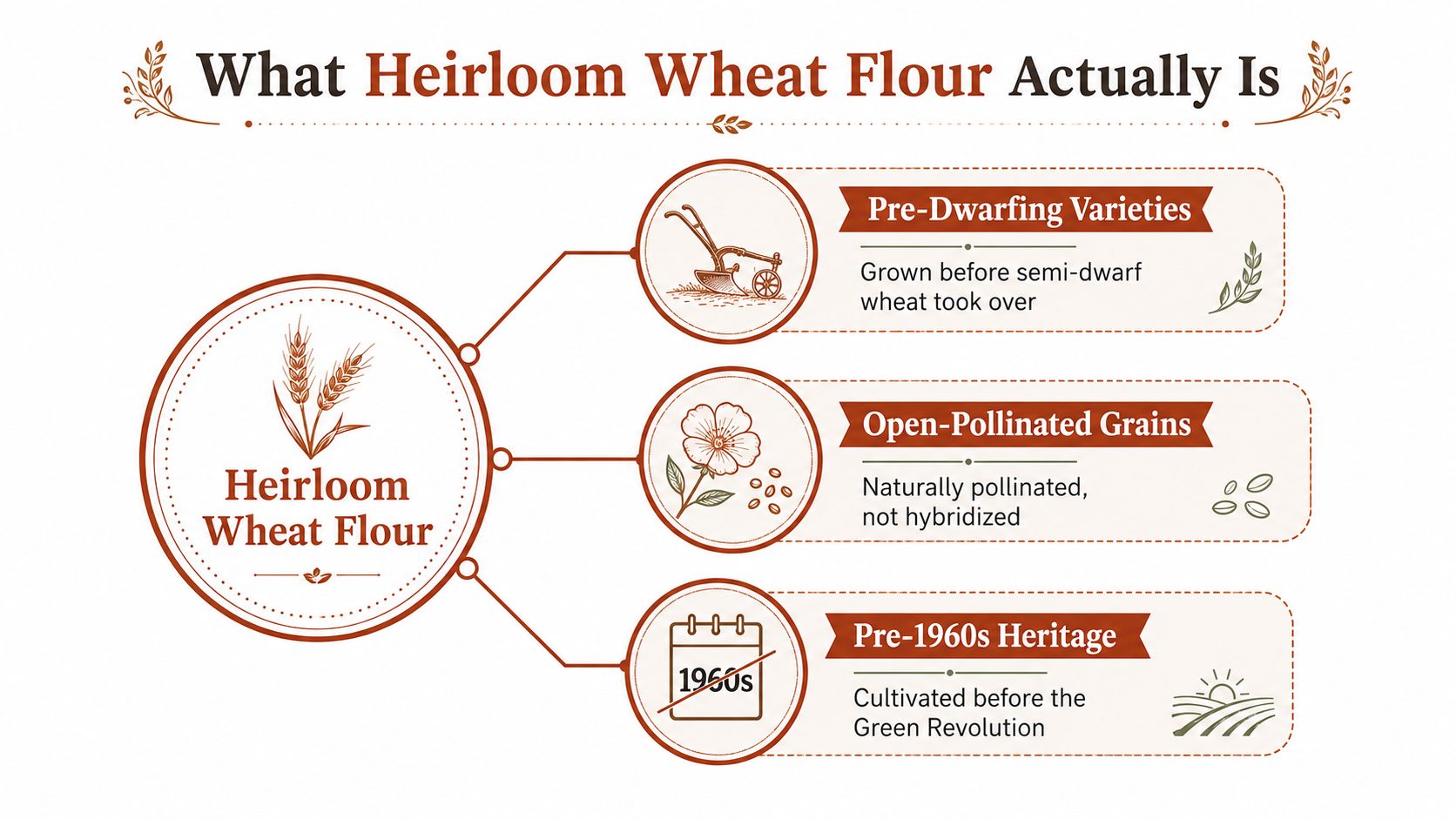
Heirloom wheat flour is a broad category, not a single standardized product. Bakers generally use the term for older wheat varieties maintained through traditional seed-saving and farming systems, including heritage wheats and some ancient wheats. The labels overlap, but they aren't identical in every milling or agricultural context. “Ancient wheat” often points to older genetic groups such as einkorn or emmer, while “heritage” and “heirloom” may describe historically important varieties that were selected and cultivated before modern commercial breeding became dominant.
The phrase “pre-dwarfing” needs care. Older wheats are often associated with taller plants and historical cultivation, while modern breeding selected extensively for shorter, more uniform, higher-yielding crops. The verified history of ancient wheats shows the tradeoff clearly. A comparative study found that einkorn and emmer produced substantially less grain than common wheat, while their grains were richer in protein, lipids, crude fibre, and crude ash (comparative research on ancient and common wheats).
The flour matters as much as the berry
A single variety can behave very differently as whole-grain, sifted, or white flour. Whole-grain flour includes the bran and germ, which add flavor, color, minerals, fiber, and water demand. Sifted flour removes some of those particles, while white flour contains mostly the starchy endosperm. The variety still matters, but extraction and freshness can change dough behavior more than a shopper expects.
That's why a useful heirloom guide has to go beyond naming varieties. You need to match the flour to the loaf, adjust water gradually, protect the dough from over-mixing, and control fermentation closely. A precision fermentation or proofing tool can help with repeatability, but it can't turn a fragile gluten network into modern high-strength dough.
Where Heirloom Wheat Comes From and Why It Matters
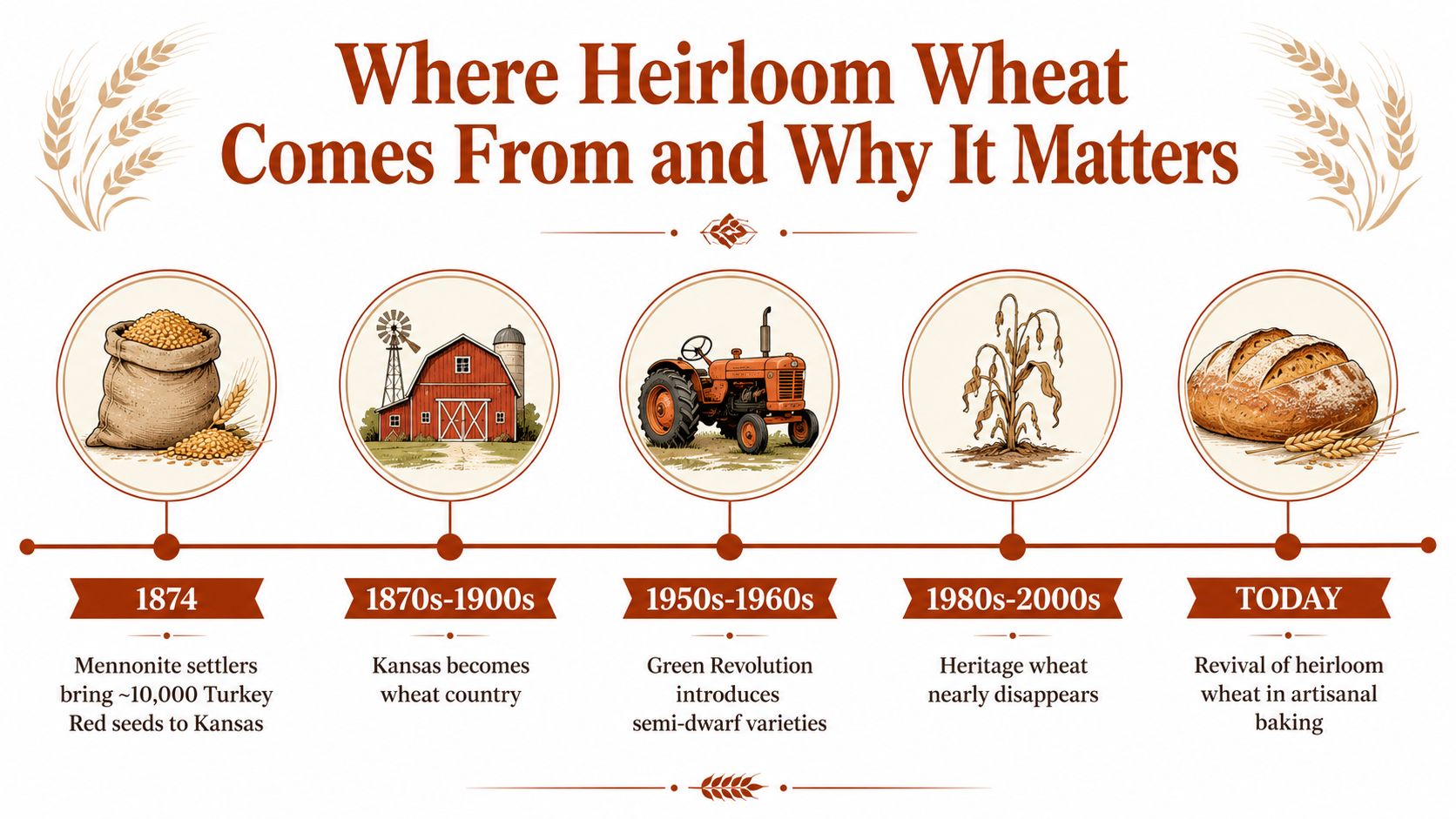
Turkey Red shows how a heritage wheat can grow from a small seed stock into a regional staple. The variety reached Kansas in 1873, with early seed estimates ranging from 360 pounds to 36,000 pounds, enough for approximately 6 to 600 acres. By the mid-1880s, Bernard Warkentin had imported about 10,000 bushels, or 600,000 pounds, from Ukraine, enough to plant roughly 10,000 acres (the history of Turkey wheat and heirloom flour).
By the beginning of the twentieth century, hard red winter wheat, almost all of it Turkey, covered about five million acres in Kansas and had become the primary wheat variety across the Plains. The same historical account places hard red winter wheat at about ten million acres in Kansas today, twice the acreage of a century ago. That history reflects practical choices about yield, climate, milling, and markets, rather than a simple “old good, new bad” story.
Why bakers still care about that history
Older wheat lineages carry genetic and cultural identities that can fade when production concentrates on a narrow group of commercial cultivars. Farmers and millers may choose them for regional adaptation, flavor, straw characteristics, lower-input farming, or ties to local food history. Their value does not guarantee better performance in every field or recipe.
Their agronomic tradeoffs also shape flour availability and price. Ancient wheats often yield less than common wheat, while review evidence reports differences in grain composition, including mineral content. One review cited mineral content ranging from 0.69% to 1.95% in ancient wheat flour, compared with 0.063% in common wheat flour (review evidence on ancient wheat composition). These figures help explain the premium niche for small-lot heritage flour, not a universal health advantage.
For home bakers, the backstory has a practical consequence. Flour from these grains may need gentler mixing, gradual hydration, and closer fermentation checks. A loaf can be nutritious in some respects and still require careful handling, so “healthier” should never replace attention to dough behavior.
Heirloom Wheat Varieties and How They Behave
Protein labels are useful, but they're not enough to choose a flour. Gluten quality, kernel type, milling, and fermentation response decide whether a dough makes a tall pan loaf, a relaxed sourdough, a cracker, or a pleasantly dense pastry.
| Variety | Type | Protein % | Gluten Strength | Flavor Profile | Best Uses | Hydration Range |
|---|---|---|---|---|---|---|
| Turkey Red | Hard red winter wheat | About 12% | Moderate, workable | Nutty and wheaty | Sourdough, pan loaves | About 65% to 75% |
| Marquis | Hard red spring wheat | About 13% | Moderate to strong | Classic bread flavor | Sandwich bread, hearth loaves | About 65% to 75% |
| Red Fife | Hard red spring wheat | About 13% | Moderate, less tolerant of excess mixing | Sweet, rounded, nutty | Sourdough, pan loaves | About 65% to 75% |
| Rouge de Bordeaux | Hard red wheat | About 11% | Weaker and more extensible | Complex and aromatic | Country loaves, crackers | About 60% to 70% |
| Einkorn | Ancient diploid wheat | About 13% | Very weak and brittle | Buttery and rich | Pan loaves, muffins, crackers | About 55% to 65% |
| Spelt | Ancient hulled wheat | Variable | Soft and extensible | Sweet, mild, grassy | Pan loaves, pastries | About 60% to 75% |
| Emmer | Ancient hulled wheat | Variable | Soft, often weak | Earthy and substantial | Pasta, flatbreads, rustic loaves | About 60% to 75% |
The protein figures in the table are practical approximate ranges, not guarantees for every lot. If you're buying a specific bag, use its label as the starting point and watch the dough rather than forcing a target hydration.
For a first experiment, Turkey Red or Red Fife is usually easier to manage than einkorn. If you're curious about another ancient grain, Kamut flour bread offers a useful comparison point for working with a distinctive wheat flour in a bread formula.
Heirloom vs Modern Wheat in Real Baking
A flour can test high in total protein and still lack the gluten strength needed for a lofty loaf. Historical wheat reviews describe higher protein in some older wheats alongside lower glutenin, the gluten fraction more closely associated with loaf volume. These doughs may reach peak viscosity quickly, show low consistency, and tolerate over-mixing poorly (review of ancient wheat processing and baking quality).
That difference is easy to feel. The dough may absorb water and come together normally, then relax rapidly on the bench. It can feel tackier, spread during proofing, and lose strength if you keep mixing in search of a dramatic windowpane. A comparative study found wide variation among einkorn, emmer, spelt, and common wheat, including wet gluten values of 39.26% in einkorn, 59.60% in emmer, 46.80% in spelt, and 67.10% in common wheat (independent comparison of ancient wheat bread quality).
| Attribute | Heirloom Wheat | Modern Hard Wheat |
|---|---|---|
| Protein label | Can be high | Often selected for bread performance |
| Gluten behavior | More variable, often extensible | Usually stronger and more elastic |
| Mixing tolerance | Shorter optimal window | Generally more forgiving |
| Dough feel | Softer, tackier, quicker to relax | More elastic and resistant |
| Crumb | Often tighter and more tender | More capable of open, tall structure |
| Best selection method | Match variety to bake | Protein and flour strength are often more predictable |
Genetics also deserve precise language. Heirloom and hybrid categories describe breeding history, not a simple safe-versus-unsafe divide. For a plain explanation of the distinction, compare heirloom and hybrid genetics without assuming that one label predicts baking quality.
Before choosing a flour by its protein percentage, check the intended use. A weaker flour may be ideal for a pan loaf or cracker and frustrating in a high-hydration free-standing boule. This guide to flour protein content can help you interpret the number alongside the dough's actual behavior.
The Honest Truth About Nutrition and Digestibility
Does heirloom wheat flour deserve its healthier reputation? Sometimes, but the answer depends on the variety, growing conditions, milling, and the person eating it. Comparisons suggest that some ancient wheats can contain more protein, fiber, ash, and minerals than common wheat, while producing less grain in the field. These compositional differences are meaningful, yet they do not prove that every heirloom loaf will be easier to digest (comparative composition findings).
Human comparison work also complicates the idea that Turkey wheat is automatically gentler. Modern wheat did not worsen gut barrier function or inflammation compared with a Turkey heirloom variety. For bakers, that means a comfortable response may reflect the flour's fiber, fermentation, portion, and the individual's tolerance, not its age or name (market coverage describing the human comparison and khapli demand).
A practical verdict on common claims
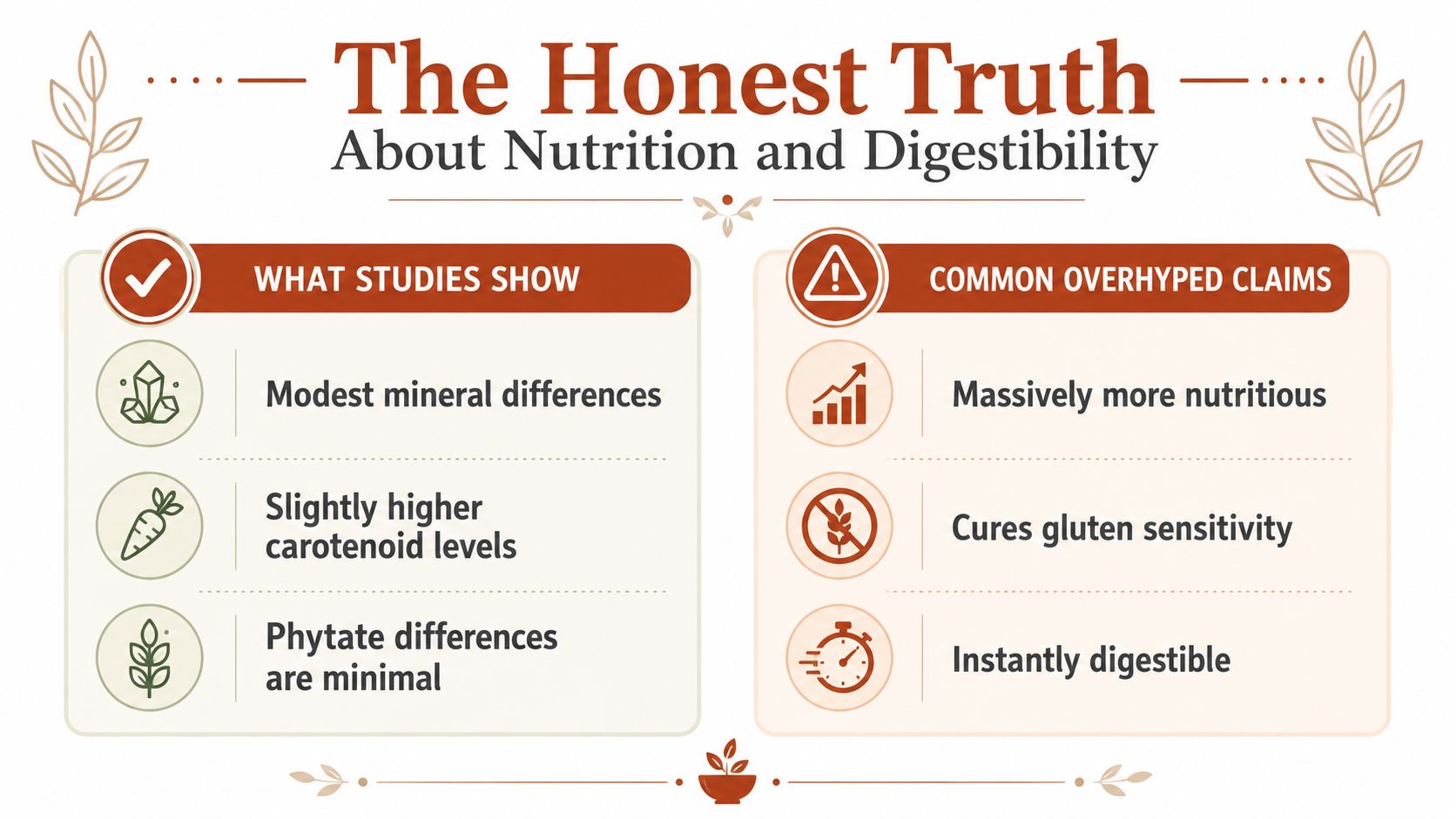
- “Heirloom wheat has more nutrients.” Sometimes, particularly in whole-grain comparisons involving protein, fiber, ash, and minerals. Results vary with variety, soil, harvest, milling, and storage.
- “It cures gluten sensitivity.” No. Heritage wheat still contains wheat proteins, and people with celiac disease should not use it as a safe substitute.
- “It digests instantly.” That is marketing, not a dependable baking expectation. Fermentation, serving size, bran content, and personal tolerance all influence the result.
- “It has lower blood-sugar impact.” The variety name cannot establish that. Product format and processing also affect the eating experience, and the available evidence does not show a universal advantage.
- “The premium is automatically justified by health.” Health alone does not settle the value question. Reported Indian market coverage places khapli or emmer flour at roughly 3 to 5 times the price of regular wheat flour. Flavor, farming practice, and personal tolerance belong in the calculation (reporting on khapli flour pricing and demand).
Baking With Heirloom Flour at Home
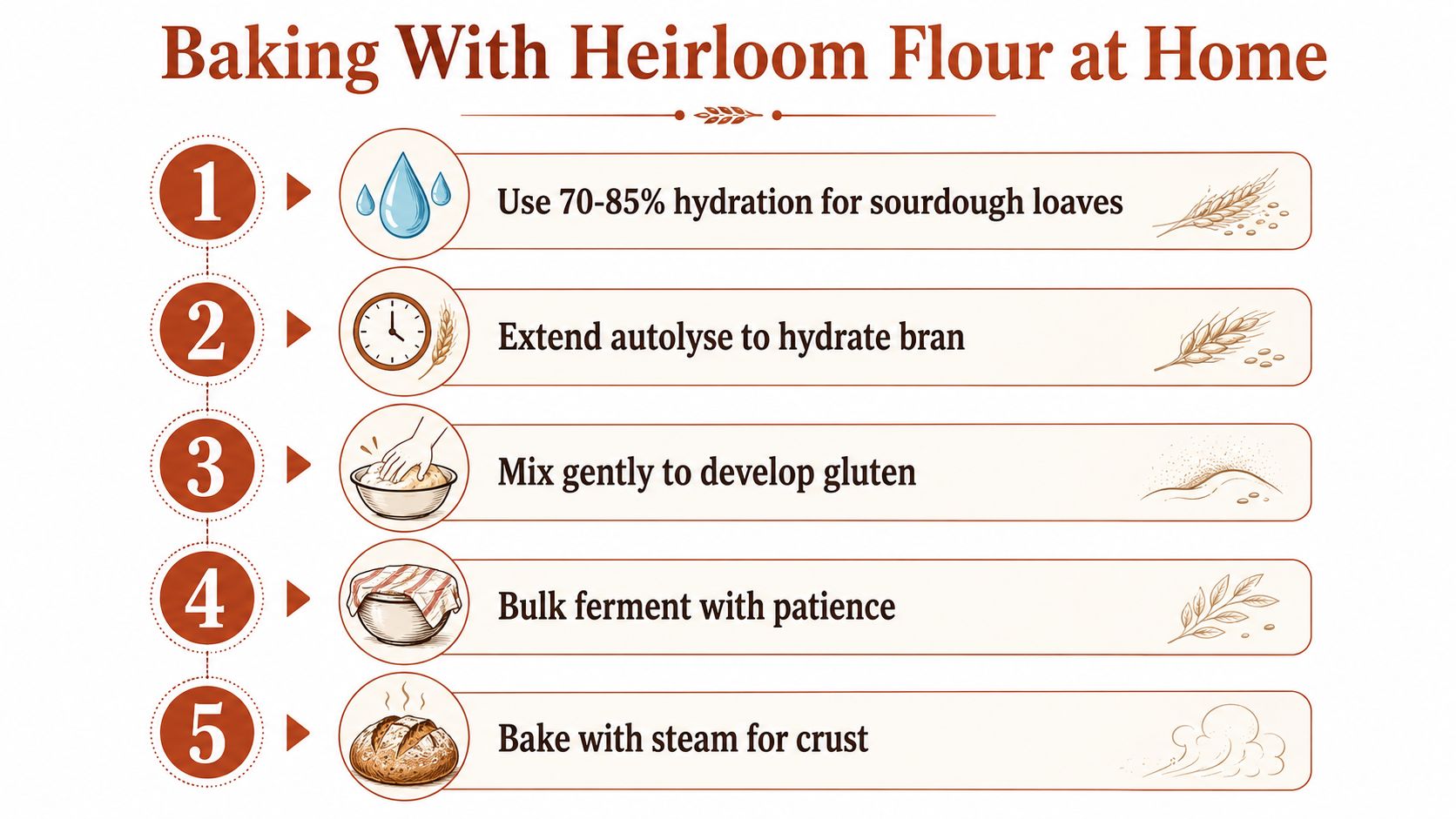
Start conservatively. For sourdough loaves, heirloom flour commonly works within about 70% to 85% hydration, but a fragile variety such as einkorn may need less water than a strong Turkey Red blend. Add most of the water, hold back a small portion, and decide after the flour has rested.
A bridge formula
A dependable starting formula is a 70% hydration sourdough boule using a 50% Turkey Red whole grain and 50% modern bread flour blend. Keep the formula lean, use enough starter for your normal schedule, and treat the water percentage as a starting point rather than a promise. The modern bread flour supplies a stronger network, while Turkey Red adds flavor and whole-grain character without asking the heritage flour to carry the entire loaf.
Give the mixed flour and most of the water an extended autolyse. The rest hydrates bran and germ, which can otherwise steal water during fermentation and make the dough feel increasingly dry. Add starter and salt after the rest, then mix gently until the dough is cohesive and moderately developed.
Mixing rule: Stop when the dough has structure and elasticity. Don't keep mixing until it looks like a strong commercial bread dough.
Bulk fermentation may need more patience, especially with a cooler dough around 22°C to 24°C. Watch expansion, aeration, and surface tension rather than relying only on the clock. Heritage doughs often relax sooner, so shape when the dough still has enough strength to hold itself, not after it has become maximally puffy.
Proof with the seam and surface protected from drying. Score with a confident, slightly shallower cut if the dough feels extensible, and bake with steam so the crust doesn't set before the loaf has expanded. Expect a more aromatic loaf with a tighter crumb than a highly optimized modern bread flour formula.
For more ideas that use bran-rich flour, see these whole-grain bread recipes.
A visual demonstration can help you compare dough strength, shaping, and scoring in real time.
Using Precision Tools for Heritage Doughs
Heritage dough responds badly to uncontrolled kitchen swings. A small temperature change can move a dough from pleasantly extensible to slack and sticky, particularly when the flour has weak gluten or high enzymatic activity. A probe thermometer gives you a much better reference than room temperature alone.
Keep the dough in a stable range around 75°F to 78°F when you're trying to develop a repeatable fermentation routine. A proofing box, insulated cooler, or carefully monitored warm space can reduce the variability that makes one batch appear perfect and the next seem over-fermented.
Humidity matters during final proofing. A covered bowl or humidity-controlled proofer helps prevent a dry skin, which is especially troublesome for low-gluten einkorn and spelt. If you use an improvised setup, cover the dough securely and check that the surface stays supple without becoming wet.
For overnight levains, a sous-vide circulator can turn a cooler into a stable fermenting chamber. It doesn't need to be complicated. The goal is to control the environment well enough that you can judge the flour and fermentation rather than constantly compensating for temperature drift.
Steam can come from an injected oven or a lidded Dutch oven. A preheated Dutch oven at 500°F traps moisture from the dough and encourages crust expansion, while a steam-injected oven offers more control across multiple loaves. Start with a thermometer and a simple proofing box before buying expensive equipment. Those basic tools often solve the largest source of inconsistency.
Sourcing, Milling, and Storing Heirloom Flour
Heirloom flour usually moves through smaller supply chains than mainstream bread flour. You may find it in 5- to 50-pound sacks from regional stone millers, farm CSAs, and online suppliers such as Crown Bake, Janie's, or Fairhaven. Availability can change from lot to lot, so a flour that performs beautifully in one season may need a slightly different process later.
Read the label before buying a large bag. Look for the named variety, whether the flour is whole grain or sifted, the extraction information if provided, the protein range, and the harvest or milling date. A protein number can help you predict broad behavior, but it won't tell you how the gluten will tolerate mixing or how much water the bran will absorb.
Fresh milling and storage
A burr mill such as a Mockmill or KoMo lets you move from fine flour to coarser meal and adjust texture for different recipes. Freshly milled flour can be especially aromatic, but its baking behavior changes as it ages. The practical window for enzymatic activity is short, so use fresh flour promptly rather than assuming it will behave like aged commercial flour.
Store flour in a sealed container away from light and heat. Whole berries keep longer than flour because the protective outer layers remain intact. Refrigerated flour is generally best used within a few months, while freezing extends its useful life further. Let chilled flour return to a workable temperature before mixing if your formula depends on a specific dough temperature.
A small-batch test before a full bake
Don't commit a full sack to an unfamiliar recipe. Test a modest dough first and record what happens.
- Choose two contrasts. Buy a hard red heritage flour such as Red Fife or Turkey Red, plus a softer option such as einkorn or white spelt, from a reputable miller.
- Use one formula. Run both with the same lean dough at about 70% hydration, using the same water, starter or yeast, salt, mixer, and room conditions.
- Stabilize temperature. Start with a probe thermometer and an insulated cooler or simple proofing box before investing in more elaborate equipment.
- Log the results. Note mix time, windowpane development, fermentation speed, shaping behavior, crumb, flavor, and how the bread tastes the next day.
This process separates flour character from kitchen randomness. It also tells you whether a variety belongs in a free-form loaf, a pan bread, a cracker, or a pasta dough. Heritage wheat flour rewards the baker who keeps notes, changes one variable at a time, and treats every new lot as an ingredient to learn.
DBakerAid™ brings controlled fermentation and proofing into the home kitchen, which can help stabilize the temperature and timing that heirloom doughs often make difficult. Visit DBakerAid™ to see how the system fits alongside careful flour selection, gentler mixing, and repeatable heritage-grain baking.