

A dough can follow the same recipe, use the same flour, and still behave differently from one baking day to the next. On a cool morning, the dough may barely move while you wait. On a warm afternoon, it can become inflated, sour, and difficult to shape before the timer suggests it should be ready.
The difference is often fermentation temperature, not baker error. Temperature controls the pace of yeast activity, affects lactic-acid-bacteria growth in sourdough, changes acidification, and influences how long the dough remains in a workable window. Treating it as a biological process variable, rather than just “keeping the bowl warm,” makes fermentation easier to predict.
Table of Contents
- Why Temperature Is the Silent Architect of Bread
- The Biological Mechanisms Behind Controlled Fermentation
- Optimal Temperature Ranges for Different Dough Types
- Air Temperature Versus Actual Dough Temperature
- Tools and Methods for Precise Temperature Management
- Debunking the Speed Myth
- Troubleshooting Common Fermentation Temperature Failures
Why Temperature Is the Silent Architect of Bread
Two bakers follow the same wheat-dough recipe. One mixes on a cold counter and leaves the bowl near a drafty window. The other checks the dough with a probe thermometer and keeps fermentation in a stable environment. Both watch the clock, yet only one is likely to produce a loaf with repeatable timing, acidity, and crumb structure.
The first baker is treating ambient air temperature as a proxy for the dough's conditions. That estimate shifts with the season, counter surface, mixing method, and ingredient temperature. The second baker measures the dough itself and manages fermentation as a living system. A modest temperature change can alter microbial balance, gas development, acidity, and the point at which the dough is ready to shape.
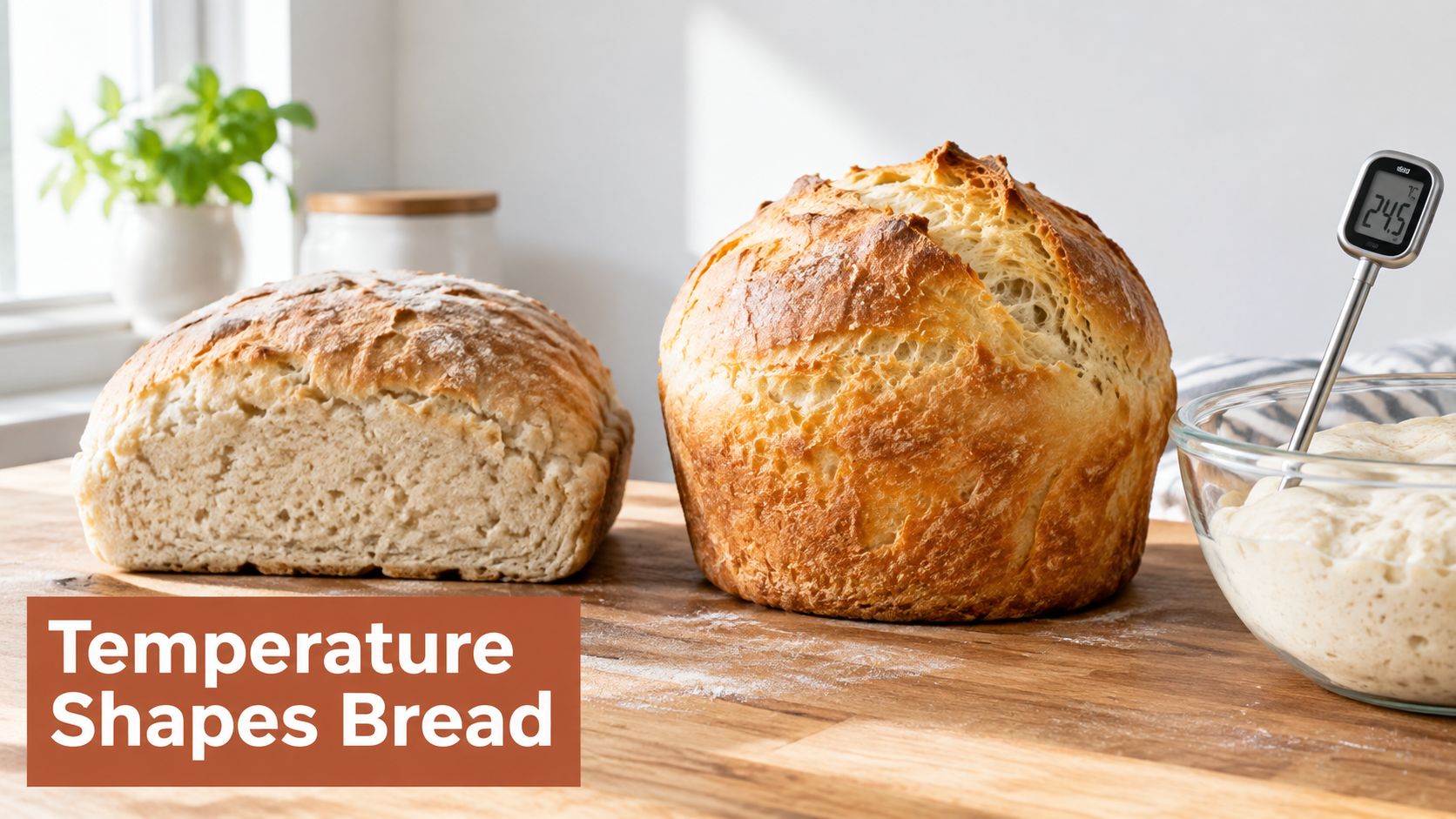
Speed is not the same as final volume
Controlled wheat-dough experiments tested fermentation temperatures from 15°C to 35°C. As temperature rose, dough produced gas and expanded more during fermentation, while dough consistency also contributed significantly to development. Temperature did not significantly change the dough's maximum volume under the tested conditions in the study published by the International Journal of Food Science & Technology.
The clock records elapsed time. It does not reveal how far the dough has progressed biologically. Warmer dough may reach a workable state sooner without raising its final expansion ceiling. Using heat only to chase volume can shorten the schedule while reducing control over acidity, dough strength, and shaping.
Practical rule: Use temperature to guide the dough toward readiness, not to force more expansion than its flour, hydration, yeast, and structure can support.
Measured temperature also improves recipe testing. If the dough reaches the same condition at different times because the kitchen changes, flour, yeast, hydration, and mixing become difficult to compare. Temperature control turns those variables into clearer experiments.
The Biological Mechanisms Behind Controlled Fermentation
A dough held at 25°C and one held at 30°C may follow different biological paths, even if they begin with the same flour, water, and starter. Temperature acts like an ecological lever. It changes which organisms thrive, how quickly reactions proceed, and how the developing dough handles gas.
Temperature functions as a metabolic thermostat for yeast, bacteria, and flour enzymes. Yeast consumes available sugars and releases carbon dioxide, while enzymes alter flour components and bacteria produce acids and aroma compounds. These reactions work together, so fermentation control means orchestrating a community rather than just keeping dough warm.
Yeast activity strongly influences gas production. Controlled wheat-dough testing across 15°C to 35°C, discussed in the rheofermentometer study cited earlier, found that warmer conditions generally accelerated gas development and expansion. Yeast, however, is only one participant, particularly in sourdough.
Yeast and lactic-acid bacteria respond together
A sourdough comparison examined wheat and whole-wheat dough fermented for 2 hours at 25°C or 30°C, with 75% relative humidity. As reported in the sourdough study cited earlier, temperature and fermentation method affected microorganism counts. The 30°C condition produced higher lactic-acid-bacteria counts and faster acidification, while yeast counts rose by approximately 1 log CFU/g on average regardless of temperature.
The practical consequence is easy to miss: warmer dough may become more acidic without producing proportionally better rise. Acidity changes gluten behavior, flavor, and the environment in which yeast continues working. The dough's ecology can shift before its volume makes the change obvious.
A separate sourdough comparison at 22°C, 25°C, 28°C, and 31°C found that endogenous leavening was favored by 22°C. Slower acidification reduced the time yeast was exposed to high acidity and undissociated acids. Cooler fermentation can therefore help the dough retain gas, even when a hotter process appears faster.
Enzymes and process time matter too
Technical sourdough research reports that Lactobacillaceae generally grow best at approximately 30°C to 40°C, while flour-conversion reactions are more pronounced at 25°C to 30°C than at 4°C to 15°C the technical review on wheat sourdough breadmaking. As temperature rises, reactions accelerate, but the useful processing window can narrow.
That creates a biological trade-off:
- Warmer conditions can shorten the route to expansion and acidification.
- Cooler conditions can slow fermentation and preserve a longer shaping window.
- Stable conditions make readiness easier to recognize and reproduce.
A guide to fermentation science in breadmaking provides further context for how these reactions interact in dough.
Optimal Temperature Ranges for Different Dough Types
A dough planned for same-day baking needs a different temperature strategy from one designed for slow flavor development. Temperature acts as an ecological lever: it shifts yeast and bacteria, changes acidity, and affects how quickly the dough moves from strong and extensible to fragile and overfermented. The target therefore depends on the result you want, not on warmth alone.
For lean wheat doughs, moderate heat can balance yeast activity with workable handling time. A review identifies 27°C to 38°C as a favorable bread-fermentation range under its cited conditions, while emphasizing that “active yeast” does not perform identically across that span the bread-production review available through PubMed Central. Within a range, the dough's response still depends on its formula and fermentation stage.
Use this framework to choose a direction:
| Dough or objective | Temperature approach | What to watch |
|---|---|---|
| Same-day wheat bread | Set a stable, moderate target within the recipe's range | Expansion may accelerate as temperature rises |
| Sourdough with stronger acidity | Choose a cooler, slower process | Acidification and yeast exposure change with time |
| Faster sourdough schedule | Use a warmer target when the formula allows it | Greater bacterial activity may increase acidity |
| High-hydration dough | Favor control over maximum warmth | The dough may pass its ideal condition quickly |
| Enriched or delicate dough | Prevent uncontrolled heat | Fat, sugar, and other ingredients alter fermentation behavior |
The 25°C versus 30°C sourdough comparison cited earlier reported faster acidification and higher lactic-acid-bacteria counts at the warmer temperature. That result describes a different microbial balance, not an automatic improvement. Choose 30°C when a faster, more active process suits the formula. Choose a cooler condition when you want slower acid development or more time to judge the dough.
Bulk fermentation and final proofing have separate jobs. Bulk fermentation distributes gas and develops the dough's overall structure. Final proofing prepares the shaped loaf for the oven. Matching their temperatures can work, while a deliberate change between stages can give you more control over strength and readiness.
Set the desired outcome first, then pair temperature with duration. The guide to yeast fermentation temperature offers practical context for matching temperature management to each fermentation stage.
Air Temperature Versus Actual Dough Temperature
A proofer can show the target air temperature while the dough remains cooler or warmer inside. The display describes the environment, not the biological conditions in the dough. Since temperature shifts yeast and bacterial activity, measuring the dough reveals which fermentation process is unfolding.
Dough gains heat gradually. Its temperature reflects ingredient temperatures, mixing friction, container material, batch size, hydration, and contact with the work surface. A large mass changes more slowly than the surrounding air, while a shallow container responds sooner than a deep one. Cold water or flour can lower the starting temperature; friction from mixing can raise it. The dough therefore acts less like a quick-reading thermometer and more like a heat reservoir.
Measure the dough, not just the room
Insert a clean probe into the center of the dough after mixing, then check again as fermentation nears completion. Record dough temperature with the time, volume, and visible texture. This record helps connect temperature with acidity, gas production, and structure, rather than treating warmth as a simple speed control.
The distinction matters because fermentation time varies across conditions. One wheat-dough study tested 5°C, 15°C, 25°C, and 35°C and found that temperature and yeast level both influenced fermentation time and crumb aroma. The shortest times generally occurred at 25°C with the highest yeast concentration, while the longest occurred at 5°C with the lowest yeast concentration the wheat bread fermentation study. These results show temperature acting as an ecological lever: changing the conditions changes microbial activity and the character of the finished crumb.
A probe can explain why a recipe behaves differently after mixing. If the dough starts warmer than intended, fermentation may accelerate even when the chamber setting looks correct. If it starts colder, the dough may need more time to reach the same level of development.
The most reliable fermentation log records dough temperature, not only the appliance setting.
Use repeated readings to calibrate your routine. Allow more time when the air reaches its target first. Expect faster fermentation when the dough is warmer than the chamber.
Tools and Methods for Precise Temperature Management
Temperature control ranges from passive adjustments to dedicated systems. The right choice depends on how often you bake, how sensitive your dough is, and whether you need repeatability across seasons.
A water bath can moderate temperature around a jar or bowl, but it requires manual monitoring. An insulated cooler with a warm pack can reduce drafts and slow temperature loss, though the heat source may create local hot spots. An oven light can provide gentle warmth, but the environment may fluctuate and the light can make the dough warmer than expected.
A dedicated proofing box offers a more controlled environment. The D'BakerAid SureDough system uses a Stage 1 yeast fermentation bowl, a Stage 2 dough proofing bowl, and a hub that coordinates temperature and time. Its stated control band is approximately ±0.5°C, a level of stability that can reduce variation when a recipe depends on a narrow fermentation window. Bakers comparing broader kitchen equipment options can also explore Recipe One's toolkit.
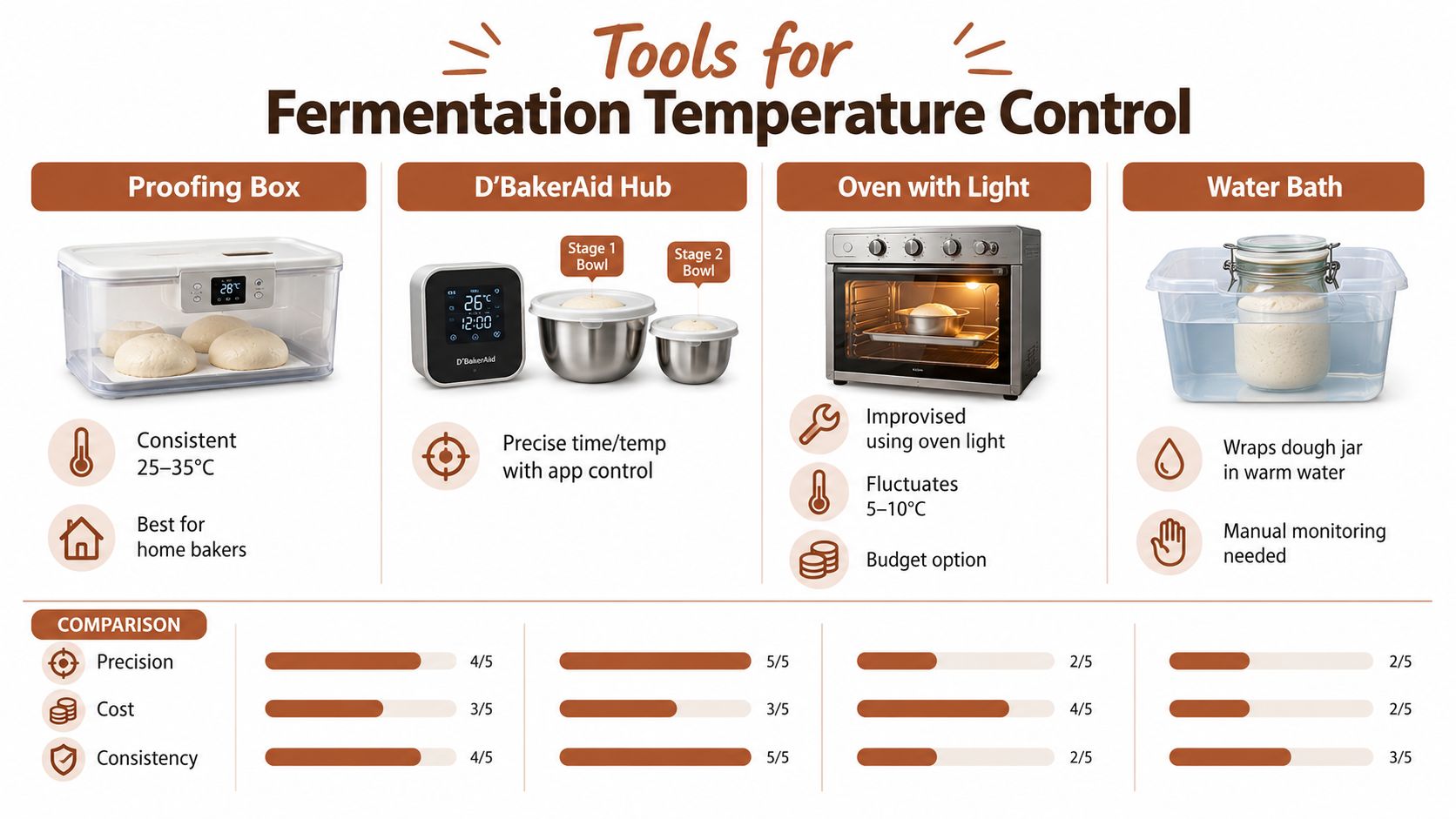
Match the tool to the process
| Method | Main advantage | Main limitation |
|---|---|---|
| Proofing box | More stable temperature around the dough | Adds equipment cost and storage needs |
| Controlled hub and bowls | Coordinates time and temperature for separate stages | Works best when the workflow matches the system |
| Oven with light | Accessible for occasional baking | Temperature can fluctuate and requires checking |
| Water bath | Buffers abrupt changes | Manual monitoring is still necessary |
The published bread protocol illustrates why this matters. One study proofed dough at 30±5°C and 85% relative humidity for 120 minutes, showing that temperature and humidity are often specified together rather than relying on elapsed time alone the published bread study.
A timer still matters, but it shouldn't operate by itself. Even at 30°C for 90 minutes, a fermentation experiment reported completion at about 60 minutes with Dr. Oetker yeast and about 70 minutes with Pakmaya yeast, with Rapunzel yeast taking longer the published fermentation experiment. Temperature control becomes more useful when it works with observation and timing, not when it replaces them.
For practical setup advice, see this guide to dough proofer temperature control.
Debunking the Speed Myth
Warmer fermentation often moves dough faster, but faster isn't automatically better. A short schedule can be useful for weekday baking, yet the warmer process may change acidification, aroma, and the point at which the dough becomes over-proofed.
In one comparison, sourdough reached its target pH in approximately 11 hours at 25°C and 9 hours at 35°C. The higher-temperature process also reduced bread hardness and altered volatile aroma production. Fermentation at 35°C produced more aldehydes and esters but fewer alcohols than fermentation at 28°C, creating a different aromatic profile rather than a universally improved one the study on temperature, sourdough, and bread quality.
Temperature also interacts with formulation. A Barbari bread optimization study modeled a favorable condition at 39.39°C for 55.81 minutes with 30% sourdough, but reported declining quality as temperature rose beyond the favorable midrange. The result supports a recipe-specific program, not a general instruction to maximize heat.
Choose speed with a reason
Use a warmer process when you need a shorter schedule and the formula has been developed for it. Use a cooler process when you want slower acidification, a broader handling window, or a different flavor profile. Neither choice is automatically correct without considering flour, starter, yeast level, hydration, and fermentation duration.
A warmer setting changes the character of fermentation. It isn't merely a faster version of the cooler setting.
The best endpoint is therefore not “the dough has been warm for the prescribed time.” It is a combination of expansion, elasticity, gas retention, acidity, and dough temperature. A recipe that ignores those signals asks the clock to make a biological decision.
Troubleshooting Common Fermentation Temperature Failures
A dough can sit for hours and still need more time, while a warmer dough may already be losing strength. Diagnose rate and readiness separately. Temperature acts as an ecological lever, shifting yeast activity, bacterial acidification, gas retention, and crumb structure rather than just turning fermentation faster or slower.
Begin with the dough itself. Measure the center, not the surrounding air, then compare that reading with the recipe's intended range. Check expansion, elasticity, surface tension, and whether the dough holds gas when gently pressed. These signs show how the biological process is progressing.
If fermentation is sluggish
Cold dough, low yeast activity, or a low yeast level can extend the schedule. The wheat-dough research comparing 5°C to 35°C found that fermentation temperature and yeast level both affected fermentation time and crumb aroma the wheat bread fermentation research.
Move the dough to a stable, moderate environment instead of applying sudden heat. Extend fermentation according to visible development. Also check whether cold ingredients, a cool mixing bowl, or a chilled work surface lowered the dough temperature at the start.
If the dough becomes sour or collapses
Warmer sourdough fermentation can favor lactic-acid-bacteria growth and stronger acidification. The comparison of 25°C and 30°C reported above illustrates how temperature can change microbial balance, not merely shorten the schedule the sourdough microbial study. A sharply acidic smell, weak texture, or poor gas retention suggests reducing the next process temperature or shortening the fermentation.
Collapse may mean the dough passed its strongest point before shaping. Reduce heat rather than adding more, record the dough temperature, shorten the duration, and inspect the dough earlier.
If the crumb is dense
A dense crumb can reflect insufficient fermentation, weak gas retention, or a timer-based endpoint. Check expansion and aeration before shaping. If the temperature was appropriate but the loaf remains dense, review yeast level, dough consistency, flour strength, and mixing.
Keep a short record of dough temperature, start time, visible expansion, shaping time, and bake result. The pattern can reveal a cold start, excess heat, an unsuitable duration, or a formula needing adjustment.
DBakerAid™ coordinates temperature and time through dedicated bowls and a hub. Visit DBakerAid™ to assess whether that setup suits your baking workflow.