

You want a loaf that brings real nutrition to breakfast, but the usual choices create a compromise. Wheat bread gives you familiar structure, gluten-free bread can turn crumbly or gummy, and high-protein formulas often bake up dense enough to feel more like a supplement than a sandwich loaf. Teff flour bread sits in the middle of that problem, offering an earthy whole-grain flavor and useful nutrition, but it needs more deliberate handling than a simple 1:1 flour swap.
Teff flour is naturally gluten-free and nutrient-dense. A 100-gram serving provides about 366 calories, 12.2 grams of protein, 70.7 grams of carbohydrates, and 12.2 grams of fiber, along with 37% of the Daily Value for iron and 11% for calcium (Healthline's teff flour overview). It has been a staple grain in Ethiopia for thousands of years and remains central to injera, a traditional bread-like food.
The practical question isn't whether teff is nutritious. It's how much teff your formula can carry before volume, crumb, and sliceability begin to suffer. The answer changes depending on whether you're making a gluten-free loaf, a wheat-teff blend, sourdough, or a yeasted sandwich bread.
Table of Contents
- What Makes Teff Flour Bread Different
- Choosing Your Flour Blend and Protein Balance
- Hydration Binders and Mixing That Actually Hold Teff Together
- Sourdough Versus Yeasted Teff Flour Bread Methods
- Proofing and Baking Adjustments for Perfect Loft and Crust
- Troubleshooting Flavor Storage and Next Bakes
What Makes Teff Flour Bread Different
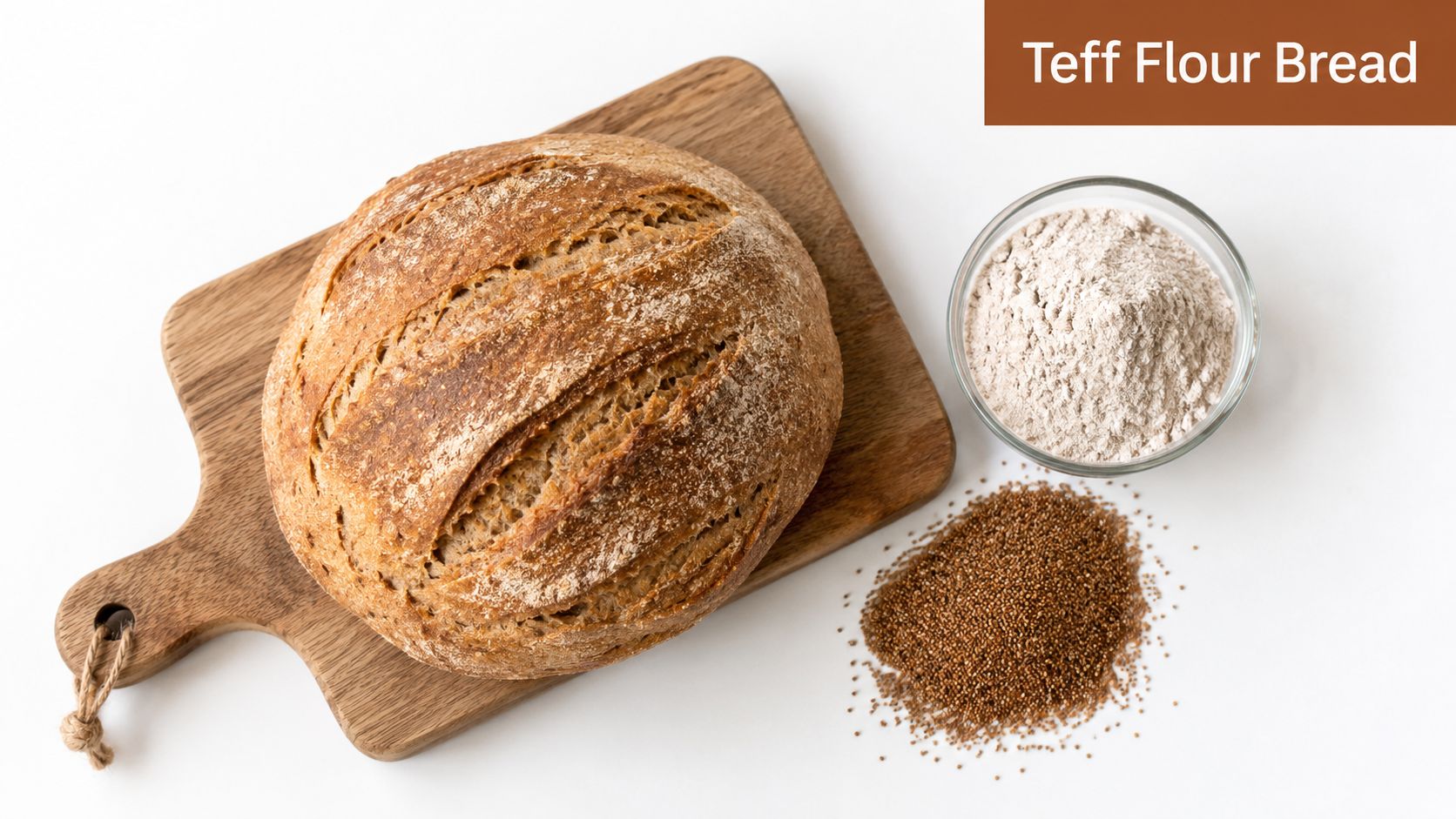
A first teff bake can look simple on paper: mix a nutritious flour with water and yeast, then expect something close to wheat bread. In practice, teff requires a formula built around its limits. It has a fine texture, pronounced whole-grain character, and earthy, mildly nutty flavor, but it cannot create wheat's gluten network.
That changes how the dough holds fermentation gas. Wheat dough becomes elastic as gluten develops. A gluten-free teff mixture instead relies on hydration, binders, starches, fermentation control, and a loaf pan for support. A wheat-teff dough has gluten to carry some of the load, yet each increase in teff still makes the dough heavier and less extensible.
Flavor and texture expectations
Teff can taste like rye, toasted grain, cocoa, or roasted nuts, depending on the variety and the rest of the formula. Seeds, molasses, honey, caraway, savory spreads, and strongly flavored sandwich fillings pair well with it. In a high-teff loaf, that flavor can dominate, so a partial blend suits bakers who want a profile closer to familiar white or wheat bread.
The crumb is usually tight and uniform rather than dramatically open. A properly mixed and baked loaf can remain soft and sliceable, but it will generally feel heavier than airy wheat bread. The crust may brown quickly, and the interior usually darkens as the teff percentage rises. Those results reflect the flour's behavior, not a failed bake.
Baker's benchmark: A successful teff loaf holds its shape, slices without crumbling, and stays tender after cooling. It does not need to imitate a high-hydration wheat boule.
Choosing the right route
For bakers who eat gluten, mixed wheat-teff bread is the more forgiving route. Bread flour or whole-wheat flour supplies the gluten framework, while teff contributes flavor, fiber, minerals, and color. A practical reference notes that teff can replace about 25% of white flour in many recipes (the 2020 teff review).
Gluten-free teff bread needs a separate structure plan. Rice, sorghum, oat, or starch-based partners balance the flour, while psyllium, xanthan gum, guar gum, or carboxymethyl cellulose provide the binding that gluten would normally supply. A 100% teff loaf is possible, but it produces a denser, more distinctive bread and gives you less room for errors in hydration or proofing.
For a first bake, use a partial blend when you want a conventional sandwich loaf. Choose a higher-teff gluten-free formula when earthy flavor and whole-grain character matter more than loft. Sourdough develops deeper flavor but requires closer fermentation judgment. Yeast gives a milder result on a more predictable weekday schedule. This ancient grains bread recipe guide offers broader ideas for combining ancient grains in bread formulas.
Choosing Your Flour Blend and Protein Balance
The flour ratio decides whether your teff flour bread behaves like a sandwich loaf or a compact whole-grain bake. Start by choosing the eating experience, not by asking how much teff you can fit into the formula. A sliceable breakfast bread needs more structural support than a rustic loaf served warm with soup.
The strongest evidence favors moderation in gluten-free formulas. Research has found that 10% teff whole flour improved sensory and nutritional quality in gluten-free bread, while other formulations show trade-offs in fiber, texture, and structure as the percentage rises (the recent review of teff bread formulation). In wheat composites tested at 0%, 10%, 20%, 30%, 40%, and 100% replacement, increasing teff reduced bread volume, with no statistically significant overall difference reported in that study (the controlled teff bread study).
The practical interpretation is straightforward. More teff usually means more flavor and whole-grain character, but less lift and a tighter crumb. The flour isn't defective. It needs a stronger supporting system.
Teff blend levels and expected loaf outcomes
| Teff level | Best for | Volume and crumb expectation |
|---|---|---|
| About 10% | First gluten-free blend, mild flavor, improved nutritional profile | Better balance of tenderness and structure, with modest teff flavor |
| About 20% | Whole-grain sandwich bread and flavor-forward blends | Noticeably earthier, slightly heavier crumb, still manageable with good binders |
| About 25% | Wheat-teff bread and practical partial substitution | Useful ceiling for many wheat-based recipes, with recognizable bread volume |
| About 30% to 40% | Experienced gluten-free bakers | Lower volume, denser crumb, greater need for hydration and binder control |
| 100% | Distinctive teff loaf, injera-inspired baking, experimentation | Strong flavor and compact structure, not a direct wheat-bread imitation |
Match the companion flour to the goal
For gluten-free baking, rice flour contributes neutrality, sorghum brings a mild grain flavor, and oat flour adds softness and sweetness where permitted by your dietary requirements. Starches can lighten the crumb, but too much starch can leave a loaf hollow, gummy, or lacking in whole-grain character. Psyllium-based formulas can avoid gums, while xanthan, guar, or CMC offer more measurable rheological control.
For wheat-based bread, combine teff with bread flour or whole-wheat flour rather than replacing every flour at once. Teff grain protein is commonly reported in the 12.8% to 20.9% range, and glutelins account for more than 46.6% of total protein (the peer-reviewed teff review). That protein contributes nutritional value, but it doesn't function as a complete substitute for wheat's gluten network.
Use this decision rule:
- Choose about 10% teff when loft and familiarity matter most.
- Choose about 20% to 25% when you want the flavor to announce itself without giving up a practical sandwich crumb.
- Choose a higher level or 100% teff when distinctive flavor matters more than height and you're prepared to use a pan, binder, and careful proofing.
- Add a separate protein ingredient only when needed. Teff contributes protein, but the final loaf's protein depends on all flour, seeds, dairy, egg, or isolate ingredients in the formula.
A detailed explanation of why flour protein matters appears in this guide to flour protein content.
Hydration Binders and Mixing That Actually Hold Teff Together
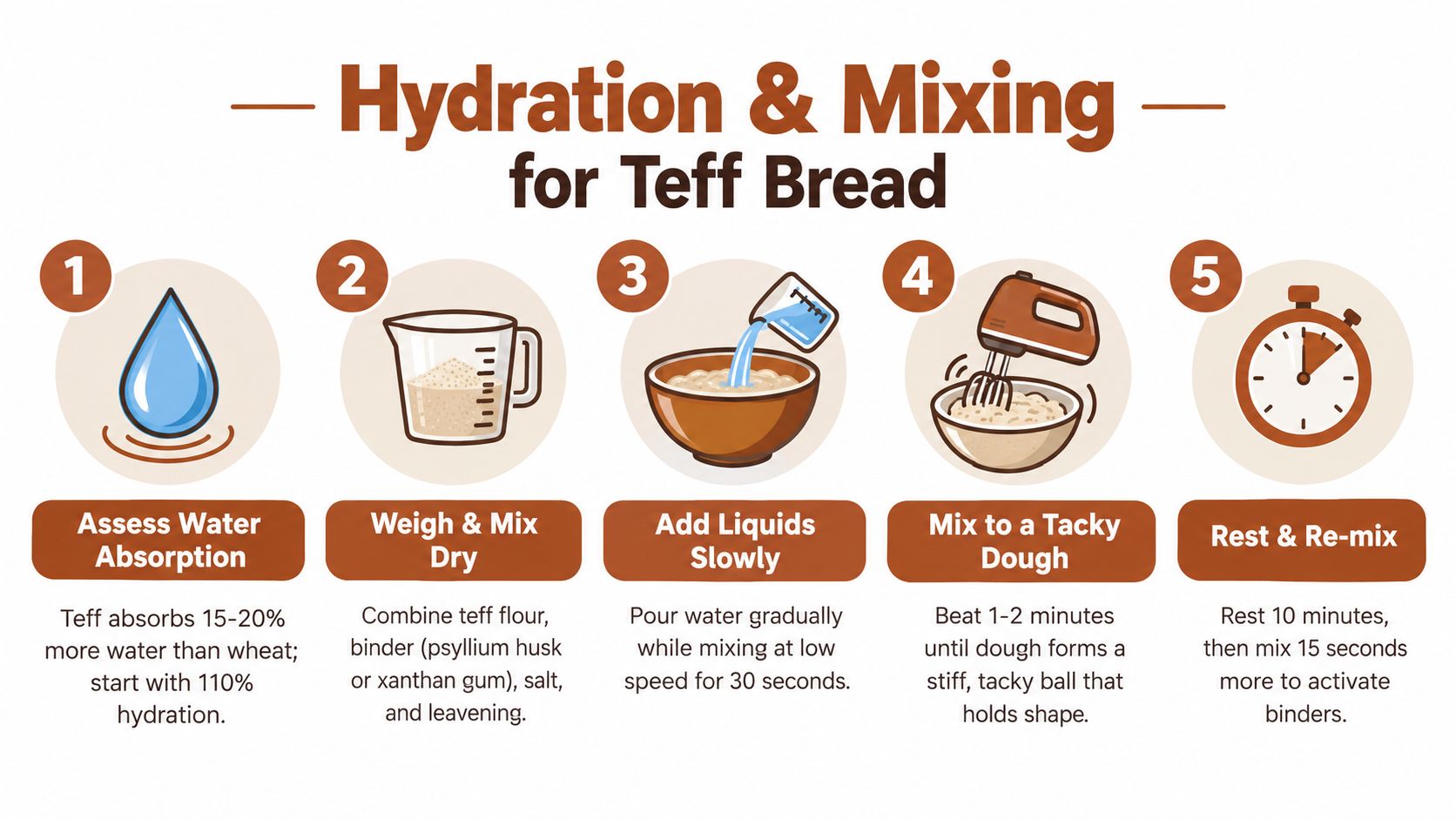
A teff dough can look perfectly hydrated at the mixer, then tighten during its first rest. Teff's carbohydrate content is commonly reported around 73% to 86%, depending on variety, which helps explain why it continues absorbing water as the dough sits. Fine-ground flour usually needs more time to hydrate than its initial appearance suggests.
For gluten-free teff bread, aim for a thick, cohesive batter or soft paste that holds a mound in the pan. A wheat-teff dough should feel tackier and slightly stiffer than ordinary wheat dough, while remaining flexible enough to shape without cracking. Dry, elastic dough is usually a sign that hydration is too low, not that mixing should continue longer.
Build the binder system first
Choose one primary structural system for a gluten-free loaf instead of combining every binder available. Research on gluten-free teff doughs found useful support from xanthan gum at 0.6%, guar gum at 1.0%, or carboxymethyl cellulose at 1.0% (the teff fermentation and hydrocolloid research). These percentages are based on flour weight, so use a scale rather than measuring spoons.
Psyllium husk works particularly well in whole-grain teff formulas. It forms a flexible gel that holds water and helps the baked loaf stay intact. Eggs can strengthen and tenderize enriched dough, but they also affect flavor, color, and dietary suitability. Ground flax or chia provides another binding route, although excess can produce a heavy crumb.
A reliable mixing sequence
- Weigh the dry ingredients. Mix teff, companion flour or starch, salt, yeast, and the chosen binder thoroughly before adding liquid. Poor distribution can leave weak areas and gummy pockets.
- Add most of the liquid slowly. Mix at low speed until no dry flour remains, then pause briefly. The dough commonly thickens as the teff hydrates.
- Adjust by texture. Add the remaining water in small amounts if the mixture fractures or will not hold together. Stop when the gluten-free dough forms a soft mound, or when a wheat blend becomes tacky but shapeable.
- Rest, then mix briefly again. Hydration improves during the pause. A short final mix distributes moisture more effectively than aggressive kneading, which cannot create gluten in a gluten-free formula.
- Transfer gently. Use wet hands or an oiled scraper, smooth the surface, and avoid compressing the dough.
Practical rule: Crumbly bread usually points to insufficient hydration or uneven binder distribution. Gummy bread calls for less liquid or a longer bake before adding more binder.
Fermentation also changes how the dough handles. A study found that adding 25% fermented teff flour to a commercial corn-based gluten-free mix improved physical properties and reduced staling compared with a non-enriched control and the same formula made with non-fermented teff (the teff processing study). Controlled hydration and fermentation generally produce better results than adding flour.
For more guidance on structure, handling, and ingredient choices, use these gluten-free baking tips.
Sourdough Versus Yeasted Teff Flour Bread Methods
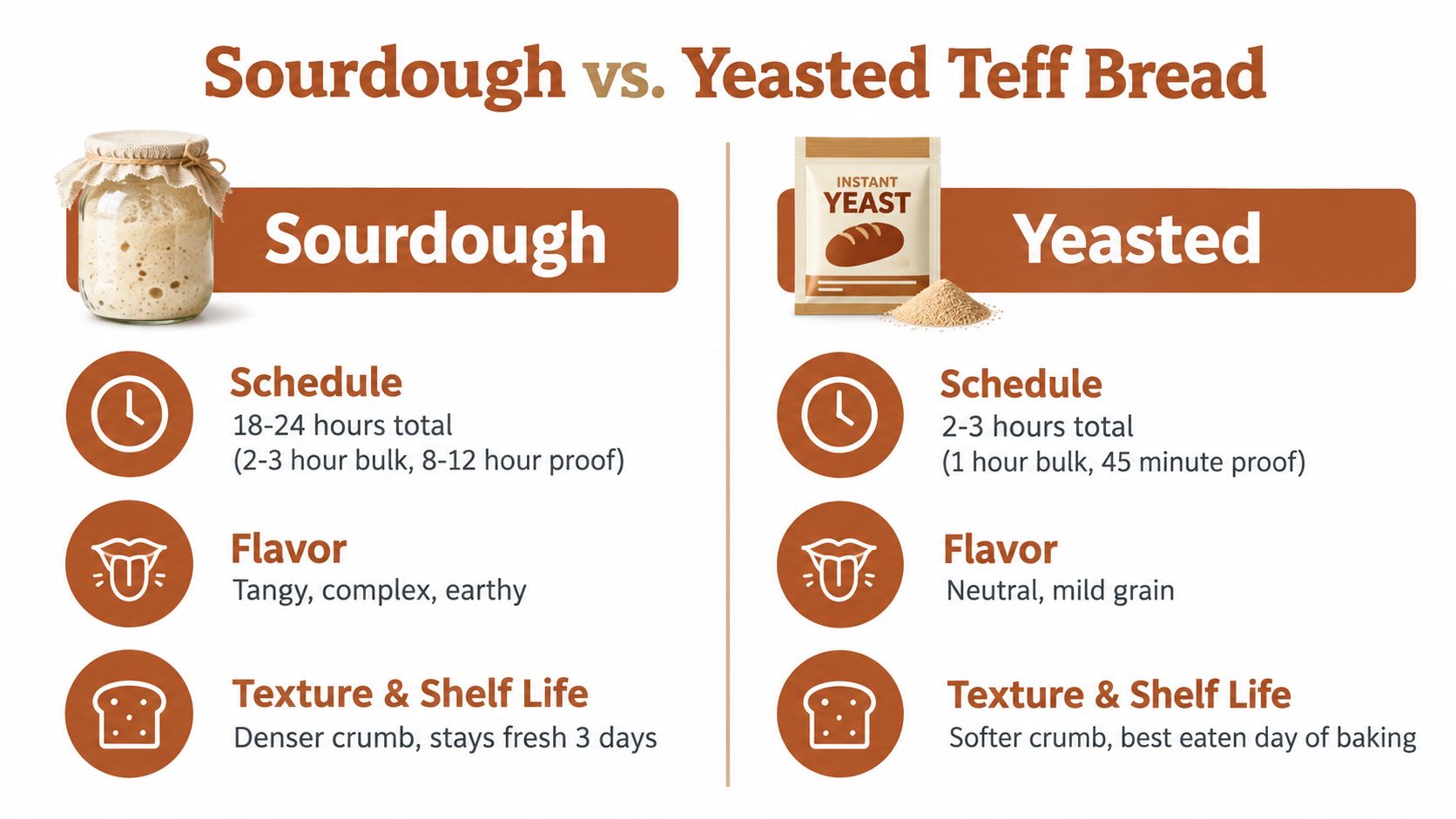
Sourdough and commercial yeast solve different problems in teff flour bread. Sourdough gives the flour more time to hydrate and ferment, producing a deeper, tangier profile. Commercial yeast offers a cleaner flavor and a shorter route to a weekday sandwich loaf.
A teff sourdough starter can be maintained with a small portion of teff alongside another gluten-free flour. The starter's acidity and fermentation activity help soften the grain character, but sourdough doesn't remove the need for binders or a supportive flour blend. Gluten-free dough still needs a system that traps gas and remains stable through baking.
Sourdough for flavor and keeping quality
Fermented teff makes sense when the loaf tastes flat, stales quickly, or carries too much raw earthy flavor. The research cited above associates fermented teff with improved physical properties and slower staling in a gluten-free system. That doesn't guarantee a tall loaf, but it can produce a more integrated flavor and a crumb that stays pleasant longer.
Use a mature starter and extend fermentation according to dough activity rather than the clock alone. Teff dough may show fewer dramatic bubbles than wheat dough, so look for a visibly aerated surface, a gentle jiggle, and an increase in volume without waiting for a full doubling.
A rye-based starter can be useful for bakers already familiar with naturally fermented dough. This resource on how to make rye sourdough starter offers a clear starting point for building the fermentation habit, though the finished teff formula still needs its own hydration and binder adjustments.
Yeast for speed and a mild loaf
Commercial yeast works well for a sandwich loaf when you want the flavor to stay neutral. Mix the dough, allow the bulk fermentation to develop visible aeration, shape it into a supported pan, and proof until it looks inflated rather than doubled. A teff-heavy dough won't necessarily provide the same spring or elasticity as wheat dough, so the pan does much of the shaping work.
Sourdough suits a weekend bake where flavor matters. Yeast suits a weekday bake where repeatability matters more. Both methods benefit from a controlled environment because teff responds visibly to fermentation temperature and hydration changes.
For either route, avoid treating fermentation as a race. Under-proofing produces a tight, heavy slice. Over-proofing leaves the dough fragile, with little reserve for oven spring. Precision proofing can help by holding the dough in a stable temperature range while you judge the visual cues.
Proofing and Baking Adjustments for Perfect Loft and Crust
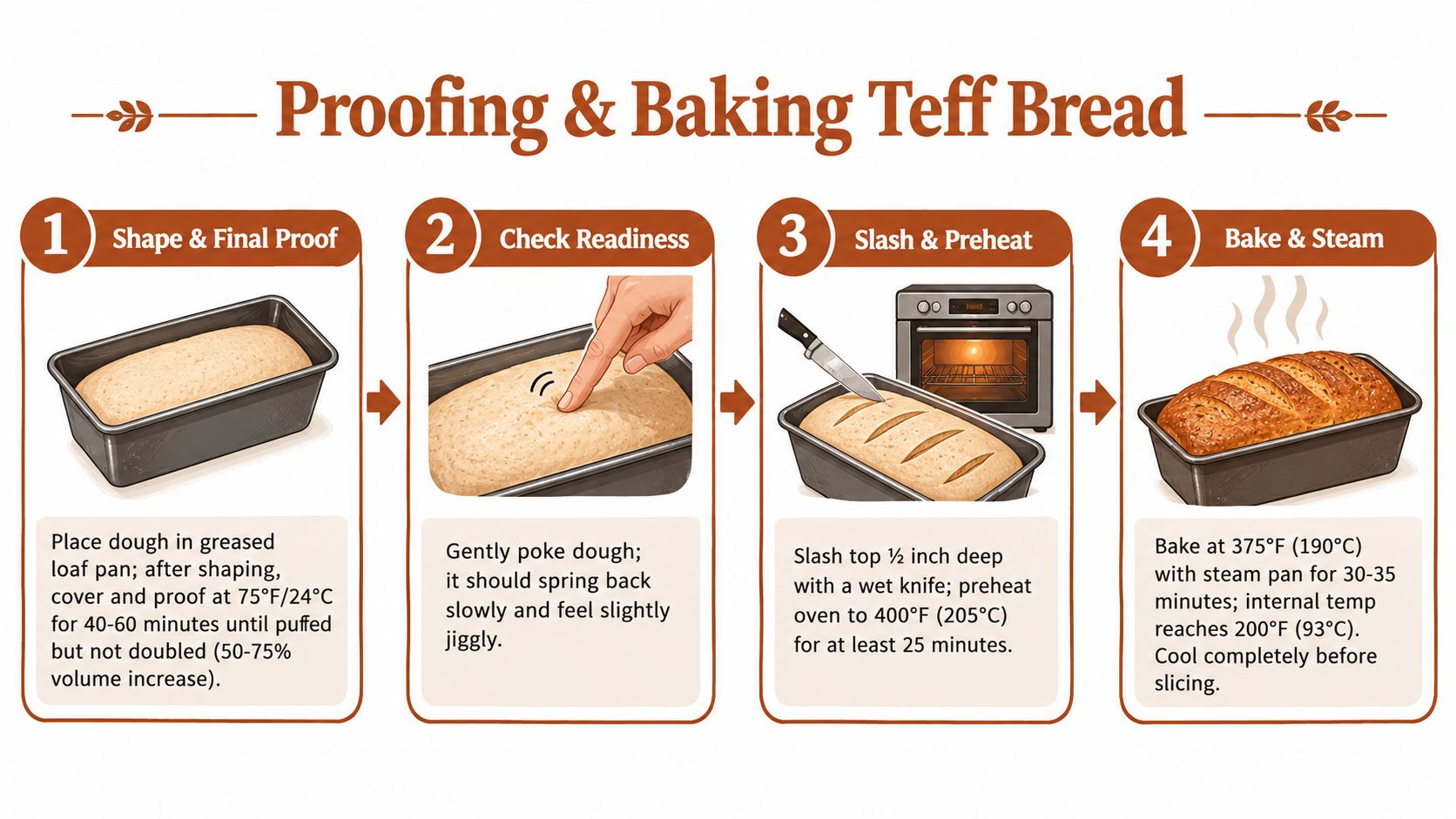
Teff loaves usually fail at the final proof, not because the flour is unusable, but because the baker waits for the wrong cue. Wheat dough often gets judged by whether it doubles. Teff flour bread generally performs better when you look for a 50% to 75% increase in volume, a puffed surface, and a slight jiggle.
Set the shaped dough in a greased loaf pan or a supported proofing vessel. A pan limits sideways spread and gives the weaker structure a dependable boundary. Free-form loaves can work, but they need a formula with enough binder or wheat gluten to stand on their own.
Read the dough before it goes into the oven
At final proof, press the surface gently with a damp finger. The dough should spring back slowly and feel slightly jiggly. If it snaps back immediately, it likely needs more time. If the indentation remains and the surface looks fragile, bake soon.
Teff browns faster than a pale wheat loaf, especially when the formula contains whole grains, dairy, eggs, honey, or molasses. Cover the loaf loosely with foil if the crust darkens before the center sets. Steam can delay crust setting and support expansion, but too much moisture late in the bake can leave the exterior soft.
Use a thoroughly preheated oven and a thermometer. A loaf that looks finished can still have a gummy center, particularly when the formula carries a high water load or substantial whole-grain flour. Cool the bread completely before slicing so the crumb can finish setting.
Watch this practical demonstration before your next bake:
Pan shape and baking behavior
A Pullman pan produces uniform slices and is especially useful when the dough is soft or tacky. A standard loaf pan gives the same structural advantage without requiring a lid. Free-form baking creates a more rustic appearance, but it exposes weak formulas to spreading and uneven expansion.
Keep notes on flour ratio, water weight, binder weight, proofing temperature, and bake time. Change one variable at a time. If you raise the teff percentage and increase hydration in the same bake, you won't know which change caused the crumb to improve or fail.
DBakerAid™ is one option for bakers who want a controlled fermentation and proofing process. Its system uses a fermentation bowl, a separate proofing bowl, and a hub that manages temperature and time, with an optional D'Steamer for oven humidity. The companion app at dbakeraid.app provides recipe and proofing guidance, but the baker still needs to choose a formula suited to teff.
Troubleshooting Flavor Storage and Next Bakes
If a teff loaf comes out dense, check the formula before changing the bake. A high teff percentage can overwhelm the available structure, while weak fermentation or low hydration limits expansion. On the next test, reduce teff by a small increment, disperse the binder thoroughly, and stop proofing when the dough has visibly puffed rather than waiting for it to double.
A gummy crumb calls for a longer bake and better cooling control. Reduce the liquid slightly in the next formula if the dough was overly wet, then cool the loaf completely before slicing. Cutting warm bread can make a baked crumb seem wet and compact because its interior is still setting.
Fix flavor without hiding the grain
Teff should taste earthy and nutty, but old flour, a high percentage, or poorly balanced fermentation can push the flavor toward bitterness, beans, or excessive intensity. Fresh flour, a longer fermentation, and a moderate blend partner usually correct the profile more effectively than heavy flavorings.
Honey or molasses can soften the flavor of a sandwich loaf. Caraway, sesame, flax, sunflower seeds, and fennel suit teff's toasted notes. Pea flour may add a beany edge, while soy generally creates a darker, fuller loaf. Whey and collagen versions tend to stay closer to a familiar cream-colored bread profile, although the protein product and the rest of the formula still control the final taste.
Store the loaf for the way you eat it
Wrap the loaf after it has cooled completely. Teff-based breads may stale more slowly than breads made with wheat, sorghum, rice, barley, or maize, as discussed in the 2020 review of the review of teff bread quality. The crumb will still change with moisture migration, cutting, and storage temperature.
For regular toast or sandwiches, slice the cooled loaf and freeze portions you will not eat soon. For a family loaf, protect the crust from drying without sealing the bread while it is warm, since trapped condensation can soften the crust and affect the crumb.
Make the next bake a controlled test. Adjust the teff percentage by a small increment, keep the binder and proofing conditions steady, and record loaf volume, crumb firmness, and sliceability. Those notes reveal which change helped far more clearly than one dramatic success or failure.
DBakerAid™ offers a fermentation and proofing system for specialty doughs, including whole-grain and gluten-free workflows. Visit DBakerAid™ to review how controlled temperature and timing can make teff flour bread tests more repeatable.