

Rapid-rise yeast is often sold as the shortcut to instant pizza. It isn't. It removes the separate blooming step and can make the dough ready to ferment sooner, but it doesn't remove fermentation, gluten development, or the need to judge the dough by feel. If you expect a reliable 30-minute miracle, you'll more likely get a tight, bland crust or dough that rises quickly and collapses.
The better way to think about pizza dough using rapid-rise yeast is as a scheduling system. Yeast quantity matters, but dough temperature, flour strength, hydration, and total fermentation time matter just as much. This guide shows how to mix the dough, adapt the timing to your kitchen, recognize readiness, and recover from the mistakes that fixed-clock recipes tend to create.
Table of Contents
- Why Rapid Rise Yeast Changes Your Schedule but Not the Science
- What Rapid Rise Yeast Actually Does in Pizza Dough
- Formulating Your Dough for Rapid Rise Yeast
- Timing and Temperature Control for Every Kitchen
- How to Avoid Overproofing and Fix It When It Happens
- Getting Repeatable Results and Better Flavor
Why Rapid Rise Yeast Changes Your Schedule but Not the Science
Rapid-rise yeast, also called instant yeast, changes the first few minutes of preparation. Its fine granules disperse readily through flour, so you can mix it directly into the dry ingredients instead of dissolving it first. That makes the process shorter, but the yeast still needs time to consume sugars and produce the gas that expands the dough.
A separate activation step can be useful when you want to check viability, but it isn't required for instant or rapid-rise yeast. This guide to fast-rising yeast makes the same practical distinction: faster preparation doesn't mean fermentation has disappeared.
The useful promise: rapid-rise yeast saves a step. It doesn't turn unfinished dough into baked pizza.
The common mistake is to use a high yeast dose, keep the dough warm, and follow a timer without checking its structure. That approach can generate gas before the gluten has organized enough to retain it. The dough may puff impressively, then lose shape when you stretch it or bake it.
A dependable same-day workflow is more measured:
- Mix efficiently: distribute yeast through the flour before adding water and salt.
- Control temperature: measure the dough itself, not just the room.
- Ferment by development: look for expansion, elasticity, and gas retention.
- Shape gently: divide and ball without squeezing out all the structure.
- Bake at readiness: don't wait for a number on the clock if the dough is already weakening.
Rapid-rise yeast is especially convenient when dinner has to happen on the same day. It can shorten the front end of the process, but the best crust still depends on flour strength, dough temperature, and enough time for the gluten network to develop.
What Rapid Rise Yeast Actually Does in Pizza Dough
Yeast is a living microorganism. It consumes available sugars and converts them into carbon dioxide and ethanol. The carbon dioxide becomes trapped inside the gluten network, and those gas pockets increase dough volume and help create the aerated structure of the baked crust.
That description reveals the main limitation of rapid-rise yeast. Yeast creates gas, but gluten has to hold the gas. If the flour is weak, the dough is too cold, the dough is overheated, or mixing hasn't developed enough structure, faster gas production won't solve the underlying problem.
A 2026 factorial study conducted at 21°C compared instant and active-dry yeast at several fermentation points. Most expansion occurred between 60 and 120 minutes, and the rise began to plateau after 120 minutes. Yeast type alone had no statistically significant effect on rise volume, with p = .635, as reported in the study published in Food Science and Technology.
The same research found that flour type had a much stronger influence. Strong white flour produced significantly more expansion than wholemeal flour, with flour type reported as the dominant factor at p = .001. That result matches what bakers see in practice: a strong gluten framework gives fermentation gas somewhere to go.
Why the flour can matter more than the packet
A 2026 controlled comparison measured dough rise in 1,000 mL measuring cylinders, using three replicates for each flour, yeast, and fermentation-time combination. The point isn't that a home baker needs laboratory equipment. The point is that the experiment separated yeast type from the other variables and showed why a rapid-rise label shouldn't be treated as a guarantee of extra volume.
Instant yeast may produce a faster rise than active dry yeast under the same conditions because it disperses readily and doesn't need a separate rehydration stage. Yet the finished result still depends on whether the flour can retain the carbon dioxide and whether the dough has fermented long enough to develop useful extensibility.
For pizza, rapid-rise yeast is therefore a convenience and timing tool. It can make the workflow more direct, but it can't compensate for weak flour, poor temperature control, inadequate gluten development, or an overly short fermentation.
Formulating Your Dough for Rapid Rise Yeast
Rapid-rise yeast is a scheduling control, not a guarantee of faster pizza. Build the dough with baker's percentages, weigh every ingredient, and adjust the yeast dose to the dough temperature and the time available. A weighed formula stays repeatable when you change batch size or kitchen conditions.
Start with 0.5–1.0% instant yeast relative to flour weight, based on the technical guidance for same-day pizza dough. Use the lower end for a warm, longer schedule. Use the higher end when the dough must be ready sooner. More yeast can accelerate fermentation, but it cannot correct weak flour, poor mixing, or dough that is already too warm.
Extra yeast also raises the chance of exhausted sugars, alcoholic odors, weak gluten structure, and over-proofing. If the dough repeatedly reaches its peak too early, reduce the yeast or lower the dough temperature before changing the flour or adding more yeast.
A workable baseline
A hydration range of about 62–68% gives many pizza doughs a manageable starting point, as summarized in pizza dough troubleshooting guidance. Choose the lower end for easier handling or flour with lower absorption. Move higher when you want a lighter, more extensible dough and can manage additional stickiness.
| Ingredient | Baker's Percentage | Effect of Adjusting It |
|---|---|---|
| Flour | 100% | Stronger flour generally supports more expansion and gas retention. |
| Water | About 62–68% | More water can make the dough lighter and more extensible, but also stickier and harder to shape. |
| Rapid-rise yeast | About 0.5–1.0% | More accelerates fermentation, but raises the risk of over-proofing and alcoholic odors. |
| Salt | 2.0% | Tightens gluten and regulates fermentation speed. Do not scale it up or down casually. |
Mix the yeast evenly into the flour first. Add the water and salt, then mix until no dry flour remains. Instant yeast makes this direct mixing practical because a separate activation stage is unnecessary.
Water temperature and dough temperature
Avoid water hot enough to damage the yeast. One baking reference identifies water above approximately 59°C as a yeast kill point, while 38–40°C is a commonly cited warm activation range. For pizza, target the final dough temperature instead of relying on a fixed water temperature. Flour temperature, room temperature, mixing friction, and batch size all affect the result.
Measure the dough after mixing. The same formula can ferment at very different rates at 18°C and 26°C, even with identical ingredients. Set the yeast percentage and proofing location together, then judge readiness by feel: the dough should show expansion, hold its shape, and stretch without tearing. Use the clock to plan the work, not to overrule those cues.
Timing and Temperature Control for Every Kitchen
Rapid-rise yeast changes scheduling more readily than it changes fermentation itself. Dough temperature, yeast quantity, flour strength, and room conditions still determine how quickly the dough develops. A dough that looks quiet in a cool kitchen can pass its best point before dinner in a warm one, so use the clock to organize the work, not to decide readiness.
At a room temperature of about 70–75°F, pizza dough may need roughly 1.5–4 hours to reach peak development, depending on the yeast dose and kitchen conditions, as outlined in pizza proofing timing guidance. Check for visible expansion, a smoother surface, and dough that stretches without tearing.
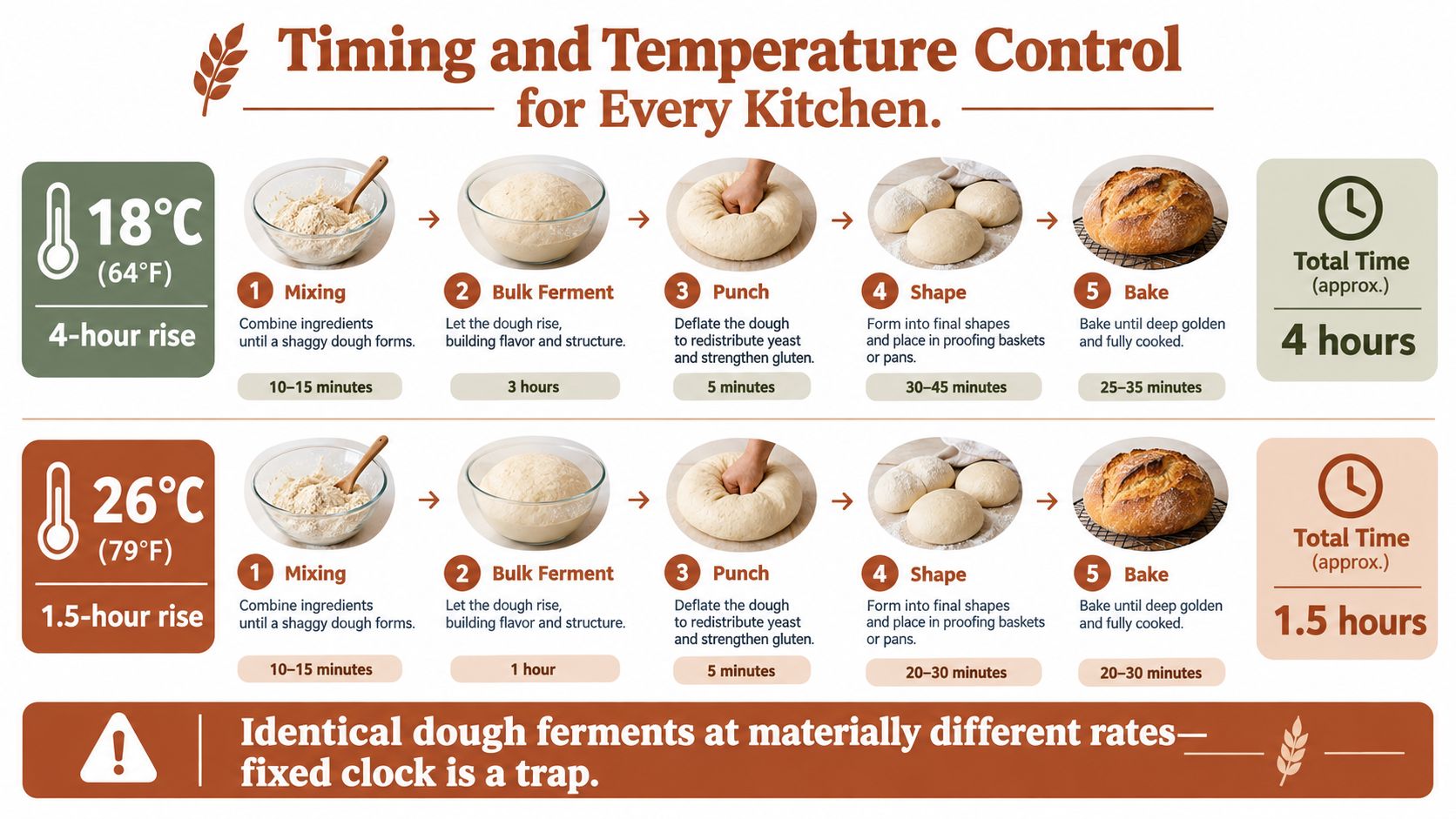
Three schedules, three ways to judge readiness
Same-day room-temperature dough balances speed with dough development. Keep it covered during bulk fermentation. Divide and ball it after visible expansion, when the dough feels elastic rather than dense. After shaping, press the surface lightly. A slow return suggests readiness, while an indentation that disappears immediately indicates that the dough needs more time.
In a warm kitchen around 85–100°F, expect proofing to compress to roughly 30–60 minutes, so watch the dough rather than the clock. It should look aerated and expanded while still holding its shape when lifted or turned. If it becomes slack before you are ready to bake, the yeast dose or room temperature is outrunning the schedule.
A cold ferment at approximately 35–41°F can take 24–72 hours. The slower pace can improve extensibility and flavor, but it requires planning. Reduce the yeast for this schedule instead of carrying the same same-day dose into the refrigerator, then let the dough return to a workable state before shaping.
Practical rule: if fermentation is running ahead of the meal schedule, refrigerate the dough. Adding flour will not correct a dough that has fermented too far.
For a broader explanation of timing and readiness, see this pizza dough proofing guide. Visible expansion, elastic handling, and a poke that returns slowly are more reliable than a fixed rise time. A tight dough that springs back quickly needs longer fermentation. A slack dough that keeps the indentation is nearing or past its useful window.
How to Avoid Overproofing and Fix It When It Happens
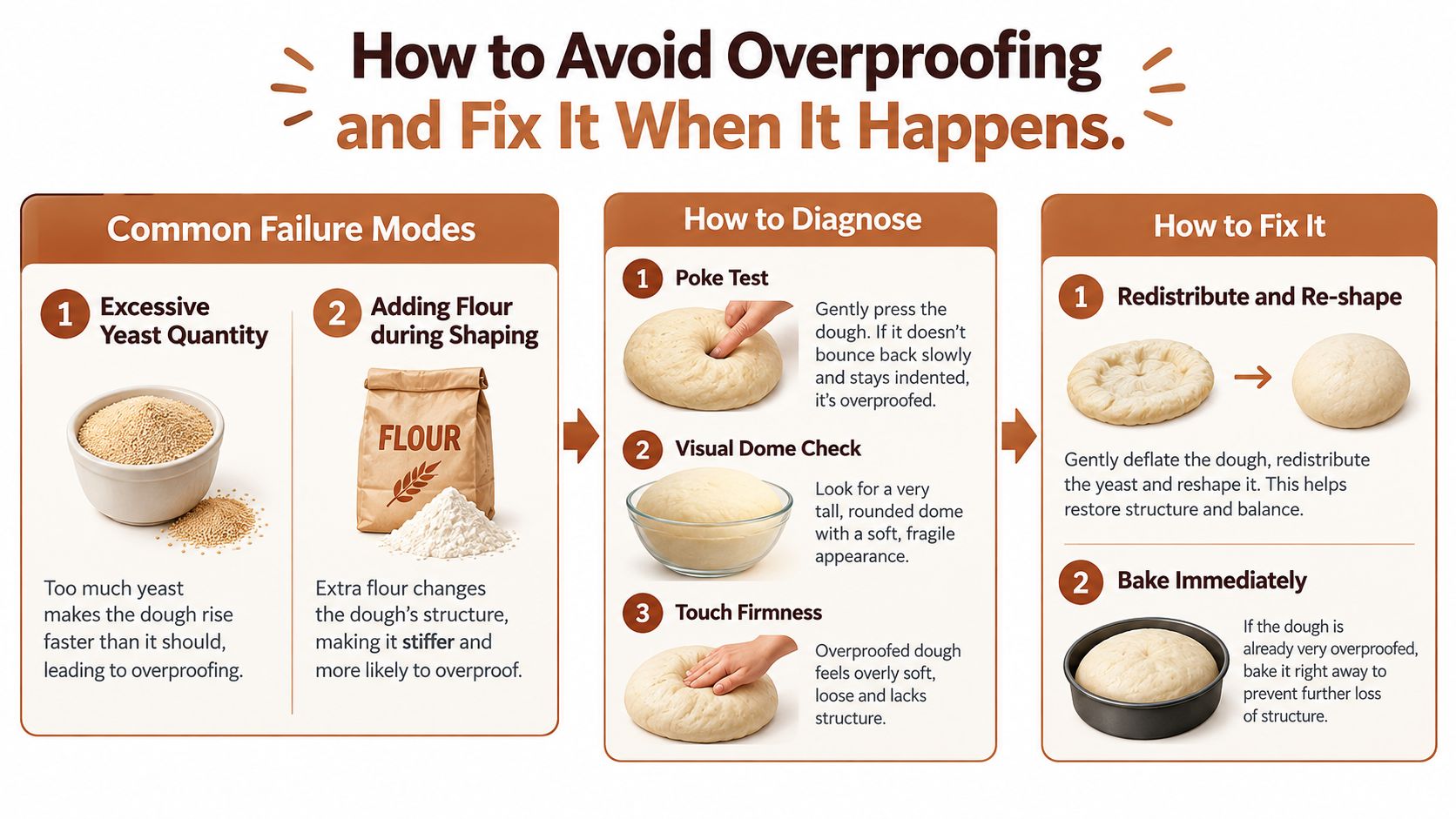
Two mistakes account for many failed rapid-rise doughs. The first is using more yeast than the flour and schedule can support. The second is adding flour during shaping, which can create a stiff outer layer while leaving the interior fermentation problem untouched.
Over-proofing has recognizable signs. The dough may have a strong alcoholic odor, lose its ability to hold a rounded shape, collapse when touched, or retain an indentation after the poke test. Under-proofed dough usually feels tight and springs back quickly.
Heat can create a particularly deceptive failure. The dough generates gas rapidly, but the gluten doesn't have enough time to organize and retain it. The result is a dough that balloons, weakens, and collapses rather than becoming easier to stretch.
The only useful recovery window
If the dough is only slightly over-proofed, reshape it with minimal degassing and give it a shorter 30–45-minute recovery proof, as outlined in pizza dough fermentation troubleshooting. Handle it gently. Aggressive punching removes the gas you need for an open edge and can leave the dough tight.
A flat dough with a strong alcoholic smell is different. It has lost too much structure for a high-quality open crust, and forcing it through another long rise usually makes the outcome worse. Bake it as a thinner pizza, use it for a flatter bread, or start again rather than expecting it to recover fully.
Prevention is simpler than repair. Keep the dough covered so the surface doesn't dry, check its temperature during bulk fermentation, and move it to the refrigerator when it is advancing faster than planned. Judge the dough's volume, elasticity, and shape retention together, because no single cue works perfectly in every kitchen.
Getting Repeatable Results and Better Flavor
The most dependable adjustment is usually temperature control, not more yeast. Rapid-rise yeast can support a quick same-day workflow, while a slower cold ferment remains a legitimate choice when you want more extensibility and developed flavor. The shortest timetable is a convenience option, not automatically a quality option.
For bakers who want tighter control, D'BakerAid's SureDough system maintains fermentation temperature within ±0.5°C and provides flour-specific proofing programs, according to the pizza dough fermentation overview. A controlled environment can reduce the day-to-day swings that make the same formula behave differently.
The repeatable framework is straightforward: weigh ingredients, choose yeast based on the schedule, target the final dough temperature, ferment by visible development, and shape only when the dough retains gas. Rapid-rise yeast makes preparation more convenient, but the dough still decides when it's ready.
D'BakerAid™ offers controlled fermentation and proofing for bakers who want rapid-rise pizza dough to behave consistently across changing kitchen conditions. Visit DBakerAid™ to explore the system, pizza dough programs, and recipes built around repeatable fermentation.