

You've measured the flour carefully, followed the recipe, and still ended up with a loaf that's dense, uneven, or strangely dry. Often, the problem isn't your mixing technique. It's the measurement system you started with.
A digital kitchen scale for baking turns ingredients into controlled variables. That matters for ordinary bread, but it matters even more for high-protein dough, where flour, vital wheat gluten, protein isolate, yeast, salt, and water must work within a narrow structural balance. The scale won't ferment the dough for you, but it gives the dough a repeatable formula to follow.
Table of Contents
- Why Precision Weighing Changes Everything
- The Science of Small Measurements
- Key Features to Evaluate Before Buying
- Mastering the Tare and Calibration Process
- Scaling Up for Advanced and Specialty Doughs
- Choosing the Right Scale for Your Kitchen
Why Precision Weighing Changes Everything
A cup of flour measures space. A gram measures mass. Those methods can produce different results because flour may be spooned loosely, poured, or compressed. That variation may be acceptable in a forgiving cookie recipe. Bread is less tolerant. Hydration, gluten development, and fermentation all depend on ratios, so inconsistent volume measurements create uncertainty before mixing begins.
The failure often appears hours later. The dough is mixed and proofed, yet the loaf barely rises. The crumb is tight, the crust feels heavy, and the cause is difficult to isolate. Weak yeast, excess flour, insufficient water, or a warm kitchen can produce similar symptoms. A mass-based formula removes one source of doubt and makes the remaining variables easier to assess.
Small ingredients create large errors
A scale earns its place most clearly with ingredients that weigh very little. A reading that is off by 1 gram represents a large share of a small yeast, salt, or baking-soda dose. The relevant issue is the scale's testing performance, not just the number shown on its display, as outlined in this precision testing guidance for baking scales.
The consequences continue through the dough. Extra yeast can speed fermentation, while too little can leave the dough underdeveloped. Extra salt can slow yeast activity and change dough strength. Added protein makes diagnosis harder because the dough is already stiffer, absorbs water differently, and gives you less room to correct an imbalanced formula.
Practical rule: Weigh every ingredient that affects structure or fermentation, especially flour, water, yeast, salt, protein powder, and vital wheat gluten.
Weighing also removes friction from repeat baking. Once a formula works, you can reproduce it without guessing whether a heaped spoonful or packed cup matches the original measurement. That repeatability matters more than a headline resolution specification. A scale cannot control fermentation or mixing, but consistent readings reduce cumulative error across every batch.
The shift from cups to grams also reflects changes in weighing equipment. Ancient balance scales, used as early as 2000 BCE, eventually gave way to electronic load-cell systems that can display tenths of a gram. In home baking, the digital scale makes formula-driven work practical, particularly when high-protein doughs require repeated adjustments and reliable comparisons between batches.
The Science of Small Measurements
Baking formulas behave as ratios, so a small weighing error can alter the balance between flour, water, yeast, salt, and added proteins. Flour establishes the reference mass. Water sets hydration, yeast controls fermentation, and salt influences both flavor and dough behavior. Whey, pea, soy, or collagen isolate and vital wheat gluten add structure, but they also change water absorption and elasticity.
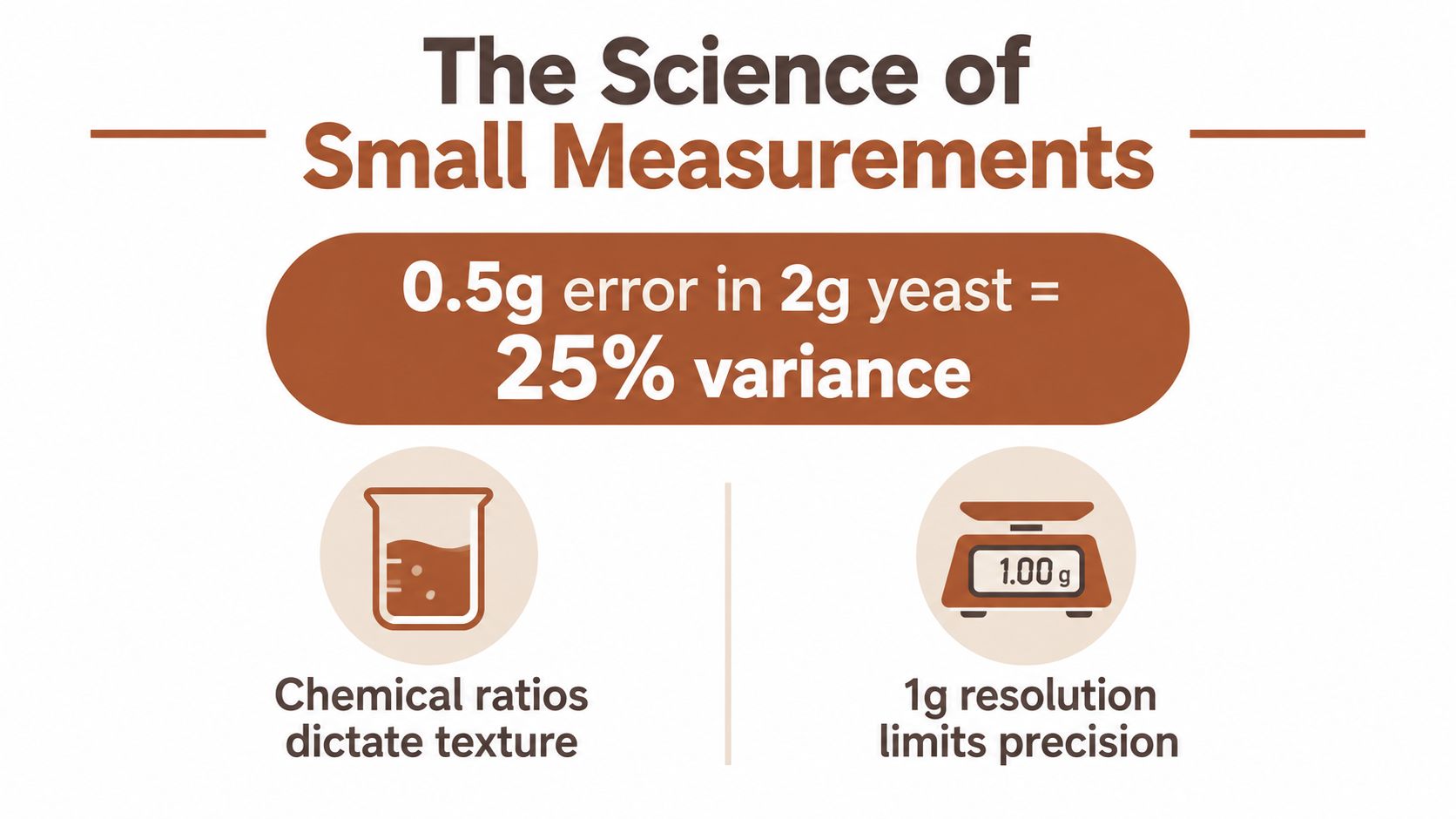
A 4-gram salt dose in a high-protein dough shows the practical risk. A 1-gram drift changes that addition by 25%, enough to affect yeast activity and dough strength even though the total mass appears small. The same arithmetic explains why a 0.5-gram error in a 2-gram ingredient creates a 25% variance. Small ingredients deserve deliberate weighing because their proportional effect is large.
Resolution is not the same as accuracy
A display that shows 0.1 grams only describes the increments visible on screen. Accuracy describes how close the reading is to the ingredient's actual mass. Those specifications answer different questions.
A scale that reads in 1-gram increments may drift by about ±1 gram or more, while lower-quality units can drift by 2–5 grams. That variation can alter hydration, yeast dosage, and salt percentages in a structured dough, according to this guidance on display resolution and true accuracy. A calibrated 1-gram scale can handle most bread and pastry work. A cheap model labelled “precision” may instead create confidence without repeatable results.
Use a 0.1-gram scale for very small additions such as yeast, salt, spices, and coffee. For cookies, cakes, and standard bread doughs, 1-gram resolution is generally sufficient. The useful test is stability at the weights you routinely measure, not the smallest number printed on the display.
Why high-protein dough exposes weak measurement
High-protein formulas make measurement problems harder to diagnose. Protein powders and vital wheat gluten can produce dough that is denser, stiffer, or slightly tacky. An incorrect water or protein quantity may appear as poor extensibility, slow expansion, or a heavy crumb rather than an obvious weighing mistake.
Hydration differences also vary between protein products. A few grams of extra dry material can tighten the dough, while a few grams too much water can make it sticky without delivering the expected lift. Precise weighing cannot standardize every ingredient, but it gives you a dependable baseline for comparing batches and adjusting the formula.
The workflow matters over time. If readings drift, you may compensate with water or flour, then misdiagnose the next batch because the adjustment was built on a false starting point. For equipment considerations, consult this high-precision kitchen scale guide. A precise formula only helps when the scale is stable enough to reproduce it.
Key Features to Evaluate Before Buying
A scale can meet its advertised specification and still slow down every batch. The practical test is the full workflow: can you read the display beneath a mixing bowl, add ingredients without overshooting, and trust the zero point after repeated tare cycles? Those small interruptions become expensive when a high-protein dough already requires careful hydration and protein adjustments.
Match resolution to the ingredient
Choose resolution according to what you weigh.
| Resolution | Capacity | Best Use Case |
|---|---|---|
| 1 g | About 5 kg | Everyday bread, cakes, cookies, and larger dough batches |
| 0.1 g | Varies by model | Small doses of yeast, salt, spices, and coffee |
| 0.1 g plus a separate high-capacity platform | Varies by model | Bakers who need fine dosing and large-batch weighing |
For everyday home baking, technical guidance recommends at least 1-gram resolution and about 5 kilograms of maximum capacity, a combination that covers regular ingredients and larger dough batches (baking scale capacity and resolution guidance).
A 0.1-gram display is useful for small amounts of yeast, salt, spices, or coffee. It is not automatically the better choice for a bowl of dough. Some inexpensive models show tenths but drift under load, fluctuate as ingredients fall, or become difficult to use with a large container. A stable 1-gram scale gives more repeatable results than a finer scale that makes you restart measurements.
Examine the physical design
Platform size matters when you weigh dough or add ingredients directly to a wide bowl. A bowl that hides the display forces you to pour, stop, lift the bowl, and check the reading. Repeating that sequence increases overshoot risk and makes recipe development harder to reproduce.
Button placement matters during messy preparation. Tare should activate with one deliberate press while your fingers are lightly floured. Touch controls may be easy to wipe clean, but sealed physical buttons often provide more dependable feedback.
Auto-off behavior can interrupt a long mix. If the scale shuts down while you gather ingredients, you may lose the active reading or rebuild the total. A hold function or longer active period reduces that interruption, provided the scale returns accurately after waking.
Power affects batch reliability. Battery-operated models are convenient, but spare batteries belong in the kitchen. Rechargeable models reduce disposable battery use, yet a flat battery still stops the workflow at the same point.
Test the scale, not the marketing
Set the scale on a hard, level counter and check it with a known weight. Look for a reading that remains steady, not one that jumps or settles slowly. Add the weight near the center and near the platform edge, since a wide bowl can distribute pressure unevenly.
Roundup reviews typically score features and accuracy separately, so a high feature score does not guarantee stable readings (cross-use reliability in digital kitchen scale testing). For bread, a bright display and quick tare may matter more than app connectivity. For developing high-protein formulas, stable readings across repeated batches matter more than decorative design or a finer number on the screen.
Mastering the Tare and Calibration Process
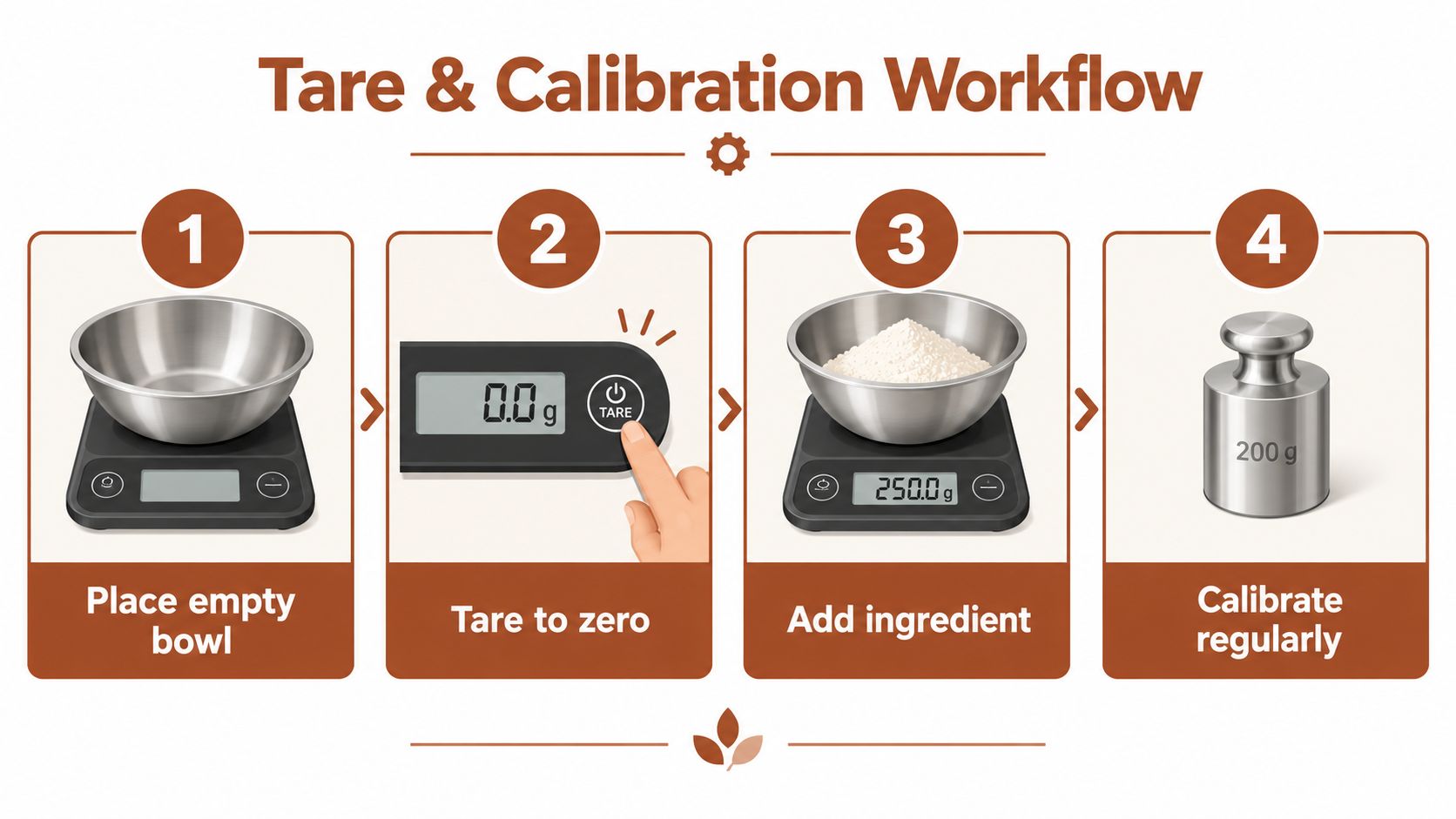
A scale can read accurately and still create friction if the tare routine is inconsistent. Tare resets the display to zero while the bowl stays on the platform, letting you build a formula ingredient by ingredient without calculating the container's mass or washing several measuring vessels.
Place the scale on a flat, clean counter. Keep the platform, sides, and base free from contact, since pressure from the counter or a nearby object can distort the reading. Use the same sequence for every batch:
- Place the empty bowl. Position it where it will remain throughout the batch. Moving it can change how its weight is distributed.
- Tare to zero. Wait for the display to settle, press tare, and confirm that the reading returns to zero.
- Add the first ingredient. Pour or spoon near the bowl's center. Stop just short of the target, then add the final amount in small increments.
- Tare before each addition. Reset after flour, water, protein powder, gluten, yeast, and salt so every target remains independent.
- Record unusual behavior. If the reading jumps, drifts, or fails to return to zero, remove the bowl and repeat the check before mixing.
Verify drift with known weights
A U.S. nickel provides a practical reference at 5.00 grams. Five nickels approximate 25 grams, and six approximate 30 grams. Place the coins together in the center, wait for the reading to settle, then remove and replace them to see whether the result repeats.
This household check does not replace laboratory calibration. It screens for changes that can disrupt repeatability. If the same load produces different readings, or the display does not return to zero, clean the platform, replace the batteries if applicable, and test again. Persistent drift makes the scale unsuitable for small ingredients.
A coin check can pass while the scale still performs poorly at very low weights. Match testing to the work: check near 2 grams if you regularly dose yeast, and assess stability under a larger load when weighing a kilogram of flour. High-protein doughs expose these weaknesses because several small additions can shift the final formula before mixing even begins.
The practical guide to using a kitchen scale can help establish a consistent tare habit. The aim is not a formal test before every loaf. It is to catch silent changes before they become a pattern of failed dough.
Scaling Up for Advanced and Specialty Doughs
A scale proves its value when one bake demands two ranges of measurement. It must register a small yeast or salt dose, then support a large flour addition or a full bowl of dough without drifting, hiding the display, or reaching its capacity.
Most basic buying guides stop at resolution and capacity. For advanced doughs, the harder question is whether the scale stays consistent through repeated additions, bowl movement, and longer mixing sessions. Evaluate that workflow yourself rather than treating a finer display as proof of better performance.
The high-protein dough test
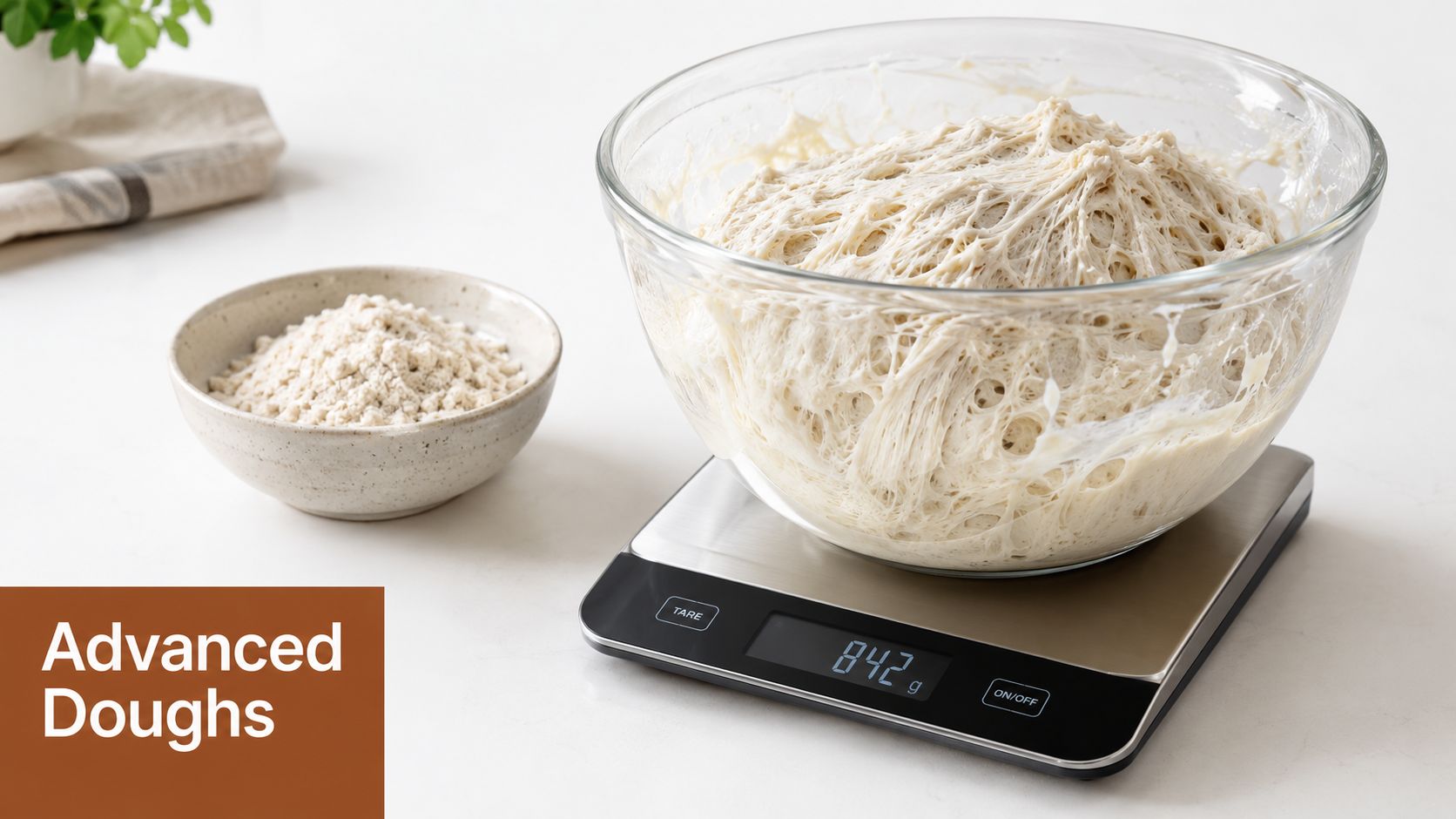
High-protein bread exposes weaknesses that simple flour-and-water recipes may hide. A formulation can combine bread or whole-wheat flour, vital wheat gluten, and a whey, pea, soy, or collagen isolate, each with different absorption behavior. The dough may become denser and stiffer than ordinary sandwich dough, so accurate water and dry-weight measurements must come first. Otherwise, ingredient error gets mistaken for a problem with the formula.
A reliable scale should handle both ends of that range:
- Small-dose control: Yeast, salt, and flavorings need stable readings. A 0.1-gram display is not useful if the value jumps or settles slowly.
- Large-bowl visibility: The screen should remain readable beneath a broad mixing bowl.
- Repeatable tare: Each ingredient should begin at zero without delayed response or accidental resets.
- Load stability: The reading should hold when the bowl shifts slightly during pouring.
- Cleanability: Flour paste and protein powder should not collect around exposed controls.
Match the scale to your repeated workflow
Laminated pastry may favor quick response for small additions. Sourdough and large sandwich batches place more pressure on capacity and bowl clearance. High-protein bread needs both, since a substantial flour base may sit alongside several small functional ingredients.
The useful upgrade may be a more stable platform, longer active time, removable display, or a second compact scale for very small quantities. Choose the setup that removes repeated interruptions. Each pause creates another opportunity to forget a tare, overshoot an ingredient, or write down the wrong weight, and those small mistakes can alter the finished dough.
Choosing the Right Scale for Your Kitchen
A scale can meet its advertised resolution and still slow down a baking session. If the display settles late, the bowl hides the numbers, or the platform shifts while you pour, each ingredient creates another interruption. In a high-protein dough, those interruptions make forgotten tares, overshooting, and transcription mistakes more likely. Choose for repeatability before adding features.
A beginner usually needs a straightforward 1-gram model with enough capacity for flour, water, sugar, butter, and standard bread formulas. Bakers who regularly measure very small yeast, salt, or flavoring doses may add a separate 0.1-gram scale. Verify its readings with known weights. A finer display does not prove finer accuracy.
Use a simple decision filter
Ask these questions before buying:
- What do you bake most often? Everyday bread and cakes suit a dependable general-purpose scale. Specialty and high-protein doughs may require better control of small additions alongside a substantial flour load.
- Will your bowl cover the display? Choose a raised, offset, or detachable display if you cannot read the weight while pouring.
- Do you make large batches? Prioritize capacity, platform stability, and enough clearance for the bowl.
- Can you verify calibration? Repeatable readings with known weights matter more than a long feature list.
- Will cleanup be easy? Sealed controls and a wipeable platform limit flour and liquid exposure around the interface.
A built-in scale can reduce handling when the rest of the baking system already manages fermentation and proofing. D'BakerAid™ combines weighing with a two-stage setup that includes a yeast fermentation bowl, a dough proofing bowl, and a hub for controlling temperature and time. Its companion recipe app is available at dbakeraid.app. Product details may change over time.
Before choosing a model, compare how it behaves across your actual workflow, not only its maximum capacity or displayed resolution. For a focused buying checklist, use this baker's scale buying guide covering capacity, resolution, and stability checks. The practical test is whether the setup keeps measurement, mixing, and fermentation consistent without repeated workarounds.
A digital kitchen scale cannot correct weak flour, stale yeast, or an unsuitable proofing environment. It can provide the dependable starting point advanced doughs require. If you want a connected system that combines precise weighing with controlled fermentation and proofing, visit DBakerAid™ to review its workflow. Then compare the high-protein recipes and choose equipment that fits the way you bake.