

You scoop flour into a cup, level it carefully, and still end up with a loaf that feels tight, dry, or slow to rise. The problem often isn't your mixing technique. It's the measurement. Bread dough reacts to small changes in flour, water, salt, and yeast, so the best bakers scale is the one that stays dependable when a large bowl blocks the display, a starter jar pushes the capacity, or a low-dose ingredient needs more care than a headline specification suggests.
For daily bread work, a quality scale usually needs 1-gram resolution, reliable readings across its working range, fast tare response, a stable platform, and enough capacity for the bowl you use. Specialized models can measure fractions of a gram, but that extra precision is useful mainly for very small quantities and precision workflows. The comparison below focuses on what matters at the bench, not just what looks impressive on a product page.
Table of Contents
- Why Bakers Weigh Instead of Scoop
- What Makes a Great Bakers Scale
- Top Bakers Scales Compared by Accuracy and Features
- Accuracy Resolution and Calibration in Real Baking
- Choosing a Scale for Your Baking Workflow
- Price Durability and Long Term Value
- Final Recommendations for Home and Pro Bakers
Why Bakers Weigh Instead of Scoop
A cup of flour isn't a fixed weight. One independent baking guide reports that scooped all-purpose flour can weigh 150–160 grams, while spooned-and-leveled flour is closer to 120–125 grams, a difference of roughly 25–33%. The flour measurement comparison explains why the same volume can produce substantially different doughs.
That variation changes more than the number written in the recipe. Extra flour lowers effective hydration, makes dough stiffer, and can produce a tighter crumb. Too little flour can leave the dough slack and difficult to shape. In bread, where gluten development and fermentation depend on the balance between flour and water, a cup is a blunt instrument.
King Arthur Baking uses 120 grams as the reference weight for a cup of all-purpose flour and describes a digital scale as a foundational baking tool because most quality models measure in 1-gram increments. Its scale guide also gives a useful calibration check: a U.S. nickel should read 5 grams, and six nickels should total about 30 grams.
Weight makes a formula repeatable
Weighing lets you build the dough in one bowl. Place the bowl on the platform, tare it, add flour, tare again, then add water, starter, salt, and yeast. You aren't estimating how tightly an ingredient settled into a cup, and you aren't washing a stack of measuring tools afterward.
The method also makes baker's percentages practical. If a formula calls for a specific flour weight, you can scale the entire dough up or down without converting every ingredient into fractions of cups and spoons. That matters for sourdough maintenance, sandwich loaves, pizza dough, and any batch where consistency matters more than convenience.
Bench rule: Weigh flour, water, starter, salt, and yeast in grams. Volume tools still have a place for rough liquid measures, but they shouldn't control a bread formula.
A 1-gram scale is the professional baseline for everyday baking. It's precise enough for most flour and water quantities, cakes, cookies, muffins, and standard bread doughs. Sub-gram models make more sense when you regularly work with very small amounts of yeast, salt, spices, or fermentation additives.
A guide to using a kitchen scale for bread is useful if you're moving from cups to grams for the first time. The important change isn't pressing the tare button. It's treating weight as the formula itself.
What Makes a Great Bakers Scale
A good scale earns its space on the bench by fitting the way you mix. Judge it by resolution, accuracy, capacity, tare behavior, and physical usability, in that order. Headline precision means little if a mixing bowl covers the display or the platform reaches its limit halfway through a dough.
Resolution is not the same as accuracy
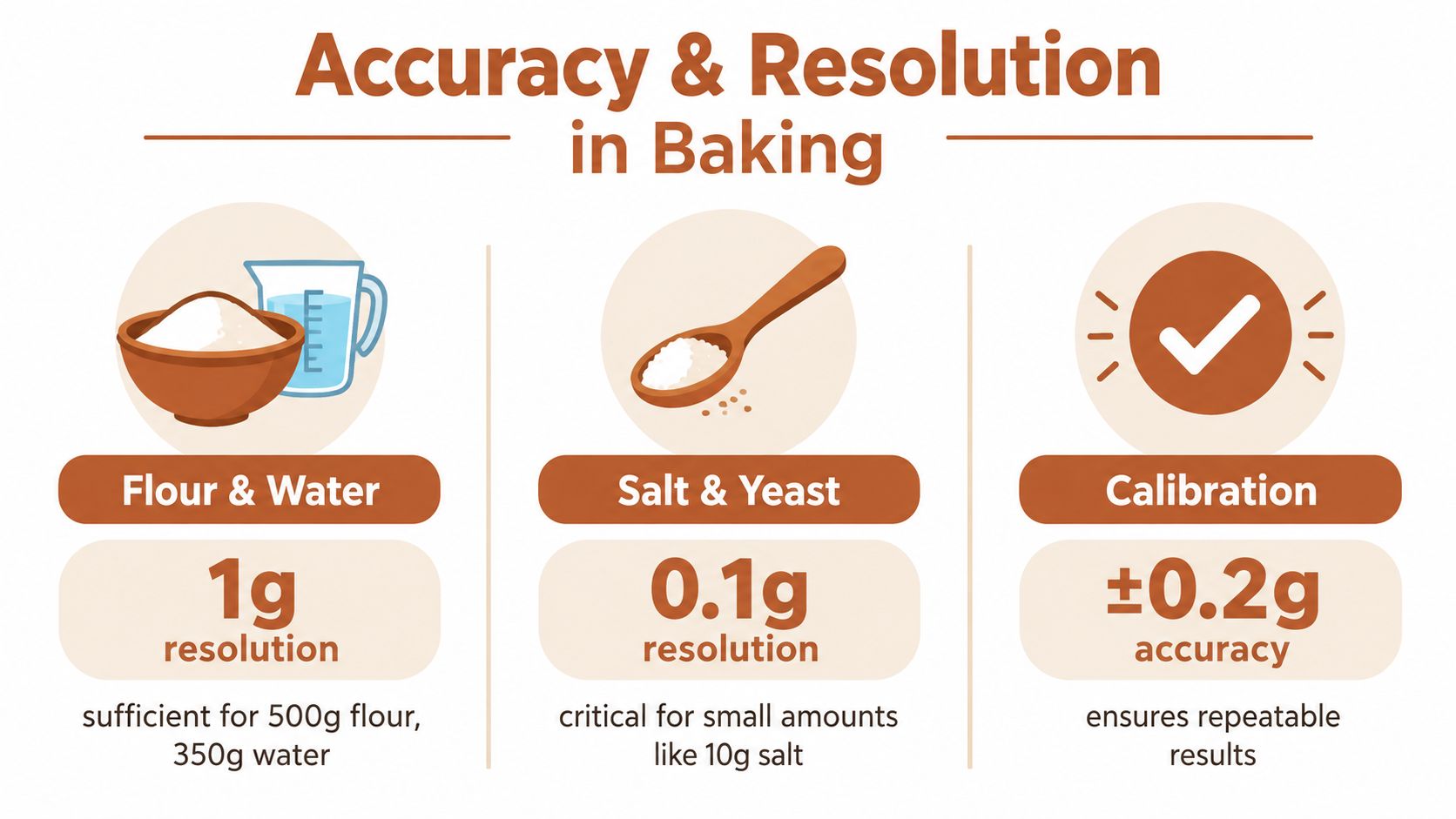
Resolution is the smallest increment shown on the display. A scale with 1-gram resolution can display 100 grams, 101 grams, and 102 grams, but those readings may still differ from the true weight. Accuracy describes how close the displayed result is to that true weight.
For flour and water, 1-gram resolution generally covers everyday bread, cakes, cookies, and muffins. Fractions of a gram become more useful for small amounts of yeast, salt, spices, or fermentation additives. They can also help with small doughs. Extra decimal places do not improve a formula if the reading keeps drifting or changes when the bench vibrates.
Capacity and tare determine whether it fits your workflow
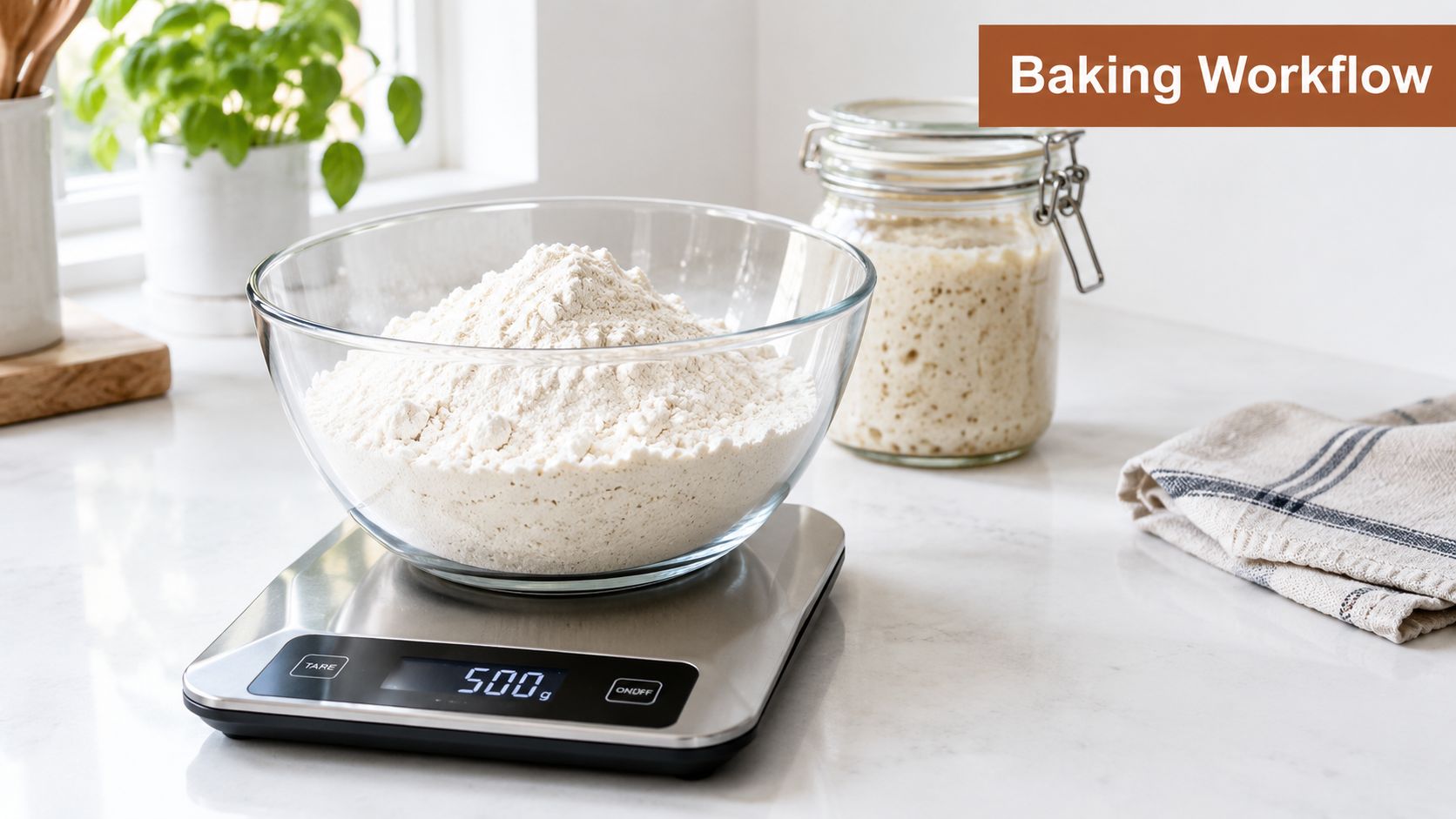
Capacity includes the bowl or container and everything added to it. A scale may handle an empty mixing bowl yet have little headroom once flour, water, and dough accumulate. A heavy glass jar for sourdough starter can use much of that capacity before ingredients enter the container.
Tare should reset quickly and consistently. A hesitant tare slows one-bowl mixing, and a flexible platform can shift the reading when you press the control. Multi-tare functions or baker's percentage calculations can help, but only when the buttons remain easy to use with flour-covered hands.
Platform shape matters more than decorative features
Choose a flat, wipeable platform with room for your mixing bowl. A raised display or pull-out screen keeps the numbers visible when a wide bowl blocks the front panel. Backlighting helps in a dim kitchen, but it cannot fix cramped bowl clearance, unstable feet, or a scale that struggles under load.
Even professional labs isolate balances from vibration with dedicated surfaces. The same principle applies at home: lab weighing table materials explain why stable support matters when a small reading affects yeast or salt. Set the scale on a firm, level counter, away from vibrating appliances. A scale that reads accurately on paper still needs enough bowl clearance, capacity headroom, and low-dose precision to work smoothly through a real bread mix.
Top Bakers Scales Compared by Accuracy and Features
The most useful comparison is not “which scale has the most precision?” It's “which one can weigh a real dough without forcing you to move the bowl, guess at the display, or exceed the load?”
| Scale Model | Resolution | Accuracy at 1kg | Capacity | Key Workflow Feature |
|---|---|---|---|---|
| Escali Primo | 1 g / 0.05 oz | 2 g off in testing | 5,000 g | Raised platform and simple tare controls |
| OHAUS Scout SPX222 | 1 g | Not specified in the verified test data | 600 g | Compact precision format |
| Myweigh iBalance i201 | 0.1 g | Not specified in the verified test data | 2,000 g | Sub-gram resolution for small ingredients |
| Basic 1-gram kitchen scale | 1 g | Test before relying on it | Varies | Low-cost entry point |
| Large-capacity baker scale | 1 g | Test at low, mid, and high loads | Varies | Bowl clearance and batch headroom |
Independent testing shows why the accuracy column deserves attention. Wirecutter reported that the Escali Primo reads in 1-gram increments and was only 1 gram off at 500 grams and 2 grams off at 1 kilogram in lab-weight testing. The Wirecutter review also notes that weaker scales can drift by around 20 grams, while Which? found that top models are usually only 1–2 grams off at 1 kilogram.
Best everyday fit: Escali Primo gives most home bread bakers the combination that matters, 1-gram resolution, generous capacity, and a platform that works with a mixing bowl.
The Escali isn't the right choice for every bench. Its 1-gram increments won't give you the low-dose control of a precision scale, and a large bowl can still make any compact display less convenient than a separated or raised readout.
Best small-ingredient option: Myweigh iBalance i201 is the more logical direction when yeast, salt, or other tiny ingredients are central to your process.
The OHAUS Scout SPX222 appears in precision-oriented recommendations because its 1-gram resolution and 600-gram capacity suit smaller ingredient work, not large dough bowls. A basic 1-gram scale can serve a beginner well, but test it with known weights and pay attention to battery condition. A larger-capacity baker scale is a better practical choice for sourdough jars, Pullman pans, and multi-loaf preparation if its display remains visible under the bowl.
Connectivity and bowl integration should be treated as workflow features, not automatic quality signals. Bluetooth, a removable bowl, or a recipe app can be useful, but none replaces a stable reading and responsive tare.
Accuracy Resolution and Calibration in Real Baking
A scale can display a number without measuring it faithfully. America's Test Kitchen found that 1-gram-resolution scales don't reliably detect a single-gram difference and considered ±3 grams acceptable for most cooking. In bread dough, that tolerance is usually minor beside several hundred grams of flour and water, but it can still shift hydration slightly when a formula is tightly balanced. Its precision-scale review also reported a model measuring accurately within 0.02 grams, showing what specialized equipment can deliver without making that level of control necessary for every baker. The America's Test Kitchen scale reviews distinguish practical bench accuracy from precision work.
For ordinary dough, 1-gram resolution is generally the sensible baseline. It becomes less satisfying when you measure a small dose of yeast or salt, where one gram represents a much larger share of the ingredient. A compact precision scale can handle those additions beside a standard baker's scale, while the larger scale remains responsible for the bowl and dough.
Check calibration before blaming the formula
Start with the nickel check. According to King Arthur Baking, one U.S. nickel should read 5 grams, and six should read about 30 grams. The calibration guidance provides a quick check when a scale arrives and whenever readings seem suspicious.
Test more than one point. A scale may behave correctly with a small object yet drift beneath a full bowl, or read well at a high load while missing a small addition. Weigh a known object near the low end, around the middle of your usual ingredient range, and close to the load used for a finished dough.
Battery condition can affect settling and consistency. Replace the batteries when the display fades, the scale shuts down unexpectedly, or repeated weighings disagree.
A practical calibration routine is simple:
- Clear the platform: Confirm that nothing touches the scale or surrounding counter.
- Check a known weight: Use a nickel or another verified object.
- Repeat the reading: Remove and replace the object instead of trusting one display.
- Test with your bowl: Tare the empty bowl, then add a known ingredient quantity.
- Replace tired batteries: Rule out weak power before diagnosing sensor failure.
For a closer comparison of lower-resolution tolerances and small-ingredient work, review high-precision kitchen scales. Choose 1-gram resolution for ordinary dough, and sub-gram precision when yeast, salt, or other tiny quantities repeatedly vary your results.
Choosing a Scale for Your Baking Workflow
The scale that feels perfect for cookies can be awkward for sourdough. A starter jar, a large mixing bowl, and a Pullman loaf formula all expose weaknesses that stay hidden when you're weighing a small portion of butter.
Sourdough needs headroom and visibility
Starter maintenance is easier when the jar can stay on the platform while you discard and feed. You need enough capacity for the container plus the new flour and water, and you need a display that remains visible behind or beneath the jar. A narrow platform forces awkward balancing, while a low display disappears as soon as you use a broad bowl.
Large-batch bakers should think in terms of capacity headroom, not the weight of a single ingredient. A scale that technically supports the dough may become frustrating when the bowl, scraper, and additional ingredients push it close to its limit. Flat stainless or sealed platforms also clean more easily after flour and sticky dough reach the controls.
Workflow test: Put your heaviest empty bowl on the scale before buying. If the display disappears or the tare button is difficult to reach, the specification sheet hasn't told you enough.
Pullman and multi-loaf work rewards a stable platform
For sandwich bread and larger batches, a scale needs to stay steady while ingredients are poured. A platform that shifts under pressure makes the final grams harder to trust, particularly when you're adding water quickly. A raised display, side controls, or a remote readout can be more useful than a decorative glass top.
Watch the following demonstration after you've assessed the physical layout of your own counter:
A baker who makes one loaf at a time may prefer a compact scale that stores easily. Someone maintaining several starters or preparing multiple loaves needs a wider platform and greater capacity. The home bakery equipment guide is a useful reminder that the scale should fit the rest of the production setup, rather than being evaluated in isolation.
Precision pastry has different priorities
Chocolate, small preferments, and tiny additions benefit from finer resolution and a display that settles quickly. That doesn't make a sub-gram scale the best choice for every baker. Many precision models have smaller platforms and lower capacity, so they can become a second tool rather than an all-purpose replacement.
Choose around the work you do most often. If your bench is dominated by sourdough, bowl clearance and capacity come first. If you routinely adjust small yeast or salt quantities, keep a precision option available.
Price Durability and Long Term Value
A low-cost scale can serve well when it holds its reading, responds quickly, and tolerates flour, water, and repeated tare cycles. The bargain becomes costly when readings drift, debris gathers around the controls, or the platform cannot handle the bowls used for full dough batches.
Paying for laboratory-style precision rarely improves ordinary bread mixing. Spend more for a better-built platform, low-dose resolution for yeast or salt, clearer visibility, or controls that remain usable with flour-covered hands. Decimal places alone do not justify the price.
Where additional spending pays off
A higher-priced model may provide a wider, more rigid platform, stronger buttons, a clearer display, better protection around the controls, and more dependable support if troubleshooting or replacement becomes necessary. Baker's percentage calculations, connectivity, or a separated display can also reduce bench friction when they fit your routine.
Those features cannot compensate for inadequate bowl clearance or capacity. Measure the bowl and estimate the full ingredient load before paying for extras. Capacity headroom often matters more than a longer feature list.
Ownership details decide longevity
Clean the platform after each session, and do not let wet dough sit around the controls. Store the scale where heavy equipment will not press on the load cell. Remove the batteries during extended storage if the manufacturer permits it.
Before purchasing, check:
- Construction: Look for a rigid platform, stable feet, and controls that do not flex the reading.
- Cleaning: Prefer a sealed interface and a surface you can wipe without forcing flour into seams.
- Power: Confirm that batteries are easy to replace and that the scale warns you before power becomes unreliable.
- Support: Read the warranty terms and learn how calibration or replacement is handled.
- Capacity: Leave room for the bowl, ingredients, and an occasional larger batch.
Long-term value comes from reliable repetition at the bench. A simple 1-gram model that stays stable, leaves room for the bowl, and reads small additions consistently can serve a home baker better than an expensive precision device that is too small for the main workflow. For bakers who regularly measure tiny yeast or salt additions, a separate fine-resolution scale may earn its place, while the primary scale handles dough.
Final Recommendations for Home and Pro Bakers
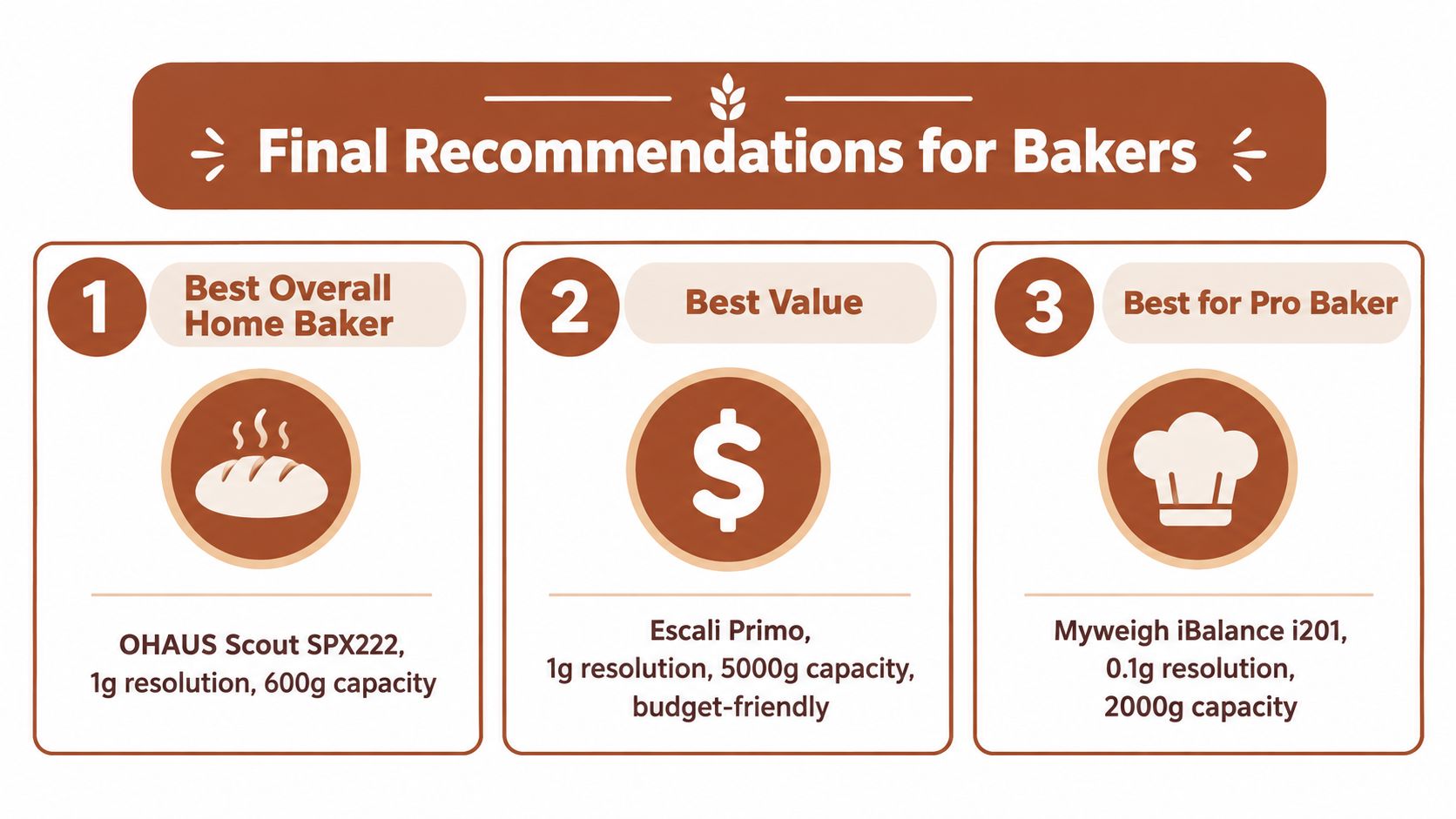
Best overall for most home bread bakers: choose the Escali Primo. Its 1-gram resolution, 5,000-gram capacity, raised platform, and straightforward tare controls cover ordinary dough, sourdough, and larger home batches. It isn't the pick for sub-gram ingredient work.
Best compact precision choice: choose the OHAUS Scout SPX222 when small-batch weighing and a compact footprint matter more than bowl capacity. Its 1-gram resolution and 600-gram capacity make it unsuitable for heavy mixing bowls and large doughs.
Best precision pick: choose the Myweigh iBalance i201 when you regularly weigh small amounts of yeast, salt, or specialty ingredients. Its 0.1-gram resolution is useful for that job, but its 2,000-gram capacity may not suit a large bowl workflow.
Best value approach: start with a dependable basic 1-gram scale if you're new to weighing. Test it with a nickel, repeat readings at different loads, and upgrade only when capacity, display clearance, or small-ingredient accuracy becomes a daily limitation.
Before you buy, measure your heaviest bowl, check whether the display stays visible, confirm the capacity leaves room for a full dough, and decide whether 1-gram resolution covers your recipes. On arrival, run the nickel test, repeat a known-weight reading, then weigh one familiar dough and compare the result with your formula.
DBakerAid™ combines a built-in professional digital scale with a bread-making system that controls fermentation and proofing, so you can weigh ingredients and manage the difficult parts of dough preparation in one workflow. Visit DBakerAid™ to explore the system, its recipe app, and equipment designed for repeatable home bread results.