

You've got two cold dough blocks on the counter. One feels softly alive, perhaps a little domed after fermentation. The other lies flat and firm, waiting for the oven rather than another rise. Both contain dough and butter folded into layers, yet they won't behave the same way under a rolling pin or in the heat.
The dividing line in croissant dough vs puff pastry is yeast. Croissant dough ferments, proofs, and develops a bread-like interior. Puff pastry is unleavened, so it depends on steam and butter layers for lift. That single difference changes the ingredients, handling, fold count, baking schedule, texture, and the recipes each dough suits. A useful technical reference is this guide to laminated dough fundamentals.
Table of Contents
- Two Doughs on the Counter
- Ingredients and Hydration Compared
- How Lamination Works in Each Dough
- Texture, Flavor, and Crumb
- Best Uses for Croissant Dough and Puff Pastry
- Troubleshooting Common Lamination Problems
- Choosing the Right Dough for Your Bake
- Croissant Dough vs Puff Pastry FAQ
Two Doughs on the Counter
Start with the dough that looks slightly more active. Croissant dough is a yeasted laminated dough, usually enriched with ingredients such as sugar, milk, and butter. The yeast continues working while the dough rests between rolling stages, then receives a final proof after shaping. In the oven, fermentation and steam work together, giving the pastry a risen, honeycombed interior rather than a purely flaky shell.
The second block is puff pastry. It contains laminated dough and butter, but it typically has no yeast or chemical leaveners. It doesn't ferment, and shaped puff pastry doesn't need a final proof. Its lift comes from water turning into steam in the hot oven, forcing apart the alternating sheets of dough and fat. This distinction is also explained in a comparison of puff pastry and yeast-raised pastry.
| Feature | Croissant dough | Puff pastry |
|---|---|---|
| Leavening | Yeast plus steam | Steam only |
| Fermentation | Yes | No |
| Final proof | Required | Not required |
| Interior | Bread-like, soft, honeycombed | Flaky, crisp, layered |
| Lamination | Fewer layers, with yeast active during rests | More layers, with no fermentation |
| Typical role | Viennoiserie and enriched breakfast pastries | Crisp pastry shells, turns, and layered desserts |
That fork affects the whole workflow. Croissant dough must be protected from excessive warmth because fermentation and butter plasticity need to stay in balance. Puff pastry is still temperature-sensitive, but the baker is managing butter and dough layers without also managing active yeast.
The difference isn't a matter of one pastry being superior. A croissant should have enough structure to support a soft, irregular crumb. A mille-feuille or palmier needs a crisp, breakable layer system. Choosing the wrong dough can produce a technically sound bake that still feels wrong for the recipe.
Ingredients and Hydration Compared
Croissant dough begins as an enriched bread dough. Flour provides the gluten network, while water or milk hydrates it. Yeast creates fermentation, sugar supports browning and sweetness, salt seasons the dough, and butter contributes tenderness and flavor. Some butter can be mixed into the dough, then a separate butter block is enclosed for lamination.
The available formulation data places croissant dough at roughly 50 to 60% hydration, with about 24 to 28% butter in the dough, depending on the formula. Puff pastry is described at about 100% hydration and around 38% butter in the cited formulation reference, though the exact calculation depends on how the baker defines the dough and fat components. These figures are best used as a structural comparison, not as a universal home recipe.
Puff pastry has a leaner ingredient identity. Flour and water form the dough, with salt for seasoning and sometimes a small amount of acid for handling. The butter is concentrated in the lamination block rather than balanced with yeast, sugar, and dairy enrichment. That simpler base leaves the baked pastry crisp and neutral, allowing fillings, fruit, cream, or savory ingredients to take the lead.
| Component | Croissant dough | Puff pastry |
|---|---|---|
| Flour | Usually bread flour or another flour with enough strength for fermentation and lamination | Bread or pastry flour can be used, depending on the desired strength |
| Water | About 50 to 60% hydration in the cited croissant formulation range (laminated dough formulas) | About 100% hydration in the cited puff pastry formulation reference (laminated dough formulas) |
| Yeast | Present | Typically absent |
| Sugar and dairy | Common in enriched croissant dough | Usually absent from the basic dough |
| Butter | Around 24 to 28% in the croissant dough, plus a separate lamination block (laminated dough formulas) | Around 38% in the cited puff pastry comparison (laminated dough formulas) |
| Main source of lift | Yeast fermentation and steam | Steam from water in the dough and butter |
The practical lesson is simple. More butter doesn't automatically create a better laminated pastry. Higher fat can support flakiness, but yeast, sugar, dairy, hydration, and proofing reshape the crumb and tenderness. That's why two pastries with visible layers can deliver completely different bites.
How Lamination Works in Each Dough
Lamination creates alternating layers of dough and fat. The baker rolls the dough, encloses a butter block, and folds the package so the butter becomes distributed through the dough. The key difference is what happens between those folds.
Croissant dough commonly uses a lock-in followed by three single folds, producing about 27 layers in one formulation reference. The yeast remains active during the rests, so the dough is both a laminated sheet and a fermenting bread dough. The baker must keep it cool enough to prevent butter from melting, while allowing enough time for the dough to relax and ferment.
Puff pastry can use more folds because there's no yeast to disturb or expand during the process. The same technical reference lists full puff pastry at about 729 layers after six single folds, while another laminating reference gives a real-world range of 81 to 729 layers, depending on fold style. More layers can create a finer, more explosive flake, provided the butter remains in distinct sheets.
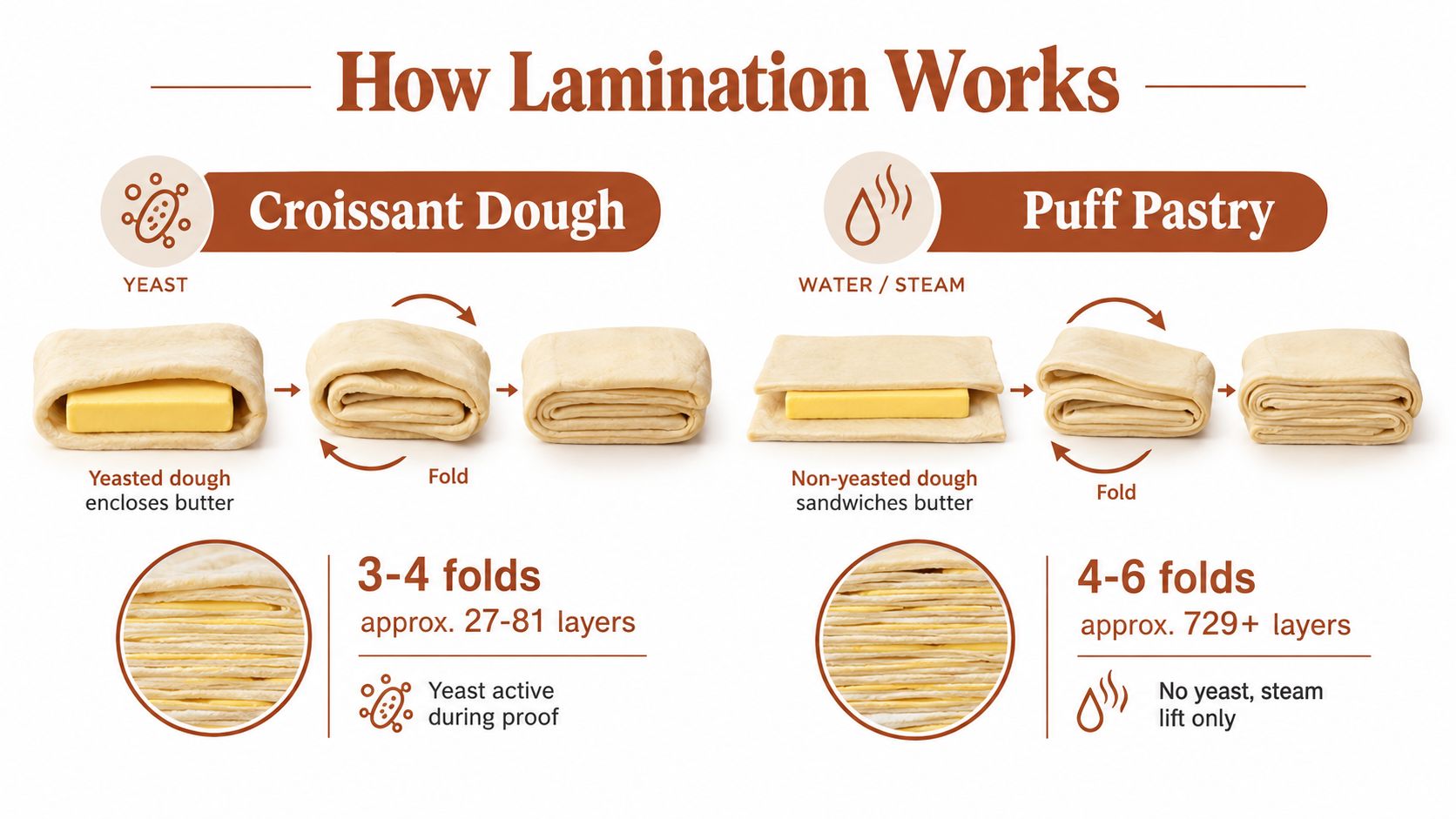
Croissant lamination
A croissant dough block has to be rolled gently. Too much pressure can compress the developing gas and smear the butter into the dough. The rests between folds let the gluten relax and give the yeast time to work, but the dough can't become so warm that the butter turns greasy.
After shaping, croissants need a final proof. That proof is what helps the shaped dough expand before the oven sets the layers and crumb. Without it, a croissant may look laminated on the outside but bake heavy and tight inside.
Puff pastry lamination
Puff pastry doesn't need to be proofed after shaping. The baker rolls and cuts it, chills it when necessary, and places it in the oven. Heat turns moisture into steam, and that steam pushes against the butter-separated layers.
For a visual walkthrough, this guide to laminating croissant dough shows why dough temperature and fold control matter. The process can look similar on the counter, but the biological activity inside croissant dough makes it less tolerant of aggressive handling.
Puff pastry's greater layer count doesn't mean every puff pastry is automatically lighter. If the butter melts during rolling, layers fuse. If the dough is overworked, the gluten can resist expansion. Layer quantity matters, but layer separation and oven heat matter just as much.
Texture, Flavor, and Crumb
Pick up a baked croissant and it should feel light for its size, but not hollow. The crust is browned and delicate, while the inside has a soft, elastic quality. Yeast fermentation gives the crumb a bread-like character, and the dough's enrichment rounds out the butter rather than leaving the pastry tasting only of fat.
The interior isn't supposed to resemble a uniform slice of sandwich bread. Well-laminated croissant dough develops irregular cells and thin internal walls. Some areas may open more than others, especially around the center and the curled ends. That unevenness is part of the pastry's structure.
Puff pastry gives you a different experience. The crust can shatter into thin flakes, and the interior is defined by stacked sheets rather than a soft fermented network. The flavor is usually more neutral, with butter carrying the main richness and the filling supplying much of the character.
| Attribute | Croissant dough | Puff pastry |
|---|---|---|
| First bite | Tender, layered, and slightly chewy | Crisp, brittle, and flaky |
| Interior | Soft, irregular, honeycombed | Thin sheets and open gaps |
| Flavor | Fermented, enriched, buttery | Buttery, clean, and neutral |
| Main lift | Yeast plus steam | Steam |
| Best visual cue | Puffy shape with visible honeycomb | Distinct flakes and separated layers |
The difference between bread-like and shatter-crisp comes from more than butter. Croissant dough has yeast-driven expansion and an enriched formula. Puff pastry has no fermentation flavor, so it stays closer to a crisp pastry shell even when it rises dramatically.
Practical rule: If the finished pastry should tear like bread, choose croissant dough. If it should break into flakes, choose puff pastry.
Best Uses for Croissant Dough and Puff Pastry
Croissant dough belongs to the family of enriched viennoiserie. Its fermentation gives shaped pastries enough interior softness to support fillings and toppings without turning into a dry shell.
Good matches include:
- Croissants: The classic crescent shape depends on yeasted lift and a soft, layered crumb.
- Pain au chocolat: Chocolate sits inside a pastry that should remain tender rather than purely brittle.
- Morning buns: Sugar and spice work well with the enriched dough and fermented aroma.
- Danish pastries: Fruit, cream, and nut fillings pair with a dough that has both flake and bread-like body.
- Chocolate babka: Its enriched, yeasted character makes it a closer relative to croissant dough than to classic puff pastry.
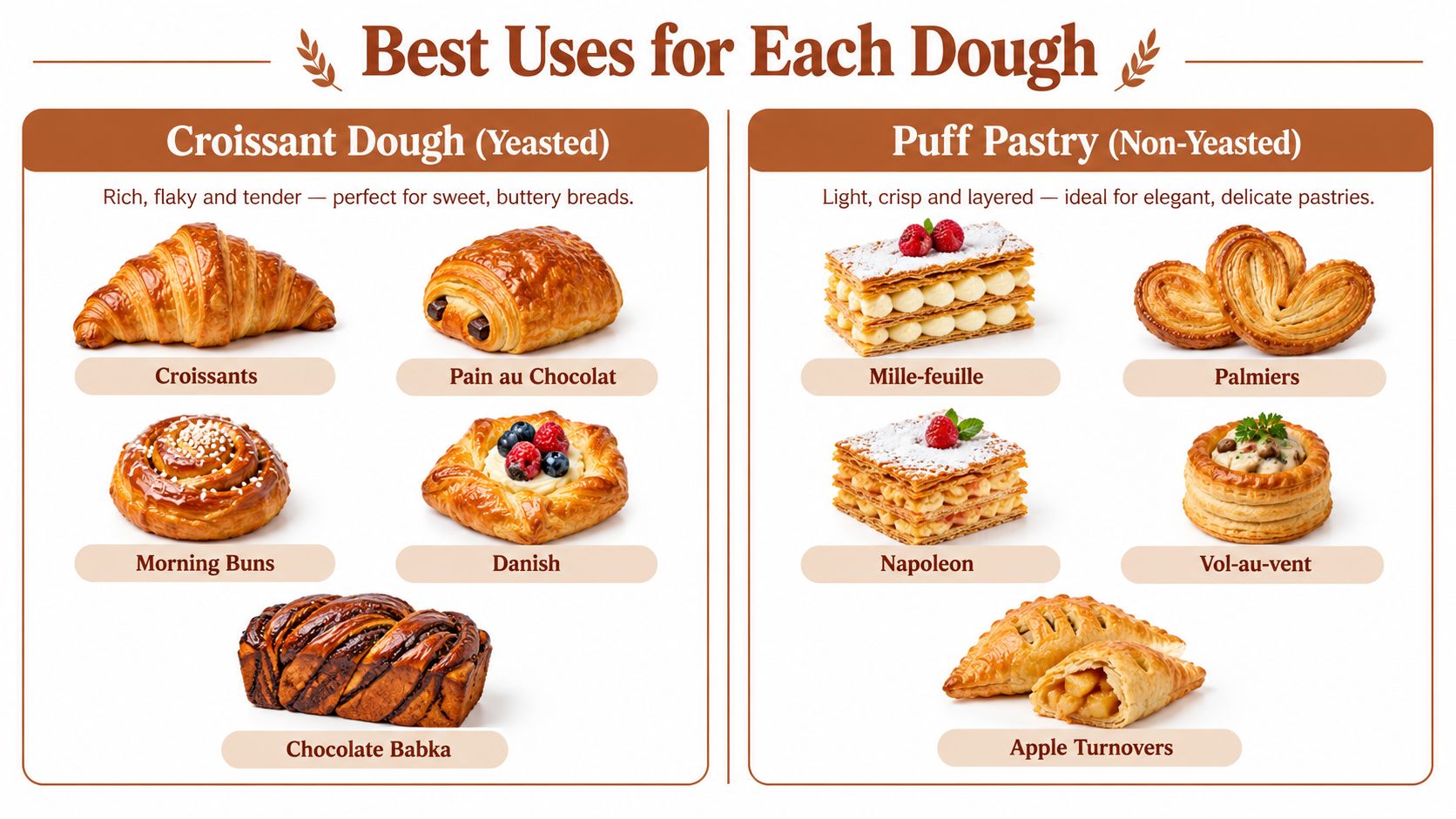
Puff pastry is the better fit when crispness and structural lift are the main goals. Use it for mille-feuille, palmiers, Napoleon pastries, vol-au-vents, beef Wellington pastry wraps, tart shells, and apple turnovers. It can carry sweet or savory fillings while keeping a distinct flaky shell.
Substitution is where many home bakers get caught. Croissant dough in a Wellington can bake too bread-like and chewy, without the clean snap expected from puff pastry. Puff pastry shaped like a croissant may rise, but it won't develop the fermented aroma or soft honeycomb. The result can taste dense, raw, or just unlike the pastry you intended.
Egg wash also changes the finish. Croissants are often brushed for a glossy, richly colored surface, while puff pastry may be left unwashed, lightly washed, or finished according to the recipe. Thickness matters too. Croissant dough needs enough body to shape and proof, while puff pastry is often rolled thin to maximize crisp layers.
Troubleshooting Common Lamination Problems
Lamination failures usually begin before the bake. Butter temperature, dough temperature, rolling pressure, and resting time determine whether the layers stay separate. Croissant dough has an extra variable because yeast continues fermenting while the dough rests.
Butter breaking through
If butter pushes through the dough, the butter is usually too warm or the dough has been rolled too aggressively. Patch the opening with a little flour if necessary, then chill the dough until the butter firms again. This problem can affect both pastries, but active fermentation makes temperature management especially important for croissant dough.
Layers fusing
Fused layers can result from butter that has softened into the dough, but they can also appear when dough and butter are too cold to roll evenly. Let the package become workable before rolling instead of forcing it with heavy pressure. Once the butter has smeared through the dough, the lost separation can't be fully restored.
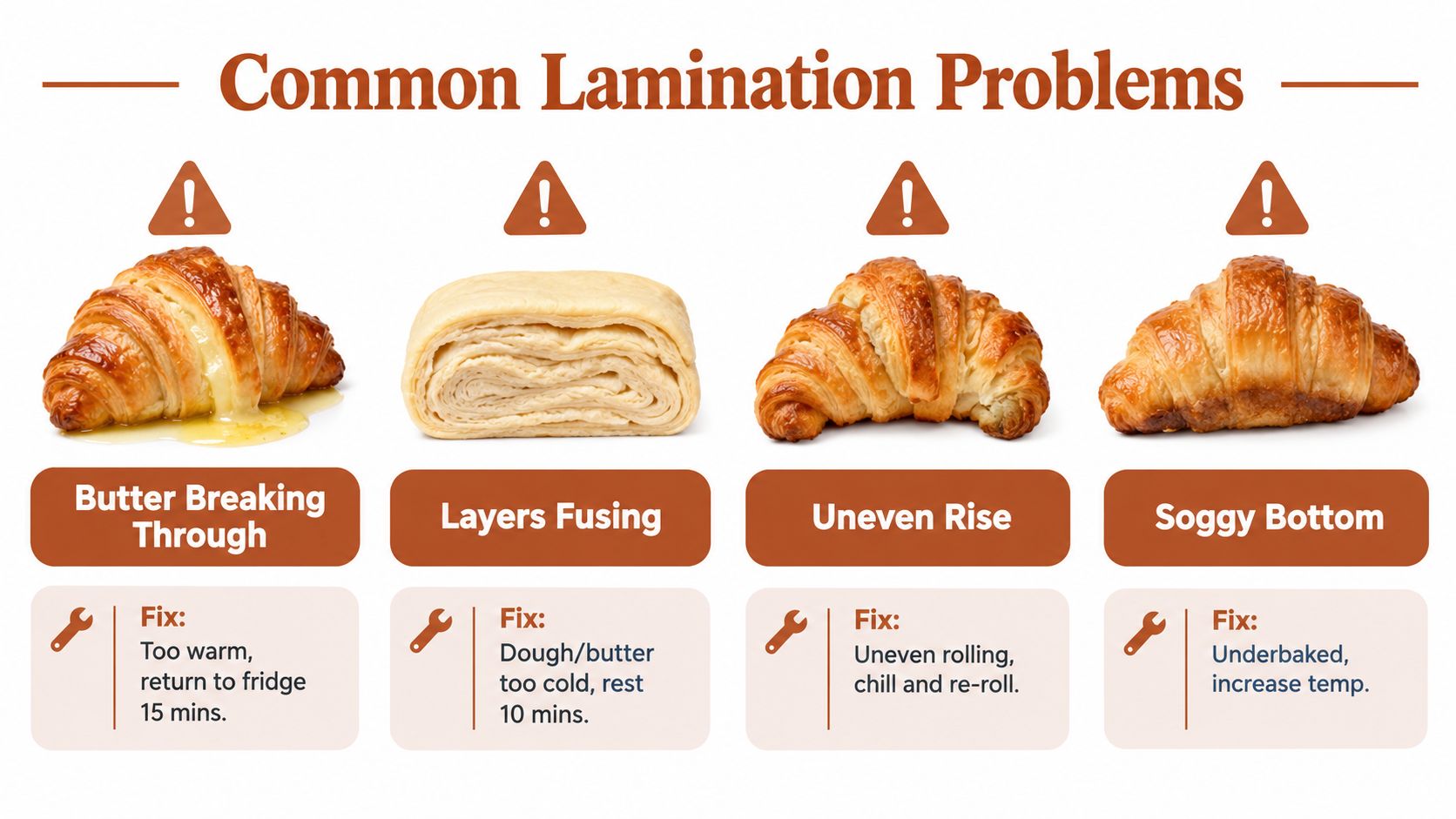
Uneven or shrunken shapes
Gluten that hasn't relaxed can pull the dough back after rolling. Croissant dough may also become uneven when fermentation changes the tension across the sheet. Cover the dough, let it relax, and roll again with even pressure. Measure the rectangle rather than trusting its appearance, especially before cutting triangles or pastry panels.
Gummy interiors
A crisp exterior with a gummy center usually points to insufficient baking or insufficient fermentation in a yeasted pastry. Croissants need enough final proof to expand internally, then enough oven time to set the crumb. Puff pastry doesn't need proofing, but it still needs thorough baking so the inner layers dry and become crisp.
Puff pastry mistakes are often harder to recover from because there's no fermentation stage to provide additional expansion. Croissant dough can sometimes recover from a minor temperature drift if the yeast remains viable and the butter hasn't melted into the layers.
Choosing the Right Dough for Your Bake
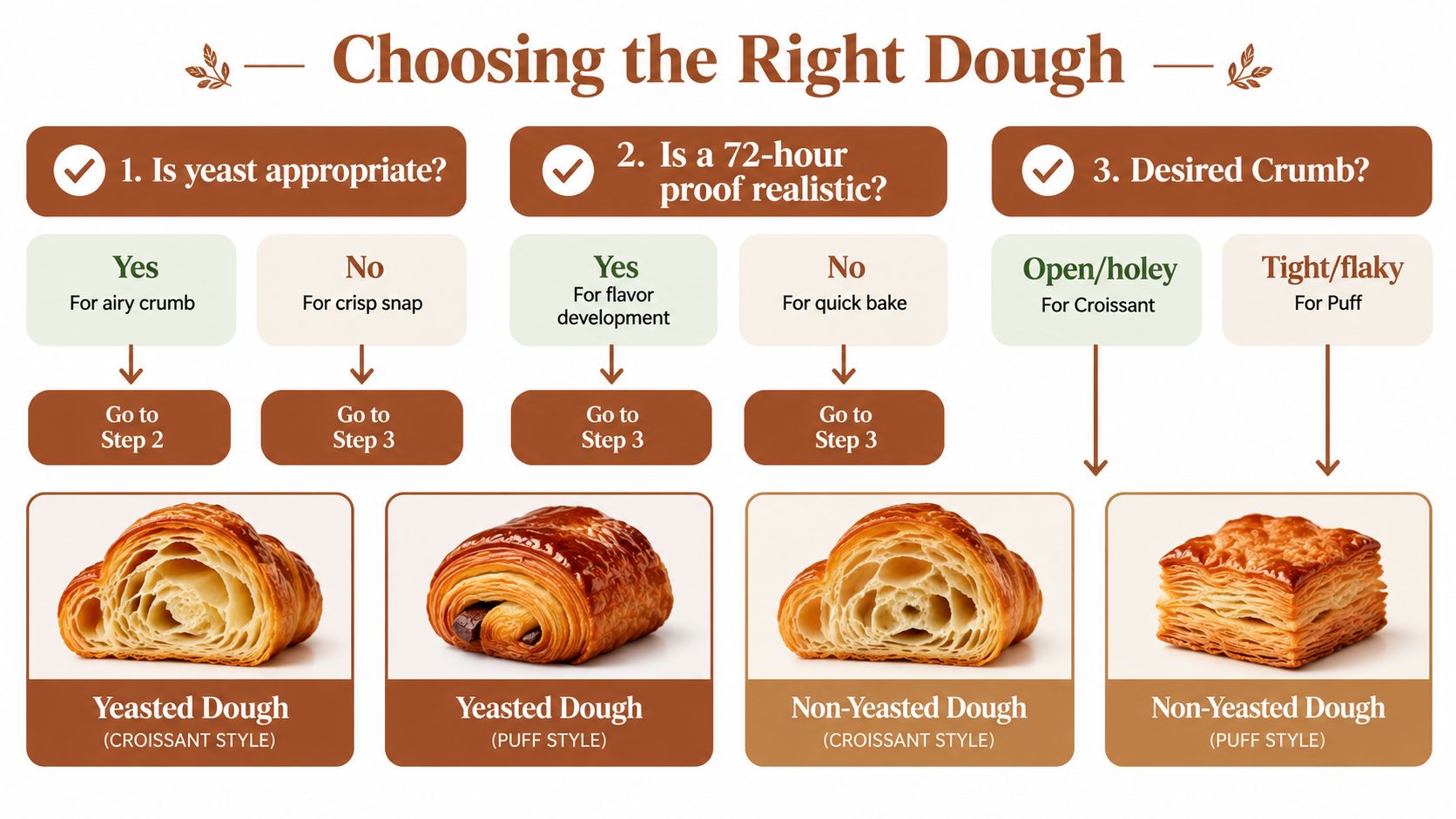
Use three questions at the counter.
- Do you want fermentation? Choose croissant dough for a soft, airy, bread-like interior and a developed yeast aroma. Choose puff pastry when you want crisp layers and a neutral base.
- Does the recipe need proofing? If the shaped pastry must expand before baking, croissant dough is the natural fit. If it should go from shaping to oven with no final rise, puff pastry is more appropriate.
- What should happen when you bite it? A croissant should tear and compress softly. A puff pastry shell should fracture into flakes.
Precision helps with either dough. A digital scale keeps the formula consistent, a thermometer helps you judge dough and butter condition, and a proofing setup makes croissant fermentation easier to control. A home system such as D'BakerAid™ combines fermentation and proofing bowls with a temperature and time control hub, and its companion recipes include guided croissant preparation. You can also follow a traditional workflow with a refrigerator, rolling pin, and careful observation, as shown in this guide to puff pastry from scratch.
For a first project, choose according to your tolerance for timing. Puff pastry removes the proofing stage but still demands neat rolling. Croissant dough adds fermentation and shaping, yet its finished texture makes the extra control worthwhile when the recipe calls for a soft, layered crumb.
Croissant Dough vs Puff Pastry FAQ
Can I substitute one for the other?
Usually not without changing the result. Croissant dough brings yeast and fermentation, while puff pastry relies on steam alone, so the substitution changes both lift and crumb.
Why can puff pastry be rerolled more easily than croissant dough?
Puff pastry has no active yeast to disturb during handling. Croissant dough also contains fermented gas and a developing crumb, so repeated rerolling can compress the structure and damage the intended interior.
Does a stand mixer replace hand lamination?
No. A mixer can develop the base dough, but it can't replace enclosing the butter block, rolling evenly, and preserving separate layers. Lamination still requires direct control of pressure and temperature.
Does store-bought puff pastry behave like homemade puff pastry?
It can bake into a flaky pastry, but performance varies with the formulation, butter or fat content, thickness, and resting instructions. Follow the package guidance rather than assuming it handles exactly like a homemade dough.
Which dough should I choose?
Choose croissant dough for croissants, Danish pastries, pain au chocolat, and other fermented viennoiserie. Choose puff pastry for palmiers, mille-feuille, vol-au-vents, tart shells, and crisp savory wraps.
DBakerAid™ brings controlled fermentation and proofing to doughs that are sensitive to timing and temperature, including croissant dough. Visit DBakerAid™ to explore the system and its guided baking recipes for more repeatable laminated pastries.