

A tray of dark, glossy brownies sits beside a second tray that looks paler and drier. The recipe, oven, and baking time were identical, yet the results aren't. One cocoa powder may have produced a deep color and rounded chocolate flavor, while the other brought sharper acidity and a lighter crumb.
That difference isn't proof that one powder is universally better. Cocoa powder quality is a fit-for-purpose decision involving acidity, fat, moisture, color, flavor, particle size, processing, and storage. The right choice depends on the bake in front of you.
Table of Contents
- What Bakers Mean When They Talk About Cocoa Powder Quality
- How Cocoa Beans Become Powder and Where Quality Is Won
- Natural Versus Alkalized Cocoa and Why the Difference Shows Up in Recipes
- The Four Specifications That Define Quality
- How Cocoa Quality Changes Baking Results and Recipe Behavior
- Sensory Cues and Simple Home Tests for Evaluating Cocoa
- Origin, Terroir, Certifications, and Heavy-Metal Considerations
- Buying and Storing Cocoa Powder the Smart Way
What Bakers Mean When They Talk About Cocoa Powder Quality
A baker evaluating cocoa powder should begin with the recipe, not the front of the packet. Ask four questions:
- What does the recipe need chemically? A formula using baking soda may depend on the acidity of natural cocoa. A recipe built around baking powder may give you more freedom to choose an alkalized powder.
- What color and flavor should the bake have? Natural cocoa can bring a brighter, more assertive chocolate note. Dutched cocoa is often selected for a darker appearance and a smoother, less acidic profile.
- Does the label identify the processing type? “Natural,” “Dutch processed,” and “alkalized” describe meaningful differences in pH and chemical composition.
- How will the powder behave during storage? Moisture can encourage clumping, interfere with flow, and shorten stability. The Codex standard for cocoa powders sets a maximum moisture content of 7% by mass, measured with validated Karl Fischer methods.
Color is useful, but it isn't a complete quality test. A very dark powder may have undergone stronger alkalization, which can reduce acidity and alter its flavanol profile. Two powders can look similarly intense in the bag while behaving differently in a cake, brownie, beverage, or chocolate filling.
Fat content also matters. Cocoa powder retains some cocoa butter after pressing, and that residual fat affects richness, tenderness, dispersion, and mouthfeel. A low-fat powder may absorb liquid differently from a powder with more cocoa butter, so the same spoonful can produce a different batter.
Practical rule: Choose cocoa for the chemistry and texture your recipe needs, then use color and aroma to refine the choice.
For home bakers, quality means repeatability. A powder that produces the same color, acidity, aroma, and hydration behavior from one bake to the next is often more useful than a prestigious powder that behaves unpredictably. For professional kitchens, the relevant evidence sits on the specification sheet, in the certificate of analysis, and in a controlled test bake.
How Cocoa Beans Become Powder and Where Quality Is Won
Cocoa powder starts as a seed surrounded by sweet pulp inside a pod. Farmers crack the pods, remove the wet beans, and begin fermentation. During that stage, the beans develop flavor precursors that roasting later turns into recognizable cocoa aromas.
Drying follows fermentation. Producers use sun drying or raised platforms to reduce moisture before the beans travel to a processor. Inadequate drying can leave unwanted flavors and storage problems, while excessive heat or poor handling can damage the raw material before roasting even begins.
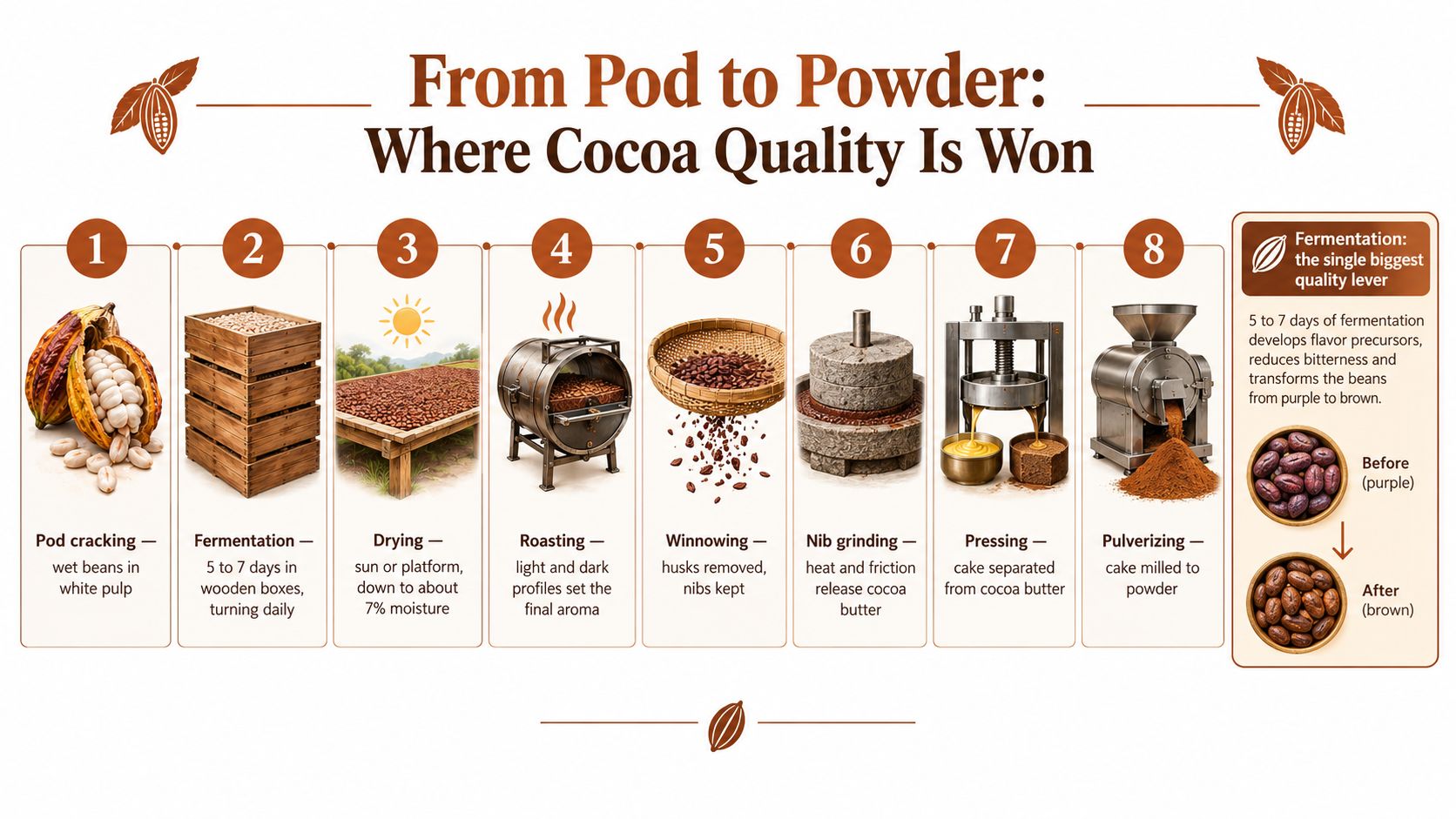
The factory stages that shape the baker's result
- Roasting develops aroma. The processor chooses a roast profile that brings out the fermented flavor precursors. An underdeveloped roast can taste flat, while an overly aggressive roast can produce harsh or burnt notes.
- Winnowing removes the husks. The remaining cocoa nibs contain the part of the bean that will become cocoa mass and, later, powder.
- Grinding releases cocoa butter. Friction and heat turn the nibs into a fluid cocoa mass.
- Pressing separates fat from solids. Hydraulic pressing removes part of the cocoa butter and leaves a firm cocoa cake. The amount of fat left in the cake affects how the final powder feels and performs.
- Alkalization may change the powder further. The processor can treat the cocoa cake with an alkaline substance to reduce acidity, deepen color, and modify flavor. That decision belongs to the next stage of the baker's evaluation.
- Milling creates the finished powder. The pressed cake is pulverized, sieved, and packed.
Most important quality decisions happen before the product reaches the kitchen. Fermentation, drying, roasting, pressing, and milling all leave signals in the final aroma, color, particle behavior, and taste. That's why a named origin, reliable processor, lot documentation, and suitable packaging can tell you more than a vague front-label phrase such as “premium.”
Natural Versus Alkalized Cocoa and Why the Difference Shows Up in Recipes
Natural cocoa retains its acidic character. Verified research places its extractable pH around 5.3 to 5.8, while alkalized powders are classified as lightly treated at 6.50 to 7.20, medium-treated at 7.21 to 7.60, and heavily treated at 7.61 or higher in the cited study (peer-reviewed alkalization research).
That pH difference changes more than color. Natural cocoa can supply acidity for a recipe using sodium bicarbonate. Alkalized cocoa is closer to neutral or alkaline, so it contributes less acid to that reaction. If you replace one with the other without checking the leavening system, the finished cake may rise differently, taste different, or show a different crumb.
| Trait | Natural | Light Dutched | Medium Dutched | Heavy Dutched |
|---|---|---|---|---|
| Extractable pH | About 5.3 to 5.8 | About 6.50 to 7.20 | About 7.21 to 7.60 | 7.61 or higher |
| Acidity | Clearly acidic | Reduced | Further reduced | Low acidity |
| Color | Often lighter or more reddish brown | Darker than natural | Deep brown | Very dark |
| Flavor | Brighter and sharper | Smoother | Rounder and milder | Strongly mellowed |
| Baking soda contribution | Can provide acid | Limited | Limited | Very limited |
Alkalization also changes the bioactive composition. One comparison reported average total flavanol levels falling from 34.6 ± 6.8 mg/g in natural cocoa to 13.8 ± 7.3 mg/g after light alkalization, 7.8 ± 4.0 mg/g after medium treatment, and 3.9 ± 1.8 mg/g after heavy treatment (ACS research on flavanols and cocoa alkalization). Another study reported an average 60% loss of total flavonoids, with average declines of 67% for epicatechin and 38% for catechin after alkalinization (ACS research on cocoa processing and flavonoids).
That doesn't make alkalized cocoa a poor ingredient. It may give a smoother, darker result and can disperse well in beverages or certain desserts. Natural cocoa is usually the more logical choice when the formula relies on baking soda and when you want a sharper chocolate note. For broader chocolate-handling guidance, the guide to choosing chocolate for tempering offers useful context about how processing affects confectionery work.
The Four Specifications That Define Quality
A cocoa powder specification sheet should help you choose the right ingredient for a recipe. The useful details are fat, particle size, moisture, and color. None ranks a powder by itself. Each describes a different behavior in the bowl.
Fat content shows how much cocoa butter remains after pressing. Higher-fat powder can give a butter cake a fuller mouthfeel and softer impression. Lower-fat powder may feel leaner and take up liquid more aggressively, which matters when adjusting a batter, frosting, or hot drink. Compare the supplier's declared cocoa-butter level rather than relying on labels such as “rich.”
Particle size controls how readily cocoa disperses. Fine, evenly milled particles mix into liquid more smoothly. Coarser or uneven particles can leave specks, hydrate slowly, or settle at the bottom of a drink. A sieve result on the specification sheet gives more useful information than the word “fine” on the front of a package. For home use, rub a little powder through a sieve, then whisk it into warm liquid and check for stubborn grains.
Moisture is both a storage and handling concern. The Codex cocoa powder standard provides an acceptance limit and recognizes Karl Fischer methods, including AOAC 977.04 and IOCCC 26, for measurement. On a certificate of analysis, check the reported value, test method, and lot number. Excess moisture can encourage caking, reduce free-flowing behavior, increase deterioration risk, and change dispersion in a batter.
Color helps predict appearance, but it cannot grade the powder alone. Strong alkalization may produce a deep brown or nearly black cocoa while also changing acidity and phenolic composition. A dramatic color can therefore signal a processing choice, not superior flavor. Read the color result beside pH and the stated alkalization level.
| Specification | What to check | Baking implication |
|---|---|---|
| Fat | Declared cocoa-butter level | Richness, tenderness, and hydration |
| Particle size | Sieve result and milling consistency | Suspension, mixing, and mouthfeel |
| Moisture | Test result, method, and lot | Flow, storage, and consistency |
| Color | Repeatable batch reading | Appearance, interpreted with pH |
A useful certificate of analysis may also list pH, microbiological results, cocoa-butter content, and moisture. Keep a reference sample from each lot if you bake commercially or change formulas often. That record helps separate a recipe problem from a new powder's behavior.
How Cocoa Quality Changes Baking Results and Recipe Behavior
The most common cocoa substitution mistake is treating color as a substitute for chemical compatibility. Natural cocoa has an extractable pH around 5.3 to 5.8, while alkalized cocoa moves into higher pH categories as treatment intensifies. That shift affects the amount of acid available to react with baking soda.
A recipe with natural cocoa and baking soda may depend on that relationship for lift. Replace the natural powder with a heavily alkalized one, and you may remove part of the expected acid without adding an equivalent source elsewhere. The result can be a tighter crumb, less rise, or a different browning pattern.
Recipes based on baking powder are often more flexible because baking powder supplies its own acid system. Even then, the cocoa can alter taste, color, hydration, and the balance of the finished formula.
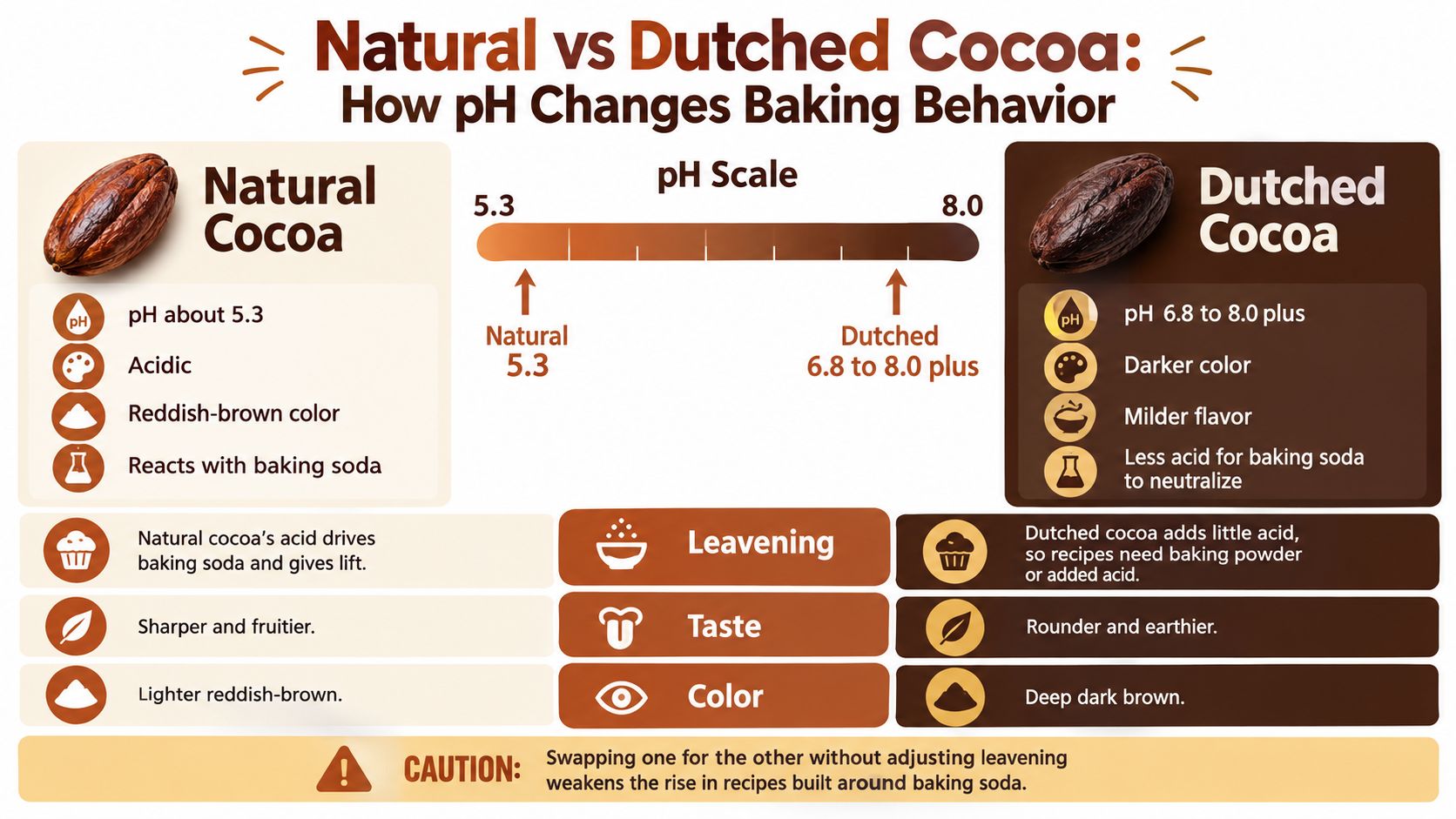
A safer substitution method
When a recipe specifies natural cocoa, use natural cocoa unless you understand its leavening system. When it specifies Dutch processed cocoa, follow that choice, especially in a cake where the darker color and milder acidity are part of the intended result.
If you need to substitute, don't make several changes at once. First identify the leavener, then check whether the formula includes acidic ingredients such as buttermilk, yogurt, molasses, or fruit. A small test batch is safer than changing the entire recipe.
Avoid treating a fixed substitution ratio as universal. The right adjustment depends on the cocoa's actual pH, the recipe's other acids, the amount of cocoa, and the strength of the leavening system. A kitchen scale can help you reproduce the test accurately, and this precision kitchen scale guide explains why weight-based measurement improves repeatability.
Higher-fat cocoa can contribute more roundness and tenderness, while lower-fat powder may tighten a batter if you don't account for its absorption. That behavior isn't automatically good or bad. It just means the powder belongs to the formula, not just the flavoring category.
Sensory Cues and Simple Home Tests for Evaluating Cocoa
A good cocoa powder should give you useful sensory information before you bake with it. Open the packet and smell it. You're looking for a clean roasted cocoa aroma, not stale fat, cardboard, smoke, or a flat absence of fragrance.
Taste a small amount only if you're comfortable doing so, and let it dissolve on your tongue rather than judging it from the first instant. Natural cocoa may show sharper acidity and fruitiness. Alkalized cocoa usually presents a rounder, less acidic profile, although the exact character depends on the beans and processing.
A simple comparison on the bench
Place small samples of two powders on separate pieces of parchment and warm them gently for a short period. Compare the aroma as the cocoa opens. One may smell more roasted, another more fruity, and a third may seem muted. This isn't a laboratory roast test, but it can reveal obvious differences between brands.
You can also compare how each powder disperses. Stir equal spoonfuls into warm water, then watch for floating clumps, stubborn dry pockets, or rapid suspension. The test doesn't replace a specification sheet, but it helps you spot a powder that may require more mixing or pre-hydration in your recipe.
An acid comparison can be useful too. Mix cocoa with warm water and add a small splash of vinegar to observe the visual change. Natural and alkalized powders may respond differently because their acidity and pH differ. Treat this as a side-by-side demonstration, not a precise measurement of pH.
Bench test: Compare aroma, color, dispersion, and taste using the same quantities and the same liquid. Consistency makes the differences easier to trust.
Write down the brand, processing type, lot information, color, aroma, and result in a simple notebook. If one powder makes a reliable brownie but produces a weak cake with baking soda, that isn't a contradiction. It's evidence that the powder suits one formula better than another.
Origin, Terroir, Certifications, and Heavy-Metal Considerations
Origin can influence cocoa's flavor because bean genetics, growing conditions, fermentation, drying, and roasting all contribute to the final profile. A named origin may help you anticipate a particular style, but it doesn't guarantee that every lot will taste identical or meet every safety expectation.
Heavy-metal control deserves a calm, practical approach. Cocoa plants can take up cadmium from soil, and available market data covering 144 cocoa and chocolate samples reported cadmium concentrations from 0.004 to 3.15 mg/kg and lead from below detection to 0.38 mg/kg. Cocoa-powder samples in that compilation averaged 0.70 ± 0.83 mg/kg cadmium and 0.11 ± 0.10 mg/kg lead (compiled cocoa heavy-metal data).
Those figures span a wide range, so labels such as premium, organic, raw, or natural aren't substitutes for lot-specific testing. The European Union has established maximum cadmium levels for different chocolate and cocoa-powder categories under Regulation (EU) No. 488/2014 (European Commission cadmium limits). The applicable limit depends on the product category and market where the finished food is sold.
A useful purchasing question is whether the supplier can provide a recent certificate of analysis showing cadmium and lead results, the test units, the lot number, and the laboratory method. Don't infer safety from a dark color or from alkalization. The cited evidence on alkalization addresses pH, color, flavanols, and sensory properties, not reliable contaminant removal.
For a broader discussion of how organic cocoa labels can fit into a buying decision, this organic cocoa powder guide from Maximum Health Products is a useful supplementary read. Treat certification as one piece of evidence, not as a complete safety document.
| Certification or label | Primary focus | What it doesn't automatically cover |
|---|---|---|
| Organic certification | Approved agricultural practices | Lot-specific heavy-metal results or flavor consistency |
| Fairtrade | Trading and social criteria | Cocoa pH, fat content, or baking performance |
| Rainforest Alliance | Environmental and social standards | A guarantee of a particular flavor profile |
| EU or USDA organic | Jurisdiction-specific organic requirements | Every contaminant or processing characteristic |
Buying and Storing Cocoa Powder the Smart Way
Most home bakers can cover a wide range of recipes by keeping one natural cocoa and one alkalized cocoa. Buy from a supplier that clearly identifies the processing type and can explain the powder's intended use. If the label doesn't say whether the cocoa is natural or alkalized, contact the manufacturer before building a recipe around it.
Choose packaging that limits light, air, and humidity. An opaque, resealable pouch with a protective barrier is generally more useful than a clear container or a package that can't be closed securely. Once opened, transfer the powder to an airtight plastic or metal container if the original packaging doesn't seal well.
The storage area should be cool, dry, and away from strong odors. Cocoa can absorb nearby aromas from coffee, spices, and garlic, so don't store it beside an open spice rack or above a steaming stove. Refrigeration can work only when the powder is sealed airtight, because condensation and neighboring food odors can create new problems.
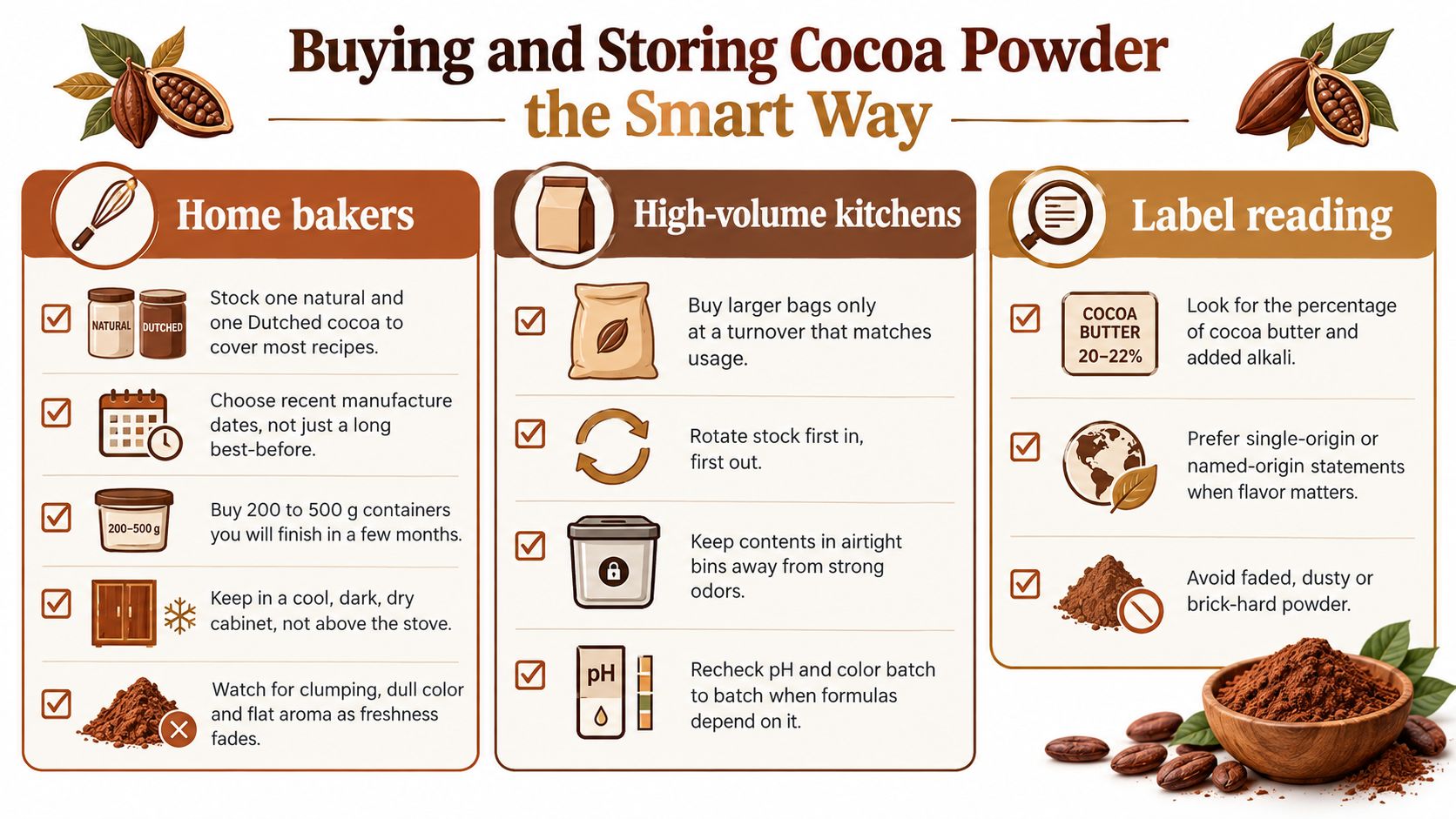
A practical buying checklist
- For home baking: Choose a size you'll use while the aroma and flow remain fresh, rather than buying a large bag solely because the unit price looks attractive.
- For professional kitchens: Request the specification sheet, certificate of analysis, processing details, and lot information. Test a small quantity in the actual formulas before changing suppliers.
- For recipe development: Record the cocoa type, pH when available, fat specification, batch, color, and the leavening system used in the test.
- For freshness checks: Watch for hard clumps, dull color, stale aroma, or powder that no longer disperses as it did when opened.
- For humidity control: Use a sealed container and follow practical kitchen guidance on controlling humidity during baking.
The Codex moisture ceiling is 7% by mass, but packaging still matters after manufacture. A powder can absorb humidity in a poorly sealed kitchen container, so inspect it before every important bake. If the cocoa smells stale or shows persistent caking, replace it rather than trying to rescue a formula with extra mixing.
For repeatable results, DBakerAid™ brings controlled fermentation, proofing, steaming, and precision preparation into the home kitchen. Visit DBakerAid™ to explore a system designed to make demanding bread and pastry processes more consistent, then use the high-protein and specialty recipes to put your carefully chosen cocoa powder to work.