

Your dough has finished bulk fermentation. It feels elastic during pre-shaping, but it also has enough water to relax quickly on the bench. Before you touch the scraper, you need to decide what will support it through the final rise. The best sourdough proofing basket isn't necessarily the most traditional one. It's the basket that matches your dough's hydration, weight, shape, and your tolerance for flouring and cleanup.
A slack country loaf needs a different setup from a firm sandwich dough. A small boule needs different geometry from a long bâtard. Rattan may give you the driest surface and strongest support, while a fabric liner can save a very wet dough from sticking. Silicone is convenient, but convenience comes with a different proofing surface and less moisture control.
This guide uses a practical decision framework: material first, then capacity, shape, hydration, and maintenance. The right banneton should hold the dough without crushing it, release cleanly at scoring time, and dry completely after baking. It should become part of your workflow rather than another source of uncertainty.
Table of Contents
- Choosing the Right Basket Before Your Next Bake
- What a Proofing Basket Does for Sourdough
- Comparing Proofing Basket Materials
- Sizing and Shape for Boules and Bâtards
- Matching Baskets to Hydration and Dough Style
- Scoring Patterns and the Case for Controlled Proofing
- Care, Cleaning, and Long-Term Storage
- Quick Answers for First-Time Basket Buyers
Choosing the Right Basket Before Your Next Bake
The first useful question isn't “Which basket has the best reviews?” It's “What is this dough going to do over the next few hours?”
A strong, moderately hydrated boule can sit comfortably in a well-floured rattan basket. A wetter dough may relax into the weave, especially if the basket is shallow or the flouring is light. An enriched dough containing butter or oil can behave differently again because fat changes how the dough contacts the basket surface.
Experienced bakers usually make five decisions before buying:
- Material: Cane and rattan breathe well, silicone cleans easily, wood pulp provides rigid disposable-style support, and linen adds a smoother barrier.
- Capacity: The basket needs room for expansion without letting the dough spread sideways.
- Shape: Round baskets support boules, while oblong baskets guide bâtards.
- Depth: Taller walls help contain dough that rises aggressively or lacks strength.
- Weave or lining: A tighter or lined surface reduces snagging, while an open weave leaves a more pronounced pattern.
Practical rule: Choose the basket for the dough you bake most often, not the loaf you admire most in photographs.
A basket that's too large produces a low, broad loaf with weak tension. One that's too small presses the dough against the sides and can distort the scoring surface. The wrong material may also create the most frustrating failure in sourdough baking, a loaf that looks perfectly proofed until it tears during the flip-out.
A properly selected basket supports the final rise while preserving the tension created during shaping. It also gives you a predictable place to refrigerate the dough, whether you proof at room temperature for roughly 90 minutes or retard it overnight for several hours, as described in King Arthur Baking's banneton guidance. The basket doesn't replace fermentation judgment, but it makes the dough easier to judge and handle.
What a Proofing Basket Does for Sourdough
A banneton, brotform, or proofing basket holds shaped dough during its final rise. After shaping, the dough needs enough support to keep its height. Without a defined boundary, especially at higher hydration, it can relax outward and lose the tension you created.
The basket's value changes with dough strength. Firm, well-developed dough may need only moderate support, while a wetter or weaker dough benefits from taller sides that contain it as fermentation continues. Rattan and cane also let air circulate around the dough and draw some moisture from its surface, helping form a skin that can hold scoring detail.
A basket does not control fermentation. Starter activity, dough strength, temperature, and time still determine whether the loaf is under-proofed or over-proofed. Sourdough guidance commonly places fermentation in a stable environment around 70–85°F (21–30°C) with humidity around 60–80%. Cooler conditions slow fermentation, while warmer conditions can increase acidity, according to this sourdough proofing temperature guide.
Support, moisture, and timing
A flat couche or towel can support firm dough, but slack, high-hydration dough often spreads sideways. A basket supplies a fixed boundary, helping the dough keep the domed profile associated with artisan loaves. That support is particularly useful when the dough will be turned out cold, when surface tension is less forgiving.
The basket can remain in the workflow through several schedules:
- The final rise can finish at room temperature inside the basket.
- The shaped dough can be refrigerated in it for a long cold retard.
- The dough stays supported until you turn it out immediately before scoring.
Bakers commonly refrigerate properly proofed dough in the basket for about 15–16 hours at around 38°F/3°C, as documented in this banneton workflow. For less predictable ambient conditions, DBakerAid's banneton proofing basket guide explains how basket support fits into a more controlled proofing setup.
Ridges or spirals on the dough are mainly visual. They do not improve flavor, but they create a recognizable crust pattern and can reveal whether the dough released cleanly. The basket's practical job is shape retention, surface management, and easier handling between shaping and scoring.
Comparing Proofing Basket Materials
Material determines how much help the basket gives you with moisture, release, cleaning, and storage. No option wins every category.
Proofing Basket Materials Compared
| Material | Breathability | Sticking Risk | Cleanup | Durability | Price |
|---|---|---|---|---|---|
| Natural rattan or cane | High | Low with correct flouring | Brush and air-dry | Long-lasting when kept dry | Moderate |
| Wicker | Moderate to high | Moderate, especially with rough or wide weave | Brush carefully | Durable, but can snag | Low to moderate |
| Silicone | Low | Low from a non-stick perspective | Easy, often dishwasher-friendly | Durable, but can deform | Moderate |
| Wood pulp | Moderate | Low with light flouring | Simple, then discard or dry carefully | Less suited to indefinite reuse | Low to moderate |
| Linen-lined rigid basket | Moderate | Low for wet or enriched dough | Remove and wash liner, dry basket | Rigid basket lasts well | Moderate to high |
Natural rattan or cane remains the strongest all-around choice for lean sourdough. It's rigid, breathable, and moisture-wicking, and it creates the familiar spiral pattern. An independent review reports 47% higher surface-tension retention and 92% fewer stick-to-basket failures across 1,240 trials for natural rattan or cane compared with the alternatives it tested, with cited rattan and ash wood rigidity of 2.1–2.4 GPa above a stated 1.8 GPa minimum. Those figures come from this proofing-basket material review, so treat them as that source's test results rather than a universal guarantee.
Wicker can work well, but the weave matters. Wider gaps may leave deep impressions, and rough strands can catch wet dough during release. Silicone reduces the release anxiety and simplifies cleanup, yet it doesn't wick moisture, so the dough surface can stay softer and less skin-like.
Wood pulp baskets offer a firm shape and consistent handling. They're useful for beginners who want support without committing to a porous basket, but they don't provide the same long-term, reusable feel as well-maintained cane.
A linen-lined basket is the sensible compromise for very wet or enriched dough. The liner creates a smoother contact surface and can be removed for washing, although it reduces direct contact between dough and the breathable basket wall.
More breathability usually means more responsibility. You'll need to flour carefully, brush thoroughly, and dry the basket fully.
Sizing and Shape for Boules and Bâtards
Basket geometry controls how your dough expands. A round banneton encourages a boule, while an oblong banneton supports a bâtard and gives the dough room to extend lengthwise.
Product and baking guides commonly list round bannetons at about 7–10 inches in diameter and oblong formats around 9 × 14 inches, with round capacities often spanning roughly 500 g to 1 kg and oblong capacities around 750 g to 1.2 kg, as summarized in this sourdough basket sizing guide. Those are useful buying ranges, but dough strength and shaping style matter as much as the label.
Banneton Sizing by Dough Weight and Loaf Shape
| Dough Weight | Round Boule Diameter | Oblong Bâtard Length | Best For |
|---|---|---|---|
| About 500 g | About 7–8 inches | Short oblong basket | Small household loaves and test bakes |
| About 750 g | About 8–9 inches | About 10–12 inches | Everyday sourdough and sandwich-style loaves |
| About 1 kg | About 9–10 inches | About 12–14 inches | Large boules and substantial country bâtards |
A 9-inch round basket is a versatile option for a compact boule or a tighter-crumb sandwich-style loaf. An 11-inch oval gives an open-crumb country bâtard more length for expansion and a better surface for a long ear.
Depth also matters. High-hydration dough benefits from taller walls because the basket contains the dough while the gluten network continues to strengthen. A very shallow basket may let the dough bulge outward before it reaches the oven.
If you bake both shapes and want only one basket, choose based on your most frequent loaf. A round basket is more forgiving for mixed shaping experiments, but it won't turn a bâtard into a convincing long loaf. A medium oblong basket is useful for sandwiches and country bread, though it takes more storage space.
Capacity labels aren't always standardized. Compare the basket's internal dimensions with your actual dough weight, and leave enough room for the final rise without allowing the dough to flatten across the base.
Matching Baskets to Hydration and Dough Style
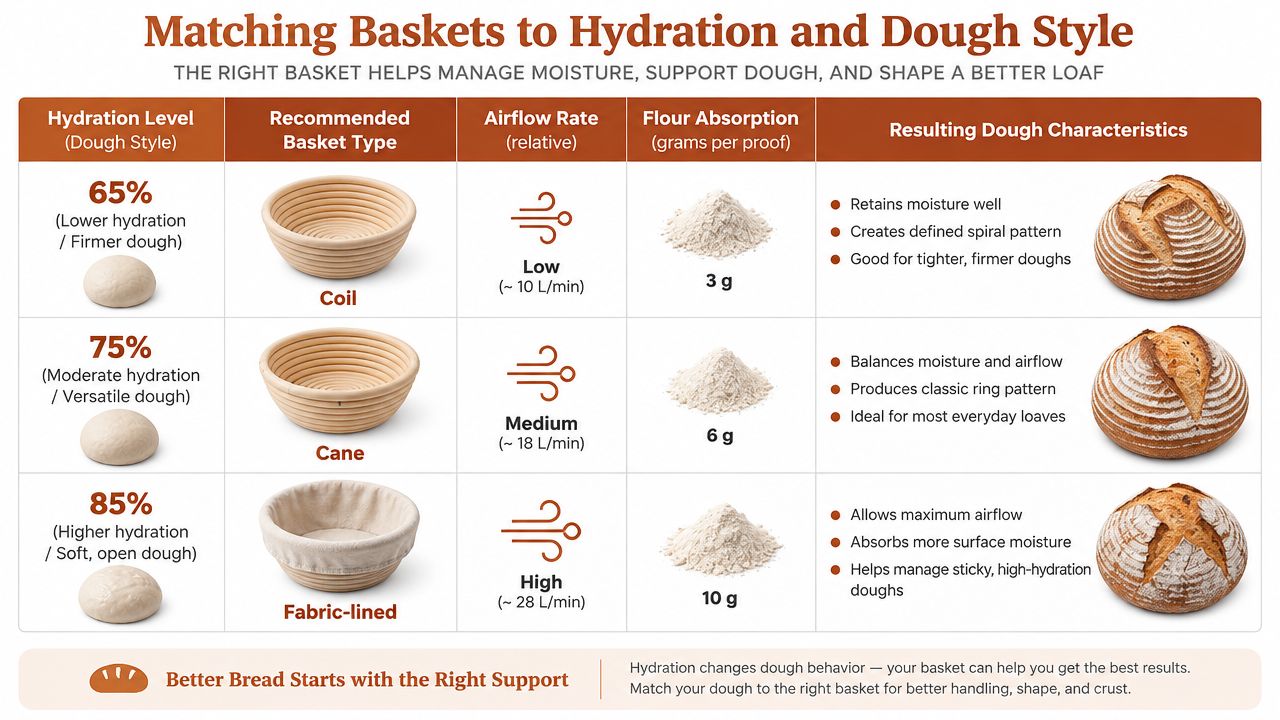
Hydration changes the problem. A moderately wet country loaf can release cleanly from rattan with a disciplined dusting routine. An extremely wet dough may need a liner, a bowl, or a different fermentation method because the basket's shape-support benefit doesn't compensate for repeated sticking.
A useful working range looks like this:
- Around 65–70% hydration: Well-floured cane or rattan usually provides enough support and airflow.
- Around 75% hydration: Rattan remains effective, but rice flour and strong surface tension become more important.
- Above 78% hydration: A linen-lined basket may be preferable, particularly when the dough is weak or the final proof is long.
- Enriched dough: Butter and oil can bond to a rough weave, so a smoother lining or bowl is often safer.
- Mixed-flour dough: Whole-grain particles can catch in open weaves, making a liner useful when the dough surface is sticky.
Flour choice and release
Rice flour is often more effective than wheat flour because it stays relatively dry on the dough surface and doesn't absorb moisture as quickly. Use a thin, even coating rather than a thick mound, which can leave pale flour patches and soften the crust.
For a very wet dough, dust the liner rather than trying to force dry flour into every groove of the cane. This guide to high-hydration dough also reflects the broader principle that dough strength and handling method matter as much as the basket itself.
When a traditional banneton isn't the right tool
A linen-lined bowl can outperform a classic cane basket for brioche, laminated dough, or a dough containing substantial fat. A wooden bowl with a smooth cloth gives reliable support when you don't need the decorative spiral.
A tea-towel-lined colander is also a legitimate substitute for occasional baking. It won't offer the same airflow or basket pattern, but it can hold a shaped loaf well enough while you decide whether a dedicated banneton earns space in your kitchen.
The contrarian conclusion is practical: the best sourdough proofing basket is the one that prevents your specific dough from sticking and collapsing. Traditional rattan is excellent for many lean loaves, but it isn't a requirement for every formula.
Scoring Patterns and the Case for Controlled Proofing
Scoring exposes the quality of the final proof. Under-proofed dough can tear sharply along the cut and burst elsewhere. Over-proofed dough may produce little oven spring, even with a sharp blade and accurate placement. Basket choice supports the process, but it cannot correct poor proofing timing.
Surface condition also affects the cut. A slightly drier skin gives the blade a cleaner path. Rattan can help wick surface moisture, while a non-porous basket may leave the dough softer. Hydration, flouring, temperature, and proof duration still determine the result, so material alone is not a reliable predictor.
Match the score to the loaf
- Round boules: Use one confident slash to give the loaf a clear expansion path.
- Oblong bâtards: A long angled cut or chevron pattern follows the loaf's length and helps form a defined ear.
- Sandwich loaves: Cross patterns encourage a controlled opening when an even slice matters more than a dramatic crust.
Turn the dough out with a gentle, deliberate motion. A clean release protects the surface tension created during shaping. If one area sticks, the dough skin can tear before the blade reaches it, weakening the intended score.
When ambient conditions create uncertainty
Room temperature and humidity shift through the day. Dough can proof faster beside a warm oven and slow considerably in a cool kitchen, making a fixed final-proof schedule unreliable.
DBakerAid™ includes a Stage 1 yeast fermentation bowl, a Stage 2 dough proofing bowl, and a control hub for managing temperature and time. The Stage 2 bowl has a 4.5L capacity, and the system includes a dedicated sourdough proofing program. This controlled environment does not replace shaping skills or the need to select a basket suited to the dough, but it can reduce temperature-related variation when timing matters.
For a closer examination of how cuts respond to dough development, follow these bread scoring techniques. The blade creates the opening. Proofing, dough strength, hydration, and basket release determine how that opening expands in the oven.
Care, Cleaning, and Long-Term Storage
Most basket problems begin after the bake, not during it. Flour and dough residue trapped in a damp cane basket can develop odors or mold, while aggressive washing can distort the fibers and extend drying time.
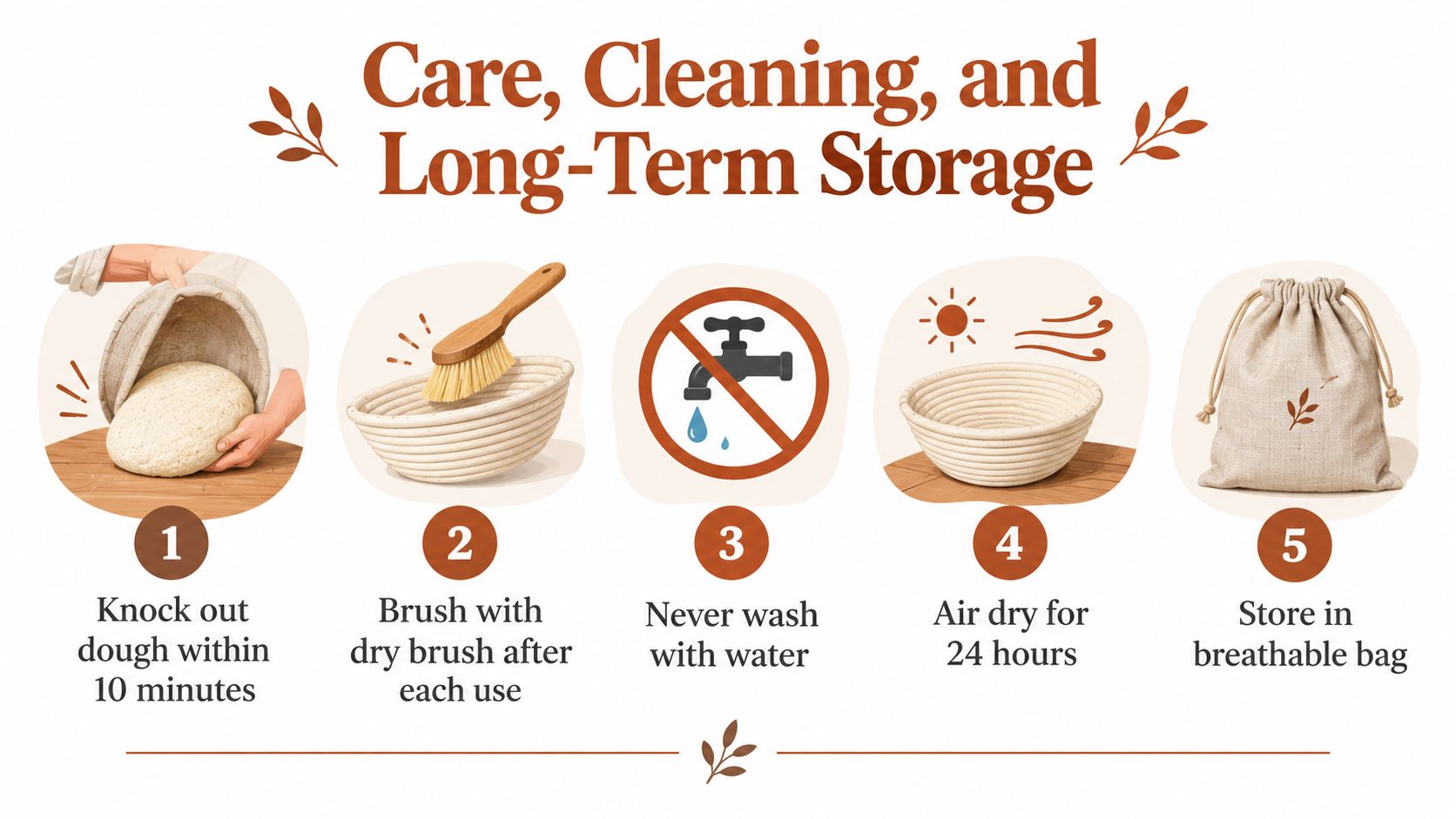
Turn the dough out promptly after the final proof. Knock loose flour and residue from the basket, then use a stiff natural-bristle brush to work through the grooves. Brush the inside, rim, and any exposed joints where flour tends to collect.
Drying matters more than washing
Water washing is rarely necessary for a rattan banneton. If dough has bonded to the fibers, use the least water needed to remove it, then give the basket substantially more drying time before putting it away. A wet basket with trapped flour is a more serious hygiene risk than a basket carrying a dry flour film.
Place the basket upside down in a well-ventilated spot away from direct sunlight. Sunlight can dry and weaken natural fibers unevenly, while ventilation helps moisture escape from the weave.
A simple routine works well:
- Knock out residue: Empty the basket as soon as the dough leaves it.
- Brush dry: Remove flour from the grooves and rim after every use.
- Inspect: Look for damp patches, persistent odors, or visible mold.
- Dry completely: Don't store the basket until the fibers feel dry throughout.
- Store with airflow: Use a breathable bag or leave space between stacked baskets.
Small spots may be surface residue, but recurring mold, soft fibers, cracking, or a persistent smell means the basket has reached the end of its useful life. Don't keep using a basket that transfers contamination to fresh dough.
If you own several baskets, stack them loosely with ventilation rather than compressing them in a sealed plastic container. Keep the stack away from steam, dishwashers, and humid cupboards. Good storage protects the shape and prevents one damp basket from affecting the others.
Quick Answers for First-Time Basket Buyers
Should I use rice flour or wheat flour? Rice flour is usually the safer starting point for sticky sourdough because it remains drier at the dough surface. Wheat flour can work well for firmer doughs, especially in a well-seasoned rattan basket.
Do I need a liner? Start without one for a moderately hydrated lean dough if your basket is smooth and properly floured. Add linen when dough is very wet, enriched, or repeatedly sticking despite careful release.
How long can dough stay in the basket in the refrigerator? Properly proofed dough is often refrigerated in the basket for about 15–16 hours at around 38°F/3°C, according to King Arthur Baking's practical banneton guidance. That isn't a universal timer. Starter strength, dough temperature, and proofing level still decide when the loaf is ready.
Can I use a bowl and towel instead? Yes. A cloth-lined bowl or colander can support many doughs, especially if you bake occasionally or don't need a spiral pattern. A dedicated basket becomes more valuable when you bake often, work with slack dough, or want repeatable shaping.
Are silicone baskets worth considering? They make sense when cleanup and storage matter more than moisture wicking. They can reduce sticking, but the non-porous surface won't dry the dough skin in the same way as natural rattan.
A proofing basket is a small lever, not a magic fix. Match it to dough behavior, keep it dry, and use controlled proofing when your kitchen conditions fluctuate.
DBakerAid™ brings timed, temperature-controlled fermentation and proofing to the home kitchen, including a dedicated sourdough program that can make the final-rise schedule more repeatable. Visit DBakerAid™ to see how the system can fit alongside the right banneton for your dough.