

Most lists for the best bread making machine still judge the wrong things. They count presets, mention loaf size, glance at wattage, and move on. That's fine if all you want is a basic sandwich loaf on autopilot. It's weak advice if you care about repeatable rise, controlled proofing, cleaner crumb, or difficult doughs like high-protein bread.
I'd buy a machine with fewer presets and better fermentation control over a menu-packed box any day. Bread lives or dies before the bake starts. If the machine can't hold dough at the right temperature, manage proofing sanely, and let you control stages instead of locking you into a canned cycle, the rest is marketing.
Table of Contents
- Why Most Best Bread Making Machine Rankings Miss the Point
- The Four Features That Actually Decide a Loaf
- Traditional Bread Makers Versus Precision Dough Stations
- Four Machine Archetypes and Who Each One Fits
- The High-Protein Use Case and the Homemade Math
- Matching a Machine to Your Baking Style
- Final Pick and Common Questions on Bread Making Machines
Why Most Best Bread Making Machine Rankings Miss the Point
The usual buying guide logic is simple. More programs must be better. Bigger loaf must be better. Higher wattage must be better. None of that reliably tells you whether the machine will make the loaf you want.
Bread machines didn't start as feature-stuffed countertop toys. The category came out of a long push to automate the full process, mixing, kneading, controlled heating, and timed baking in one appliance. Patent records show this architecture taking shape from the late 1970s into the 1980s, with early filings covering cooking apparatus and automated mixing and baking systems, then later Japanese designs refining kneading, temperature detection, and automatic baking functions in the patent history of automated bread-making systems. That history matters because it shows what the category was really built around, process control, not button count.
By the 1990s, bread machines hit mass adoption. The category was introduced in Japan in 1986 by Matsushita Electric, now Panasonic, then spread fast in the U.S. Sales were projected to exceed 1 million units by the end of 1992, and after prices dropped to about $200 in 1993, reported sales passed 3 million units. By 1999, about 20% of American households owned one, and estimates for the decade put ownership around 25 million American households in Taste's history of the bread machine boom.
Most buyers weren't paying for “artisan performance.” They were paying to dump in ingredients and get a loaf back.
That old convenience-first framework still shapes modern rankings. It shouldn't. Today's home bakers want more than timed white bread. They want dough-only cycles, better crust, long fermentation options, and the ability to handle specialty formulas that don't behave like standard enriched sandwich dough.
What actually changes outcomes
A peer-reviewed review on bread fermentation reports that yeast stays active from about 0 to 55°C, with the most favorable fermentation range around 27 to 38°C, and another study in that same review used 35°C as a controlled fermentation condition in this scientific review on fermentation variables. That's the kind of detail that matters more than whether a machine has 12 programs or 24.
If a machine can't hold dough near target temperature when your kitchen runs cool in winter or hot in summer, you won't get consistent proofing. That's why I'd rather read about sensor placement, temperature stability, stage control, and steam support than “jam mode” or “cake mode.”
For buyers trying to sort serious equipment from spec-sheet fluff, this is a better lens than most roundup lists use, and it's the same lens I'd apply when looking at home bakery equipment that prioritizes actual dough control.
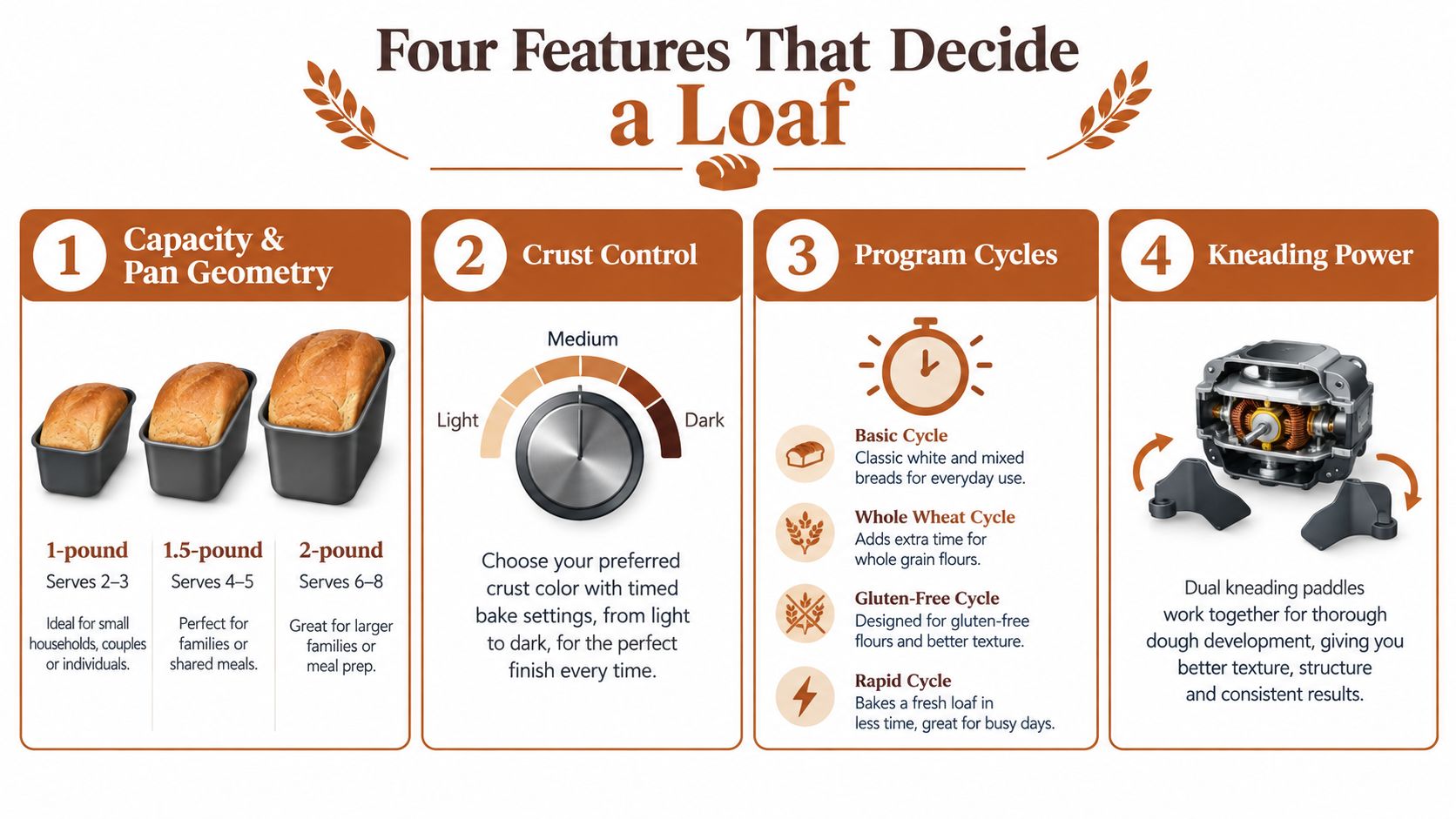
The Four Features That Actually Decide a Loaf
The spec sheet is full of noise. These four things are the signal.
Capacity and pan geometry
Capacity matters, but not because bigger is always better. It matters because pan shape affects loaf profile, side crust, slice shape, and how evenly the dough bakes. A tall narrow pan can make a sandwich loaf that slices neatly but risks denser side walls. A wider pan can support more even rise and less exaggerated mushrooming at the top.
What I look for is simple:
- Household fit: Buy for how much bread you eat, not the largest loaf the machine can claim.
- Pan shape: Prioritize loaf shape that matches how you use bread, toast, sandwiches, or baking for freezing.
- Removable hardware: A pan and paddle setup that's easy to clean will get used more often.
Crust control and heat distribution
Independent testing has pointed to heating-element placement and even heat distribution as major drivers of browning quality, and food science shows that humidity changes how heat moves and how crust develops during baking. Research summarized alongside testing notes that pore opening occurs mainly around 71 to 81°C, dough solidification spans roughly 50 to 110°C, and crust dries and hardens as moisture moves outward in Wirecutter's bread machine testing discussion.
That's why “medium crust” on a button label doesn't tell me much. I want to know whether the machine bakes mostly from the bottom and sides, whether top browning is weak, and whether it lets me adjust bake duration.
Programmability and stage control
A useful machine lets you extend or skip stages. A limiting machine forces every dough through the same script.
Practical rule: If you can't separate mixing, fermentation, proofing, and baking, you can't really tune the loaf.
For shoppers comparing product pages, this quick checklist is more useful than a preset total:
| Feature | What to Look For | Red Flag |
|---|---|---|
| Bread capacity | Pan size that matches your household and sandwich needs | Buying oversized capacity you won't use |
| Crust control | Adjustable bake stage and more even top-to-side browning | Color presets with no real bake-stage control |
| Program cycles | Dough-only mode, custom cycles, ability to extend stages | Locked programs you can't modify |
| Temperature handling | Stable fermentation and proofing control | A generic “rise” cycle with no detail |
Flour strength changes behavior fast, especially when you start working with stronger dough systems, so it helps to understand how flour protein content changes structure and machine performance.
Traditional Bread Makers Versus Precision Dough Stations
There are really two different categories hiding under the same shopping term. Treating them as interchangeable is where a lot of bad recommendations start.
The all-in-one machine
The classic bread maker uses one pan and runs the whole sequence in that same chamber. It mixes, kneads, rises, proofs, and bakes with minimal input. For low-effort sandwich bread, that still makes sense. If you want to add ingredients and walk away, this architecture is hard to beat.
It's also the architecture with the most built-in compromises. The same pan has to work for mixing and final baking. The same enclosure has to handle warming dough and then baking it. And the machine usually assumes you'll accept its sequence rather than shape the dough, retard it, or finish it in a conventional oven.
The precision dough-station approach
A precision dough station separates the critical early stages. Instead of forcing every dough through a one-pan bake, it emphasizes controlled fermentation, controlled proofing, and flexible finishing. That's a better match for bakers who care about shaping, oven spring, steam, or formulas that don't tolerate a generic cycle well.
Scientific work on fermentation and proofing supports this distinction. A review reports dough may be fermented around 26 to 27°C before a later fermentation stage around 30°C, while proofing research identifies 30 to 35°C and 70 to 85% relative humidity as normal conditions for final proofing, with final proofing time commonly varying from 15 to 60 minutes depending on dough and yeast variables in this review of bread fermentation and proofing conditions. That separation isn't a gimmick. It reflects how bread behaves.
For buyers looking at controlled systems, one example is D'BakerAid, which uses a Stage 1 yeast fermentation bowl, a Stage 2 dough proofing bowl, and a hub that manages time and temperature, with an optional steamer for oven humidity. That design choice lines up with the logic behind a fermentation temperature control kit built around stage-specific handling.
A traditional bread maker is for convenience first. A precision dough station is for outcome first.
Which architecture fits which baker
If your priority is cheap, simple, and mostly hands-off, buy the all-in-one. If your priority is specialty doughs, better repeatability, and the option to finish in your own oven, buy the system that gives you stage control.
The all-in-one wins on footprint and straightforward use. The precision station wins on granularity, flexibility, and difficult dough tolerance. That is the trade-off. Not “16 presets versus 22.”
Four Machine Archetypes and Who Each One Fits
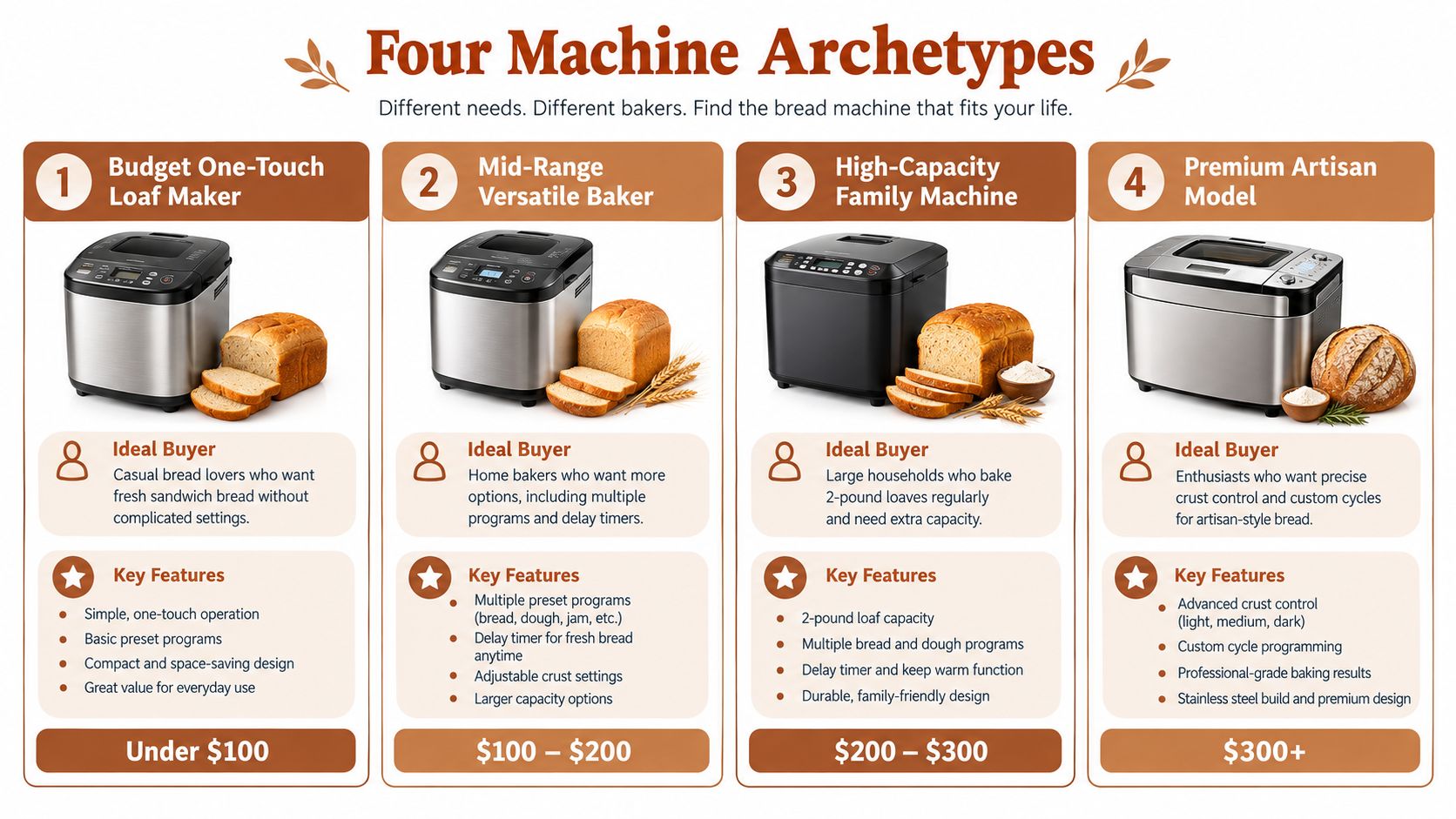
Shopping gets easier when you stop comparing every machine to every other machine. Most buyers fit one of four archetypes.
Budget one-touch loaf maker
This is for the person who wants basic sandwich bread and doesn't want to think. You load ingredients, hit basic, and accept the result. It's the right choice for occasional use and tight budgets.
The trade-off is obvious. You don't get much control, and once you move beyond standard doughs the machine usually shows its limits fast.
Preset-heavy mid-tier machine
This is the sweet spot for many households. You get more cycle variety, a delay timer, and usually better fit and finish than the cheapest models. For families baking weekly, that's often enough.
What I don't love is how often this tier sells complexity instead of capability. Twenty menus can still hide weak stage control.
Custom-cycle artisan-friendly machine
This one is for hobbyists who want a dough-only mode, longer runs, and more manual intervention. If you want to mix in-machine, then shape, proof further, or bake elsewhere, that is where machines start getting interesting.
A sourdough-focused decision especially needs this flexibility. A review of wheat sourdough research found fermentation and proofing windows ranging from 30 minutes to more than 20 hours, and 30°C appeared in 61% of documented processes. The same review notes cooler fermentation can favor some bacterial species, while warmer fermentation speeds enzymatic conversion, and other research cited there reports low-temperature fermentation can improve aroma and sensory quality but takes substantially more time in this wheat sourdough review. That's why the “best bread making machine” for sourdough often isn't the most automatic one.
Precision dough station with optional steam support
This is for bakers who care about repeatability across tough formulas, not just convenience. It suits macro-trackers chasing consistent high-protein loaves, enthusiasts who shape by hand, and anyone who wants tighter control over fermentation and proofing than a standard bread maker usually offers.
Here's the honest downside. It's a different workflow. You're buying control, not one-button novelty.
- Casual sandwich baker: budget one-touch is enough.
- Busy family baker: mid-tier preset machine is usually the sensible buy.
- Sourdough or artisan hobbyist: custom-cycle machine or precision station makes more sense.
- Protein-focused or difficult-dough baker: precision handling earns its keep.
The High-Protein Use Case and the Homemade Math
High-protein bread exposes weak bread-machine recommendations quickly. Preset count matters less than whether the machine can manage a dense dough through mixing, fermentation, and proofing without losing structure.
These loaves behave differently from standard white bread. The dough is denser, stiffer, and slightly tacky, and it usually rises only about 50 to 75% rather than doubling. Expect a tight, uniform crumb, a soft but heavier feel, and a crust that browns a bit faster. Protein choice also changes the finished color. Whey and collagen stay closer to a normal cream tone, pea can look slightly grey-green, soy bakes darker and more tan, and whole-grain formulas brown more.
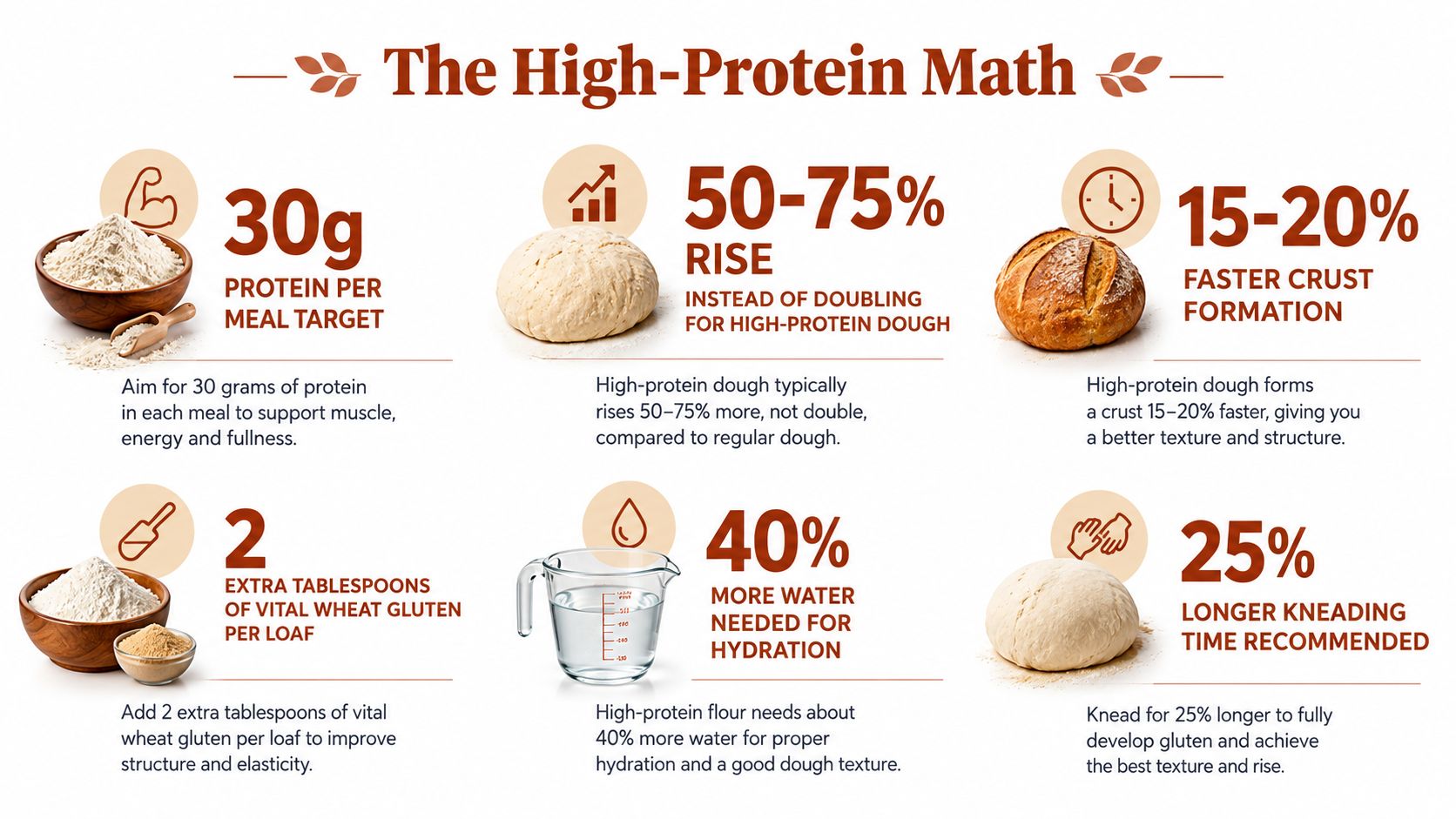
That behavior makes generic bread-maker rankings a poor guide for this use case. Proofing conditions directly affect the result. One study reported that temperature and fermentation time significantly affected dough expansion, loaf expansion, elasticity, texture, color, and moisture. Its best treatment used 30°C for 120 minutes and produced 424.34% dough expansion. Another study found that proof time tracked closely with yeast concentration and dough and proofer temperatures, with correlations of 0.96 to 0.99. It also reported that temperature adjustments could reduce yeast use without sacrificing production time or bread quality in this proofing research summary.
What the protein numbers look like in practice
The five Pullman-style recipes use whey, pea, soy, or collagen isolate with vital wheat gluten and wheat flour. The figures below are calculated from those recipe formulas and ingredient quantities, rather than presented as retail nutrition data.
| Recipe | Protein per loaf | Protein per slice | Cost per slice |
|---|---|---|---|
| Whey + Sprouted Wheat | about ~170g | ~10.6g | ~$0.22 to ~$0.43 |
| Vegan Pea + Whole Grain | about ~171g | ~10.7g | ~$0.22 to ~$0.43 |
| Soy Multigrain “Fitness” | about ~170g | ~10.7g | ~$0.22 to ~$0.43 |
| Seeded Whey + Flax | about ~163g | ~10.2g | ~$0.22 to ~$0.43 |
| Collagen + Whole Wheat | about ~184g | ~11.5g | ~$0.22 to ~$0.43 |
The Collagen + Whole Wheat formula is the outlier, reaching about ~184g protein per loaf and ~11.5g per slice. The recipes are high-gluten formulas, not gluten-free.
Commercial high-protein breads commonly provide around 5 to 7 g per slice, while ordinary commercial bread often provides around 3 to 4 g per slice in Tasting Table's comparison of store protein breads and Food Republic's review of store-bought high-protein loaves. A homemade slice at about ~10 to 11g therefore delivers roughly twice the protein of many retail protein breads and clearly exceeds standard white or whole-wheat bread.
Cost per gram is the useful cost metric
Based on the recipe quantities and the stated ingredient-price assumptions, these homemade loaves cost roughly ~$3.56 to ~$6.81 per loaf, or about ~$0.22 to ~$0.43 per slice and ~$0.67 to ~$1.28 per three-slice meal. The same calculation puts them at about ~2 to 3 cents per gram of protein, compared with about ~5.2 cents per gram for retail protein bread. That works out to roughly 42 to 60% cheaper, or about half the retail protein cost.
Don't oversell this as “pennies.” Protein powder is the cost driver. The honest win is cost per gram of protein, not fantasy-cheap bread.
For a high-protein routine, the strongest reason to buy a capable machine is consistency. It needs to handle dense dough, control the proofing stage, and repeat the same result without forcing you to monitor every rise.
Matching a Machine to Your Baking Style
The right pick depends less on brand fandom and more on what you bake most often.
For the macro-tracker
If you lift, track meals, and care about getting about 30g of protein in a meal, your machine should support repeatable proofing, protein-source flexibility, and recipes that don't collapse when dough gets dense. A precision-oriented system makes more sense than a cheap one-touch box.
For the busy health-conscious parent
Buy the machine that removes friction. You want dependable sandwich loaves, easy cleanup, and enough flexibility to repeat the same family loaf without babysitting it. A solid mid-tier machine works if your doughs are conventional. If you're trying to make higher-protein loaves regularly, step up.
For the plant-based lifter
You need reliable handling for pea or soy-based formulas, because plant proteins can change dough behavior more noticeably than whey. Recipe support matters more here than preset count. So does the ability to adjust stages instead of trusting a generic automatic cycle.
The best machine for a vegan high-protein loaf is the one that lets you control the dough, not the one with the flashiest menu.
For the home-baking enthusiast
If you care about shaping, crumb structure, crust quality, and baking in your own oven, don't lock yourself into a fixed-pan bake unless convenience is the priority. Look for dough-first capability, visible proofing workflow, and optional humidity support.
A simple price guide keeps this practical:
- Under ~$150: casual use, basic sandwich loaves
- ~$150 to ~$300: better presets, more flexibility, family use
- ~$300+: precision systems with separated fermentation and proofing stages
Final Pick and Common Questions on Bread Making Machines
My pick is clear: choose the best bread making machine by the loaf it struggles with, not by its preset count. A mid-tier bread maker handles ordinary sandwich bread well. For high-protein doughs, sourdough workflows, and more exacting artisan baking, choose a precision dough station with separate fermentation and proofing control. Those stages determine rise, crumb, and repeatability.
Common questions:
- Which machine handles high-protein dough best? Choose one with adjustable fermentation and proofing. A “protein-friendly” recipe label is not enough.
- Does a gluten-free preset prove a machine is good for gluten-free bread? No. Ingredient-specific testing matters more because formulas vary widely, as discussed in this research overview on bread-making variables.
- How much protein can homemade protein bread realistically deliver? About ~10 to 11g per slice, depending on the recipe, protein source, and slice thickness.
- Is it cheaper than retail protein bread? At roughly 2 to 3 cents per gram of protein versus about 5.2 cents for retail loaves, a three-slice daily habit saves around $15 to $20 per month.
For equipment built around fermentation and proofing control, DBakerAid™ supports that workflow. Review the exact formulas in the DBakerAid high-protein recipe collection, then compare the system if you want more control over difficult doughs.