

Laminated dough is dough layered with fat through repeated folding so steam separates the layers during baking to create flake and lift. In practical terms, it's the structure behind croissants, puff pastry, and Danish pastry, not a single recipe or ingredient.
You notice the result before you think about the method. A croissant breaks with a light crack, the interior pulls into thin curved sheets, and butter perfumes the space between them. That texture comes from alternating layers of dough and fat, carefully built, chilled, and baked so they separate instead of merging.
The process looks simple on paper: enclose butter, roll, fold, rest, and repeat. The difficult part is keeping the dough and butter workable at the same time. If the butter cracks, the layers rupture. If it softens too much, it smears through the dough. A successful bake depends on geometry, temperature, gluten behavior, and steam working together.
This guide answers what is laminated dough in plain language, then separates the main pastry families, explains why turns multiply layers, and shows where temperature control determines the outcome. If you're learning croissants at home, this guide to making croissants at home gives the broader shaping and baking context.
Table of Contents
- Why That Croissant Shatters Into a Thousand Flakes
- What Laminated Dough Really Is and How It Puffs
- How Lamination Builds Layers Turn by Turn
- Puff Pastry Croissant and Danish Compared
- Why Temperature Control Makes or Breaks Lamination
- Common Uses Troubleshooting and Modern Variations
- Choosing and Baking Laminated Dough With Confidence
Why That Croissant Shatters Into a Thousand Flakes
The first bite tells you whether lamination worked. A well-made croissant doesn't just feel soft. Its outside gives way in crisp fragments, while the inside stays tender and visibly layered. Those flakes are the baked remains of a controlled stack, not random air pockets.
Laminated dough combines a base dough with repeated sheets of fat. The baker rolls the dough around a butter layer, then folds the package so the butter and dough alternate. During baking, water becomes steam, pressure pushes the sheets apart, and melted fat helps stop them from bonding again. The result is lift, separation, and flakiness.
A useful analogy is a deck of cards with butter between selected cards. Rolling makes the deck thinner, folding creates a new stack, and resting lets the cards stop sliding and bending. The oven then turns moisture into the force that opens the stack.
The three pastry families
Croissants and Danish pastries use yeast as well as lamination, so their dough ferments and gains a softer, more bread-like interior. Puff pastry relies on the laminated structure and steam rather than yeast, which gives it a sharper, more brittle break.
The differences affect what you should expect on the plate:
- Croissant dough is usually buttery, lightly sweetened, and airy but still resilient enough to shape into crescents.
- Danish dough is richer and often sweeter, with fillings, fruit, custard, or nut pastes.
- Puff pastry is designed for crisp expansion, making it suitable for tarts, turnovers, palmiers, and savory pastry shells.
Historically, the modern buttery, flaky croissant is widely dated to French recipe books from the early 1900s to 1910s, while laminated pastry itself developed from earlier crescent-shaped and puff-pastry-style forms. The important change was applying repeated folding to a yeasted dough, turning an enriched mixture into a predictable layered system. Technical history of croissant lamination
What Laminated Dough Really Is and How It Puffs
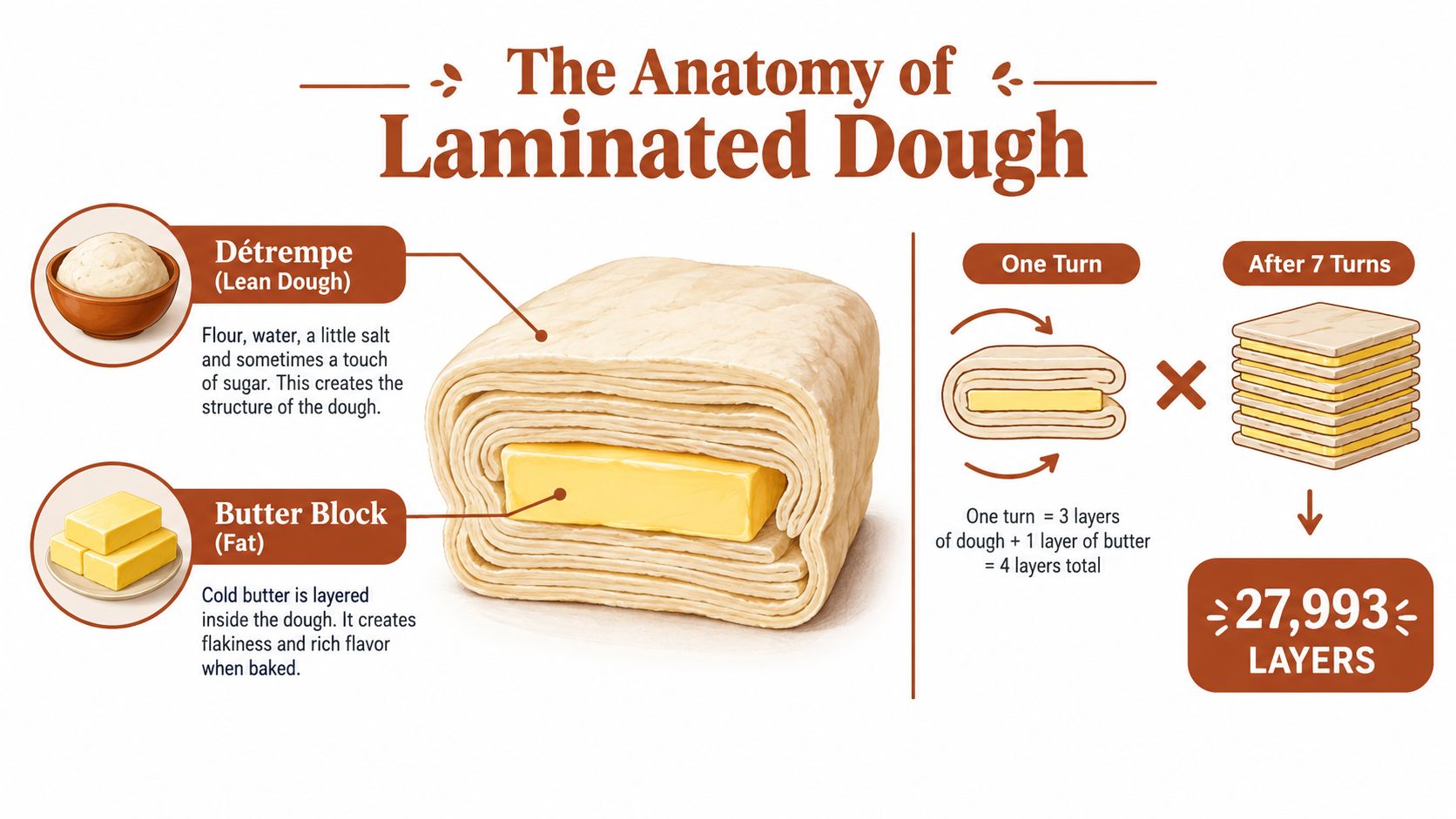
Start with two parts. The détrempe is the main dough, usually made from flour, liquid, salt, and any enrichments or yeast required by the pastry. The roll-in fat, commonly butter, is shaped into a flat block that can be enclosed inside the détrempe.
The butter shouldn't be treated as a filling. It's a structural sheet. Once enclosed, it must spread into an even layer as the dough is rolled. A thick spot creates a weak point, while a thin spot leaves neighboring dough layers too close together.
Steam does the lifting
The oven supplies the expansion force. Water in the dough and fat turns to steam, and the steam presses against the surrounding dough sheets. Melted fat coats the interfaces, helping the layers remain distinct instead of fusing into a single mass. Laminated dough fundamentals and phase changes
That explains why laminated dough needs both moisture and separation. Without enough moisture, the dough can't generate the same internal pressure. Without intact fat layers, steam has no clean boundaries to push apart.
Think of the pastry as a stack of miniature sealed channels. Each channel can expand slightly during baking. The more evenly those channels are distributed, the more regular the crumb and the more consistent the lift.
Why the layer count matters
Folding multiplies layers rather than adding them one at a time. Three letter folds can create 27 butter layers, while classic croissant schedules using three double turns can produce 64 layers. Industry references describe typical croissant laminations from 24 to 144 fat layers, Danish pastry from 24 to 54, and puff pastry from 81 to 729. Croissant layer structure and lamination ranges
More layers don't automatically guarantee a better pastry. The sheets must stay even, the gluten must relax, and the butter must remain distributed. Lamination is therefore a recipe and a construction method, with the final texture determined by how the layers behave in the oven.
How Lamination Builds Layers Turn by Turn
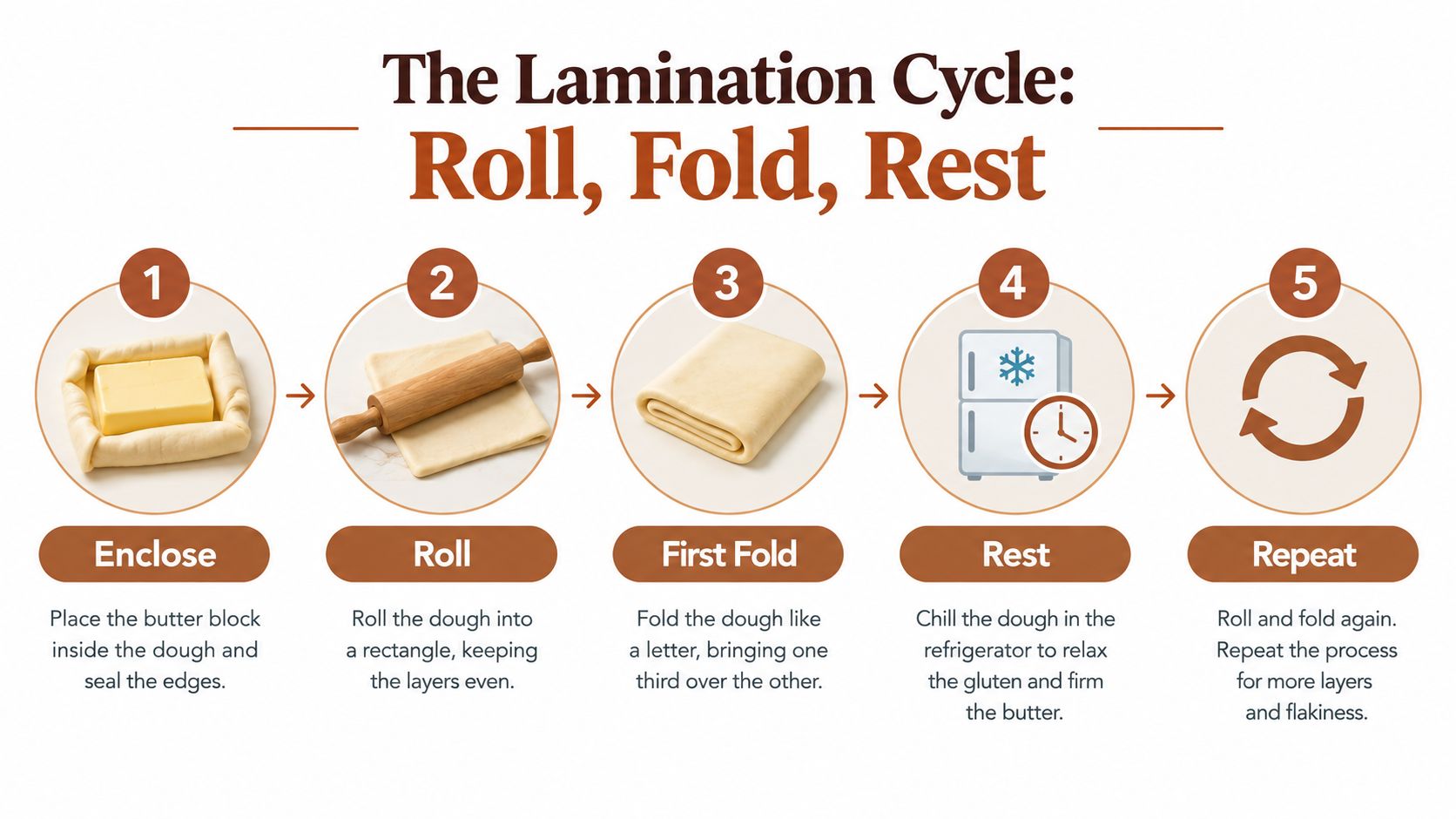
A turn is one complete sequence of rolling and folding. The baker begins with a butter-filled dough package, rolls it into a long, even sheet, folds that sheet according to the chosen pattern, and then rests it before rolling again.
A detailed croissant method rolls the dough to about 8 mm before a first fold-in-four turn, followed by another turn after resting. The exact schedule varies, but the logic stays constant: create a uniform sheet, fold it without tearing, and give the dough time to recover. Croissant dough preparation and folding
The cycle in practical terms
- Enclose the fat. Seal the butter block inside the détrempe, keeping the package square and the butter centered. A clean enclosure prevents exposed butter from sticking to the bench or leaking during the first roll.
- Roll evenly. Apply steady pressure from the center outward. The purpose isn't to force the dough thin as quickly as possible. It's to stretch dough and butter together so the fat remains a continuous sheet.
- Fold the sheet. A letter fold divides the rolled dough into overlapping sections. A book fold brings the ends toward the center and closes the package. Each choice changes the layer count and the final bite.
- Rest the dough. Resting allows gluten to relax and butter to firm. If you roll immediately after folding, the dough may shrink, resist the pin, or push butter toward the edges.
- Repeat the planned turns. Each additional fold multiplies the stack. Six single folds can yield 729 layers, a figure sometimes rounded to roughly 1,000 total laminae when alternating dough and fat sheets are counted. Historical and technical explanation of layer multiplication
Manufactured laminated sheets are often described as approximately 100 to 200 micrometres thick, and common croissant fold patterns may yield roughly 27 to 81 distinct dough-and-fat layers before baking. Small changes in turn count, sheet thickness, and rest time can therefore alter the finished pastry noticeably. Laminated dough sheet thickness and folding technique
For a visual demonstration of the handwork, see this croissant dough lamination walkthrough. Watch for the dough's resistance and the butter's consistency, not just the number of passes with the rolling pin.
Puff Pastry Croissant and Danish Compared
All three pastries use the same broad idea, but they don't produce the same eating experience. The biggest dividing line is leavening. Puff pastry gets its expansion from steam, while croissant and Danish doughs combine steam with yeast fermentation.
The fat-layer ranges also differ. Puff pastry commonly carries the largest stack, while Danish pastry tends to use a narrower range. These are typical industry references rather than rigid rules, since a bakery can alter its fold schedule, dough formula, and desired texture.
| Dough Type | Leavening | Typical Fat Layers | Texture Result |
|---|---|---|---|
| Puff pastry | Steam | 81 to 729 | Crisp, brittle, highly flaky |
| Croissant | Yeast and steam | 24 to 144 | Light, layered, buttery, resilient |
| Danish pastry | Yeast and steam | 24 to 54 | Soft, rich, tender, often sweet |
Matching the dough to the bake
Choose puff pastry when you want a clean snap and defined shards. It works well for fruit tarts, savory turnovers, palmiers, mille-feuille, and pastry shells where the layers should remain crisp.
Choose croissant dough for a shaped breakfast pastry with a thin crisp exterior and a lighter fermented interior. The dough needs enough strength to stretch around a filling or hold a crescent shape without tearing.
Choose Danish dough when the pastry will carry a generous filling or topping. Its richer formula and softer structure suit custard, fruit, nuts, and sweet cheese.
The distinction also helps diagnose expectations. A croissant that feels as brittle as puff pastry may be too dry or overbaked. Puff pastry that feels pillowy may have been formulated or handled more like a yeasted laminated dough. Lamination creates the family resemblance, but fermentation, enrichment, and shaping decide the personality.
Why Temperature Control Makes or Breaks Lamination
A croissant can leave the oven with tall, distinct layers or collapse into a greasy, compact strip. The difference often begins before baking, when the dough and butter must respond similarly to the rolling pin. This matching plasticity lets both materials deform at a similar rate. The dough should stretch without snapping back, while the butter should spread without cracking or flowing away.
If the butter is firmer than the dough, rolling compresses the dough around a hard slab. The butter cracks, breaks through, and creates gaps in the layer system. Those ruptures interrupt steam-driven lift, and exposed butter can leak in the oven.
If the butter is softer than the dough, it smears into the dough instead of staying in a sheet. The boundaries disappear, so steam cannot lift each layer cleanly. Lamination therefore works like precision engineering: temperature controls whether the layers remain separate long enough to expand.
Useful temperature targets
A bakery troubleshooting guide gives practical targets of around 24 to 26°C for the dough at the start of folding, 16 to 18°C for the butter block, and 26 to 28°C with 70 to 75% humidity during proofing. These figures provide a process-control framework, but hand-feel still matters. Laminated dough temperature and proofing troubleshooting
Practical rule: If the butter and dough feel different beneath the rolling pin, stop and correct their consistency before continuing.
Resting protects the gluten network as well as the butter. Rolling stretches gluten, and immediate re-rolling encourages shrinkage, making accurate sizing difficult. A cold rest firms the fat, limits smearing, and gives the dough time to relax.
Proofing adds a final temperature test. Excess heat softens the fat before the pastry reaches the oven. Low humidity dries the surface and restricts expansion. For final-rise guidance, consult this guide to proofing croissants, which treats proofing as a controlled stage rather than an afterthought.
Common Uses Troubleshooting and Modern Variations
One laminated dough can support several distinct pastries because its layer structure acts like a built-in frame. Puff pastry becomes tart shells, savory cheese straws, or layered desserts. Croissant dough becomes crescents, pain au chocolat, and filled breakfast pastries. Danish dough supports fruit, custard, nuts, and sweet cheese while keeping its layered character.
Hybrid formats extend the same idea. Crookies and flattened croissants have moved beyond short-lived novelty toward regular bakery offerings in 2026, according to industry coverage of laminated bakery formats. Their appeal comes from the contrast between a crisp, buttery shell and fillings or inclusions that would behave differently in ordinary bread dough.
Read the failure before changing the recipe
- Uneven layers usually indicate uneven rolling or too little rest. Measure the dough sheet instead of forcing one area thinner. If the dough contracts, pause and let the gluten relax.
- Butter leaking during proofing or baking points to excess warmth or an incomplete enclosure. Check the butter's plasticity before the next turn, then keep the proofing environment within the planned range.
- A tough result can develop through overworking or under-proofing. Gluten must provide enough strength to hold the layers, while resting and fermentation give the dough time to relax and expand.
- Weak lift may result from low steam or damaged layers. Once butter smears through the dough, the oven cannot reopen clean, alternating boundaries.
Reformulation introduces a different engineering problem. Whole-wheat flour absorbs water differently, while bran can interrupt the smooth gluten network that supports expansion. A peer-reviewed study found that adding vital gluten to whole-wheat laminated dough can improve its rheological performance, showing why a direct flour substitution may require changes to the formula. Study of whole-wheat laminated dough and vital gluten
High-protein dough follows the same logic. More protein may strengthen the network, yet it can also produce dough that feels stiffer, tackier, and less forgiving. Balance flour, added protein, hydration, mixing, resting, and proofing together. Extra gluten alone does not guarantee a taller pastry.
Choosing and Baking Laminated Dough With Confidence
Use the pastry's intended texture to choose the family. Pick puff pastry for crisp, shattering layers, croissant dough for a fermented and airy breakfast pastry, and Danish dough for a richer base that supports substantial fillings.
Then protect the structure with a short checklist:
- Keep the butter and dough similarly plastic before rolling.
- Roll evenly instead of chasing thinness with force.
- Rest whenever the dough resists or shrinks.
- Proof without allowing the fat to soften excessively.
- Bake while the layers remain distinct and the dough has enough moisture to generate steam.
Temperature is the memorable rule. Lamination creates the channels, and steam opens them. Butter consistency determines whether those channels survive long enough to reach the oven.
Home bakers who want to sell croissants, tarts, or Danish pastries also need to think beyond the formula. Pricing, production flow, equipment, and customer demand belong in the same planning conversation, so these baking business plan tips can help connect pastry technique with a workable operation.
DBakerAid™ offers a precision bread-making appliance system with a fermentation stage, a proofing stage, and a temperature-and-time control hub for difficult doughs, including specialty and laminated formulas. Visit DBakerAid™ to explore the system and see whether controlled fermentation and proofing belong in your home baking setup.