

Your starter looked lively yesterday. Today it smells harsh, barely rises, and your dough spreads instead of standing tall. That swing is what pulls people into sourdough and wears them down at the same time.
The romance is real. Sourdough wild yeast feels ancient, local, and alive in a way a packet of commercial yeast never does. But the bakers who get repeatable loaves aren't lucky. They control the environment well enough that the culture behaves predictably.
Table of Contents
- The Magic and Frustration of Sourdough
- The Living Culture What Is Sourdough Wild Yeast
- Creating Life From Flour How to Cultivate a Starter
- Mastering the Variables The Science of Feeding Your Starter
- Common Problems and Scientific Solutions
- From Starter to Loaf Achieving a Perfect Bake
The Magic and Frustration of Sourdough
Most bakers meet sourdough through contradiction. One bake has a fragrant loaf with an open, glossy crumb. The next one, using the same flour and the same hands, comes out squat, gummy, or oddly flat in flavor.
That inconsistency usually gets blamed on vague ideas like weak flour, bad luck, or a moody kitchen. The cause is almost always simpler. A sourdough culture is a living system, and living systems react to temperature, feeding rhythm, hydration, and time.
I've seen the same pattern in home kitchens over and over. A baker leaves the jar on the counter in cool weather, feeds it when they remember, then wonders why the starter peaks at unpredictable times. They shape too early one week, too late the next, and the loaf quality swings with it.
Sourdough rewards observation more than optimism.
The word wild makes people think the process should stay uncontrolled. It shouldn't. Wild only describes the origin of the microbes. It doesn't mean the baker should accept random outcomes.
A good sourdough routine feels less like chasing a mystical culture and more like tending a fermentation you understand. You learn which signs matter. You stop treating bubbles alone as proof of strength. You notice whether the starter rises with structure, whether the aroma is clean and acidic rather than harsh, and whether the dough gains resilience instead of just softness.
Three trade-offs usually decide the result:
- Flavor versus speed. Cooler, slower ferments often push sharper acidity. Warmer conditions usually move things faster and change the acid balance.
- Rise versus over-acidification. A starter can smell active yet still weaken dough if the balance drifts too far toward acidity.
- Intuition versus repeatability. Experience matters, but stable conditions matter more.
That's why some bakers improve dramatically the moment they stop improvising the fermentation environment. Better bread doesn't come from treating sourdough as mysterious. It comes from making the microbial behavior legible.
The Living Culture What Is Sourdough Wild Yeast
A starter looks simple until two jars fed from the same bag of flour behave differently by dinner. One doubles cleanly and smells like yogurt and fruit. The other turns slack, sharp, and late. That gap is microbiology, not luck.
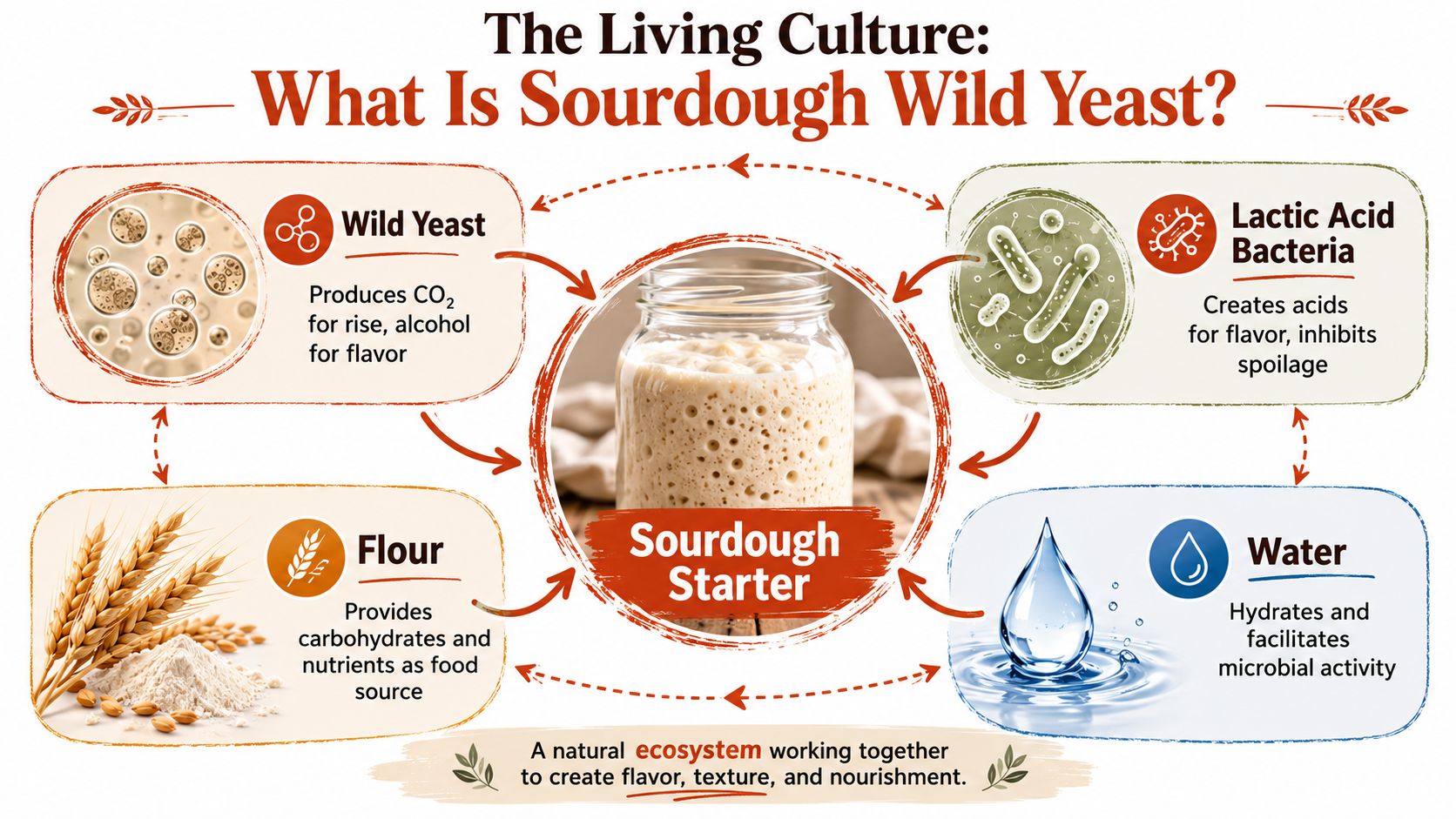
A starter is not just yeast
A sourdough starter is flour and water colonized by a mixed culture. Yeasts produce carbon dioxide and ethanol. Lactic acid bacteria produce lactic and acetic acids, along with many of the aroma compounds bakers associate with a mature starter.
Those microbes do not contribute equally under all conditions. Temperature, hydration, flour choice, feeding ratio, and time between refreshments keep shifting which organisms have the advantage. That is why one starter rises fast but tastes flat, while another develops better acidity and aroma but loses lifting power if it ferments too long.
A healthy culture smells layered because multiple organisms are active at once.
This fermentation system also has deep roots in bread history. This historical overview of sourdough fermentation traces sourdough's use long before commercial yeast standardized baking around speed and predictability.
If you want the practical distinction between the mother culture and the portion built for a specific dough, this guide to what levain is explains the difference clearly. In production, that distinction matters because it changes how you schedule fermentation and control flavor.
Why sourdough behaves differently from commercial yeast
Commercial yeast is a monoculture selected for reliable gas production. Sourdough is a community. That gives better flavor potential, but it also introduces more variables.
| System | Main biological character | Typical baking effect |
|---|---|---|
| Commercial yeast | Mostly one leavening organism | Faster rise, narrower flavor profile |
| Sourdough culture | Yeast plus lactic acid bacteria | Slower rise, more acidity, more aroma complexity |
The flour seeds much of the culture. Air contributes less than bakers often assume. Flour brings microbes, minerals, enzymes, and damaged starch, all of which shape which yeasts and bacteria establish themselves and how they perform afterward.
That is one reason sourdough feels inconsistent in an ordinary kitchen. The culture is always responding to its environment. Give it a cooler room, a longer gap between feeds, or a different flour, and the balance shifts. Bakers who control those variables get a starter that peaks on schedule and produces dough with more predictable strength. Systems such as the DBakerAid™ SureDough™ matter for exactly that reason. Stable temperature and environment let the biology stay readable instead of drifting day to day.
The same principle shows up in other fermentations. Pep Tea SCOBY instructions make a useful comparison because kombucha also depends on managing a mixed culture rather than treating fermentation as random. Different microbes, same lesson. If the environment wanders, the results wander with it.
A starter develops its character through repeated microbial selection under the conditions the baker provides.
That is why one culture trends mild and creamy while another runs sharper and more solvent-like. The cause is almost always simpler than mystique. Microbes are responding to the conditions in the jar.
Creating Life From Flour How to Cultivate a Starter
Starting from scratch is simpler than commonly expected, but it's slower than generally hoped. The mistake I see most often is assuming the first bubbles mean the culture is ready. Early activity is common. Stability takes longer.
A predictable starter needs regular refreshment and a narrow temperature band. A stable sourdough culture requires precise temperatures between 25–30°C (77–86°F) and refreshments every 24 hours for about two weeks (336 hours) to establish a dominant and predictable microbial colony, as summarized in this sourdough cultivation reference.
What to do in the first days
Use flour and water. That's enough. Whole grain flour often helps at the beginning because it tends to bring a richer microbial load and more nutrients into the mixture.
A practical routine looks like this:
- Mix a simple paste. Combine flour and water in a clean jar until no dry flour remains. You want a thick batter, not a pourable liquid.
- Keep it warm, not hot. The target range above is where culture development becomes more predictable. A cold windowsill slows selection and stretches the timeline.
- Refresh on schedule. Feed every 24 hours rather than reacting emotionally to what the jar did that morning.
- Watch structure, not just bubbles. A useful starter rises after feeding and then falls back as food runs out. Random surface fizz alone doesn't tell you much.
If you've made kombucha or other ferments, it helps to think in the same biological terms. The mechanics differ, but the discipline is similar. Good fermentation comes from a clean vessel, consistent feeding, and patience. The process behind Pep Tea SCOBY instructions gives a helpful comparison point because it shows the same principle of building a stable culture rather than forcing one.
What healthy progress actually looks like
The jar will often go through awkward stages. One day it smells floury. Another day it smells fruity. Then it may smell sharply acidic before settling into something cleaner and more balanced.
Use this as a guide:
- Early phase. Activity can look dramatic and then disappear. That drop doesn't mean failure.
- Middle phase. The aroma usually shifts toward tangy and fermented. Texture starts to hold gas more evenly.
- Mature phase. The starter rises predictably after feeding, then recedes on a repeatable schedule.
A few signs matter more than others:
- Good sign. The surface domes slightly and the body looks aerated throughout, not just at the top.
- Less useful sign. A few scattered bubbles with no meaningful rise.
- Bad sign. Visible mold or unusual discoloration.
Practical rule: Don't bake with a new starter just because it's active. Bake with it when its activity becomes repeatable.
A mature culture should feel boring in the best possible way. Feed it, keep it in a stable temperature range, and it responds with the same pattern again and again. That repeatability is what turns sourdough from a hobby of rescue attempts into a reliable bread process.
Mastering the Variables The Science of Feeding Your Starter
Once a starter is mature, the work changes. You're no longer trying to create a culture. You're steering one. That means controlling which organisms are favored strongly enough to shape rise, flavor, and timing.
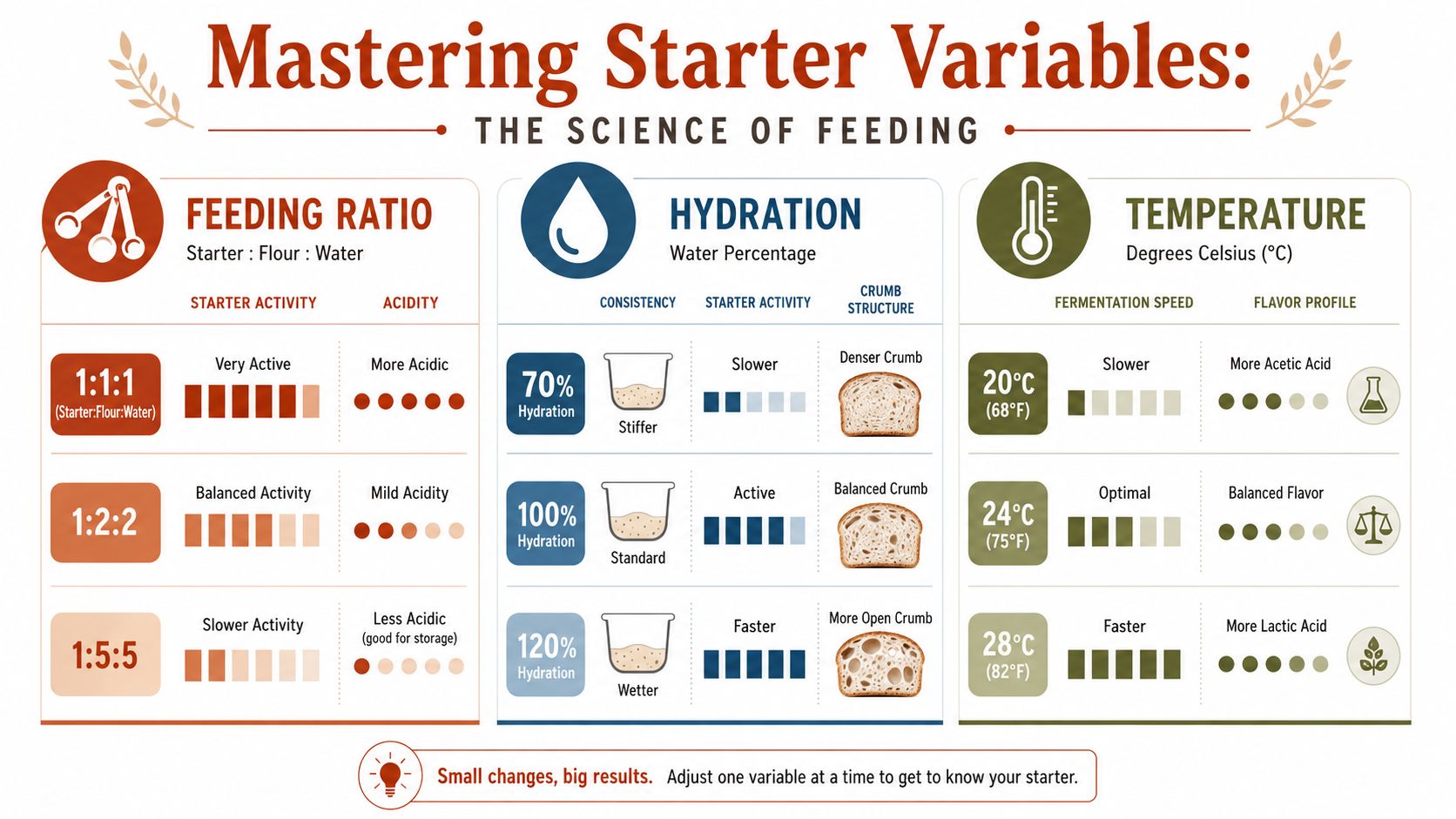
Temperature changes who wins
In a mature sourdough starter, lactic acid bacteria outnumber wild yeast cells by approximately a 100:1 ratio, and fermenting at 77°F (25°C) favors wild yeast activity for gas production, while temperatures between 86°F–95°F (30°C–35°C) promote LAB growth and lactic acid production for a milder flavor, according to Modernist Cuisine's sourdough science reference.
That single fact clears up a lot of confusion. Bakers often talk as if wild yeast alone explains sourdough behavior. It doesn't. Yeast lifts the dough, but the bacteria dominate the ecosystem and strongly influence what the dough becomes.
In practice:
- Near 25°C. You tend to support stronger gas production from the yeast side of the partnership.
- Warmer conditions. You push bacterial activity harder, which shifts flavor and acid development.
- Swinging room temperatures. You get inconsistency, because the culture keeps receiving mixed signals.
The useful takeaway isn't just scientific. It's operational. If your kitchen drifts, your starter drifts with it.
Hydration changes the kind of sourness
Hydration is the second big lever. A stiff starter and a liquid starter don't just look different. They encourage different metabolic behavior.
Lower hydration restricts diffusion and tends to favor acetic acid production, which gives sharper, more pointed sourness. Higher hydration gives the bacteria an easier medium and tends to favor lactic acid expression, which reads as rounder and milder.
That means hydration is a flavor control, not just a convenience choice.
| Starter style | Likely effect |
|---|---|
| Stiffer | Sharper acidity, firmer handling |
| Looser | Milder acidity, faster movement through the food supply |
I usually tell bakers to stop asking whether one hydration is best. Best for what? If you want a cleaner sandwich loaf profile, wetter often helps. If you want a more assertive tang, stiffening the culture can help.
Feeding rhythm changes stability
Feeding ratio and timing control how long the organisms live with abundance versus scarcity. Starved cultures acidify harder, weaken structurally, and often develop harsher aromas. Overfeeding can dilute activity if the culture wasn't strong enough to begin with.
A practical maintenance framework:
- For daily baking. Keep the refreshment rhythm tight and predictable so the starter peaks on schedule.
- For stronger leavening. Feed before the culture collapses into exhaustion. A starter that has recently peaked is usually more useful than one that has been hungry for hours.
- For flavor consistency. Change one variable at a time. Don't alter temperature, hydration, and feeding ratio all at once, then guess which change mattered.
The maintenance notes in this sourdough starter maintenance guide align well with what works in practice. The point isn't complexity. The point is keeping the culture on a rhythm you can read.
Strong starters don't come from feeding more often at random. They come from feeding deliberately enough that peak activity becomes predictable.
If you want consistency, controlled fermentation earns its value. Not because sourdough needs gadgets, but because microbial systems respond to precision. When temperature holds steady and feeding stays regular, the starter stops acting mysterious and starts acting measurable.
Common Problems and Scientific Solutions
Most starter problems are not separate problems. They're symptoms of the same thing. The microbial balance shifted, and the jar is telling you how.
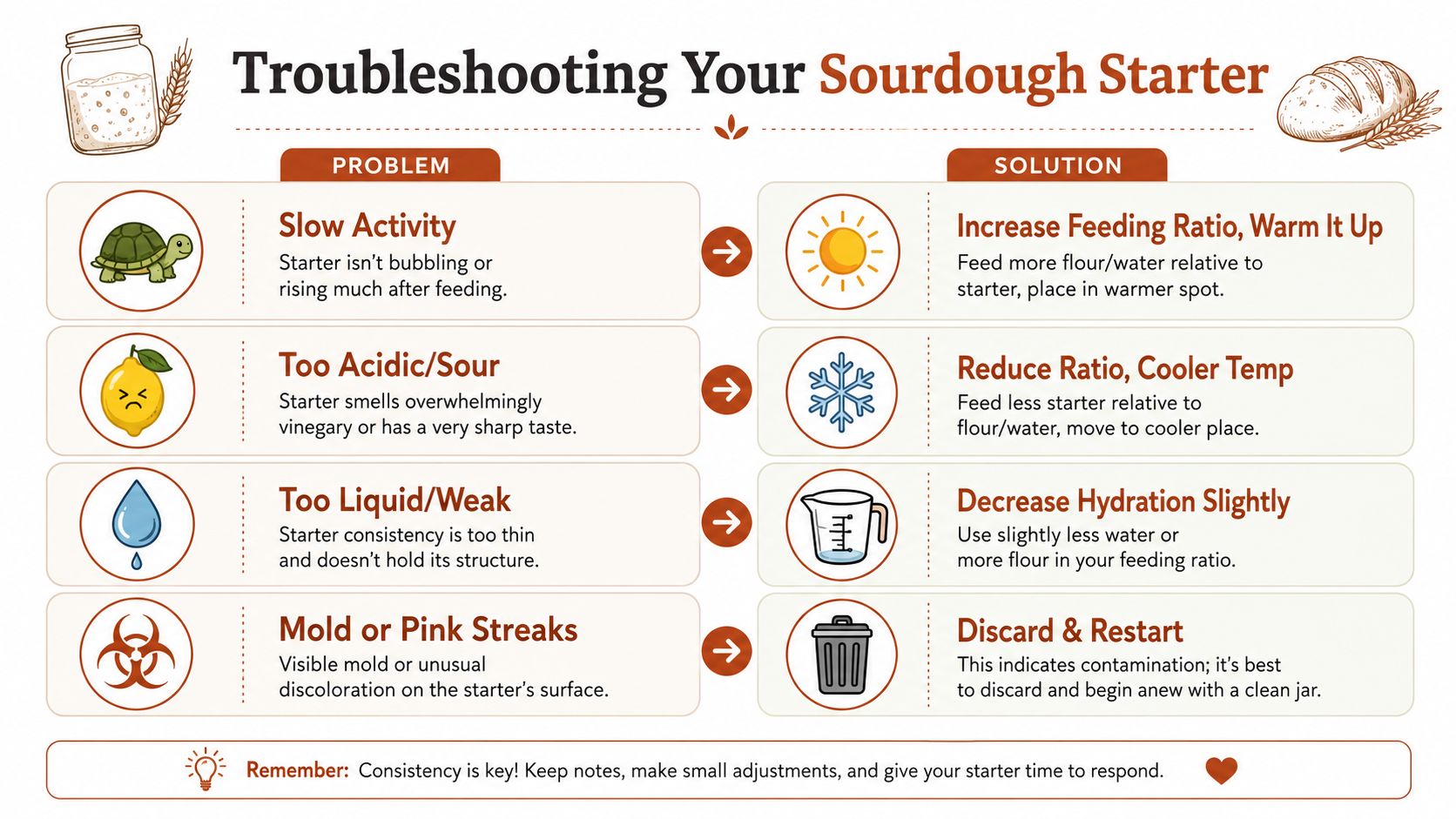
When the smell turns sharp or solvent-like
That harsh smell usually means the culture has run too long on too little food. The organisms have acidified the environment aggressively, and the starter is no longer in a comfortable growth phase.
Correct it by changing the environment, not by hoping the next loaf works out.
- Feed sooner. Don't wait until the starter has spent a long stretch in collapse.
- Check temperature stability. Wide swings can produce irregular peaks and deeper starvation phases.
- Moderate hydration if needed. If the culture is racing through its feed, a slightly stiffer build can slow the pace.
A layer of liquid on top often belongs in the same category. It signals separation and hunger more than catastrophe.
When the starter is slow and the loaf stays dense
Bakers often blame shaping or flour strength too early. Weak rise usually starts upstream in the culture.
Common causes include a cool environment, underdeveloped starter strength, or using the starter too late after peak. The solution is usually a combination of warmth, regular refreshment, and better timing.
A weak starter matters even more in the oven because yeast doesn't keep working indefinitely. The wild yeast colony dies and ceases metabolic activity at an internal dough temperature of 60°C (140°F), a critical threshold where the final surge of carbon dioxide expansion occurs before the yeast perishes, as noted in the earlier cultivation source. If the dough enters the oven with poor gas potential, it won't invent it at the last minute.
The oven doesn't rescue weak fermentation. It exposes it.
That's why oven spring is tied so tightly to fermentation quality. The dough gets one last expansion window before the microbial engine shuts down.
When contamination is the real problem
Not every problem is fixable. Mold, pink streaks, or clearly abnormal discoloration mean the culture should be discarded.
Use a simple decision rule:
| Symptom | Likely interpretation | Best response |
|---|---|---|
| Harsh acidic smell | Hunger or over-acidification | Refresh and stabilize conditions |
| Little rise after feeding | Weak culture or low temperature | Warm it and rebuild strength |
| Mold or pink discoloration | Contamination | Discard and restart |
This is one of the places where bakers waste time. They try to save a contaminated culture out of attachment. That's not discipline. It's sentimentality.
The cleaner approach is to read the jar like a lab sample. If the signs point to starvation, adjust feeding. If they point to poor temperature control, stabilize temperature. If they point to contamination, start over.
From Starter to Loaf Achieving a Perfect Bake
The dough looks ready on the bench, but the result was decided earlier. The loaf in the oven is a readout of microbial strength, acid balance, dough development, and heat management.

A good loaf starts before mixing
Starter condition sets the pace. A culture fed at the right interval, held at a stable temperature, and used near peak activity gives dough stronger gas production and better structure. A culture that has drifted too acidic can still raise bread, but it often does it with less margin for error. The dough turns slack sooner, proofs less predictably, and gives a tighter crumb.
Hydration changes flavor direction as well as handling. Stiffer systems tend to push fermentation toward a sharper profile. Wetter systems usually favor a rounder, milder acidity. Bakers feel this in the bowl long before they taste it in the loaf. The point is practical. Flavor is not added at the end. It is built by microbial conditions you set on purpose.
That is where precision matters. Temperature swings of only a few degrees change how quickly yeast reproduce, how fast acids accumulate, and how long the dough stays in its strongest fermentation window. In a loosely managed kitchen, sourdough can seem temperamental. In a controlled environment, it behaves more like a biological system with readable inputs and outputs. That is the essential value of tools built for fermentation control, including the DBakerAid™ SureDough™ approach to stable temperature and timed feeding or proofing cycles.
A few results usually follow:
- More reliable proof timing
- Better gas retention and crumb definition
- Cleaner acidity with less harshness
- Dough that is easier to score and less likely to spread
Enriched doughs add another layer. Fat softens the crumb and changes extensibility, but it can also mute fermentation speed if the dough is already weak. For bakers folding olive oil into softer formulas, these expert olive oil bread tips are useful because oil changes mixing, aroma, and crust development.
The last variable is the oven environment
A well-fermented dough still needs the right baking conditions. Steam delays crust set. Surface drying changes expansion. Heat transfer determines how long the loaf can keep opening before the outer layer hardens.
For a practical explanation of that transition, this guide to oven spring explains what happens in the first minutes of baking. It ties fermentation quality directly to loaf volume, scoring bloom, and crust formation.
The visual difference is easiest to see in motion:
Repeatable sourdough comes from controlling the variables that matter most. Starter maturity, dough temperature, hydration, proof endpoint, steam, and bake profile each leave a visible mark on the finished loaf. Bakers who get consistent results are usually not guessing better. They are measuring better and changing fewer things at once.
The same discipline applies to high-protein bread, and the trade-offs are even clearer there. These doughs are denser, stiffer, and less forgiving than standard white sandwich bread. They usually rise less, brown faster, and set into a tighter, more uniform crumb. That does not make them inferior. It means the baker has to manage fermentation, mixing intensity, and final proof with more precision.
For people baking around macros, the practical appeal is obvious. D'BakerAid's high-protein Pullman-style loaves are formulated to deliver substantially more protein per slice than standard sandwich bread, while keeping the process manageable at home. The exact numbers depend on the recipe, protein source, flour blend, and slice thickness, so they should be treated as formula-specific rather than universal. Cost also needs to be judged by protein yield and usable texture, not by sticker price alone.
The market has responded to that demand. Grand View Research's high protein bakery products market report describes a growing category driven by consumers who want bread and bakery products that fit higher-protein eating patterns. That interest makes sense from a baker's perspective. People want fresh bread that supports a specific nutrition target, and they want it without accepting wildly inconsistent results.
Consistency is where controlled fermentation equipment earns its place. A system that regulates starter temperature, proofing conditions, and timing removes much of the guesswork that home bakers often mistake for sourdough mystique. Better bread usually comes from better control, not better luck.