

You've mixed the dough, set it somewhere warm, and watched it slowly swell against the sides of the bowl. A few hours later, the same dough may bake into a tall, light loaf, or it may stay dense, collapse, or rise unevenly. The difference begins with a simple question: how does yeast make bread rise?
The answer involves more than yeast producing carbon dioxide. Yeast ferments sugars, gluten holds the resulting gas, temperature controls the fermentation rate, and the oven creates a second burst of expansion called oven spring. Understanding those stages makes homemade bread easier to predict, including challenging high-protein doughs where structure and timing matter even more.
Table of Contents
- Why Your Dough Puffs Up Before Your Eyes
- Meet Yeast The Tiny Living Engine Behind Bread
- How Carbon Dioxide and Gluten Work Together to Lift Dough
- Temperature and Time How Warmth Controls the Rise
- The Second Rise You Do Not See Happening in the Oven
- Why Some Doughs Rise Tall Then Collapse or Stay Dense
- Putting It All Together for a Reliable Rise Every Time
Why Your Dough Puffs Up Before Your Eyes
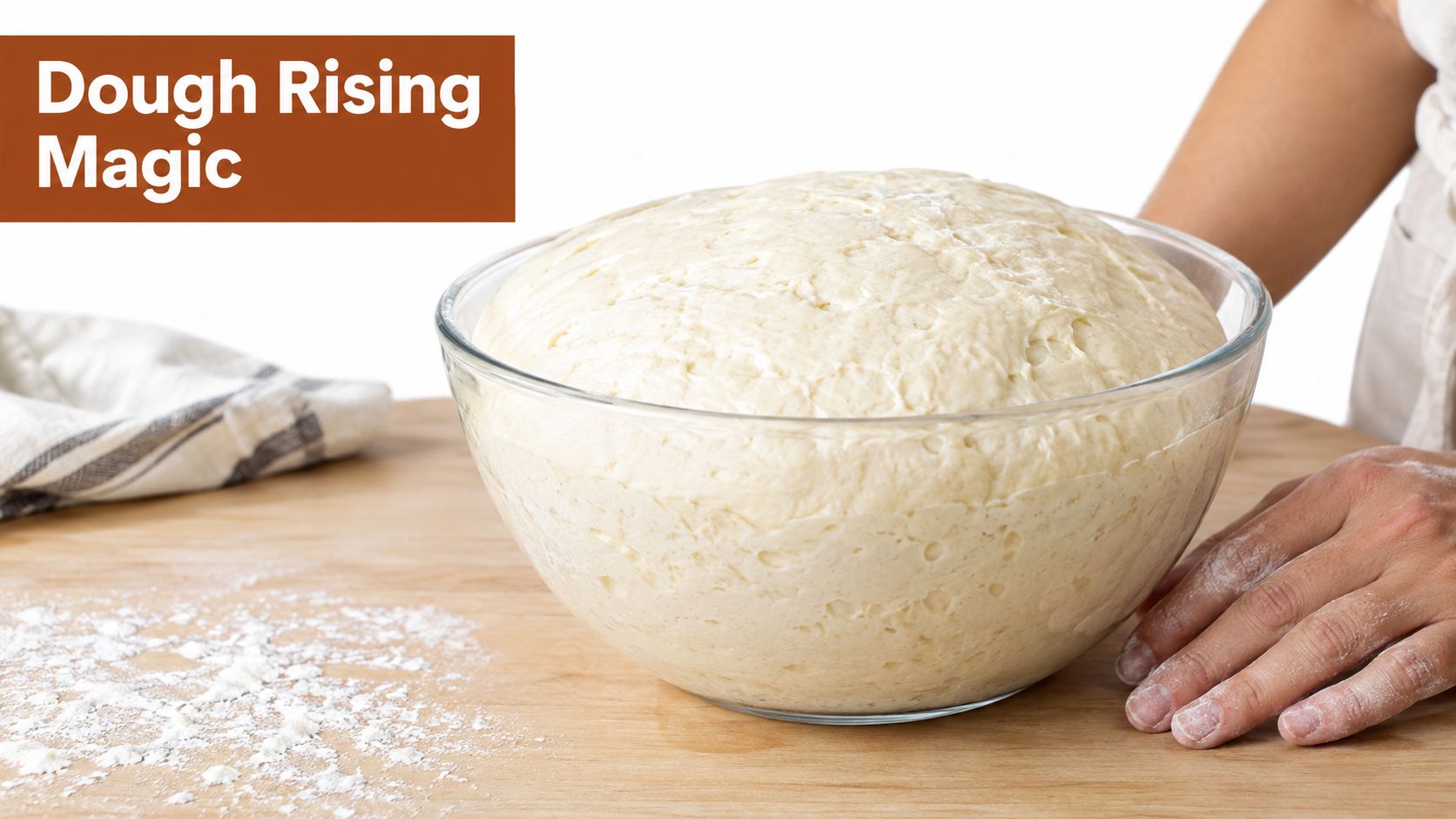
A bowl of dough looks quiet at first. Then small bubbles appear, the surface rounds out, and the dough begins climbing higher. That visible swelling is the result of an invisible biological process. Living yeast is consuming available sugars and releasing gas inside a stretchy network made from flour, water, and gluten.
Think of the dough as a soft net filled with tiny balloons. The yeast inflates the balloons, while the gluten net keeps them from floating away. If the net is strong and flexible, the dough expands. If it's weak, too dry, overly stretched, or unable to retain gas, fermentation can continue without producing a lofty loaf.
Rise happens in two important phases
The first phase takes place during fermentation and proofing. Yeast metabolizes sugars, carbon dioxide accumulates in the dough, and existing air cells expand as they receive more gas. Bakers usually judge this stage by dough volume, surface tension, and feel rather than by a fixed clock, because warmer dough ferments faster and cooler dough ferments more slowly.
The second phase happens after the dough enters the oven. Heat expands gases already present in the dough, changes the behavior of the dough matrix, and contributes to rapid loaf expansion before the crumb sets. A dough that looks merely adequate on the counter can still gain substantial height in the oven, while another dough with similar proofing can produce little oven spring if its yeast cells or structure aren't able to tolerate the transition.
The practical idea: yeast creates the lift, but the dough decides whether that lift becomes bread.
That distinction helps explain several common surprises. Adding more yeast won't automatically repair a weak gluten network. Letting dough proof longer won't necessarily improve its shape. And a cold kitchen isn't just inconvenient, because temperature changes the biological speed of fermentation itself.
For a beginner, this science replaces guesswork with observable clues. For an experienced baker, it offers a better way to diagnose tight crumb, uneven holes, collapsed tops, and disappointing oven spring.
Meet Yeast The Tiny Living Engine Behind Bread
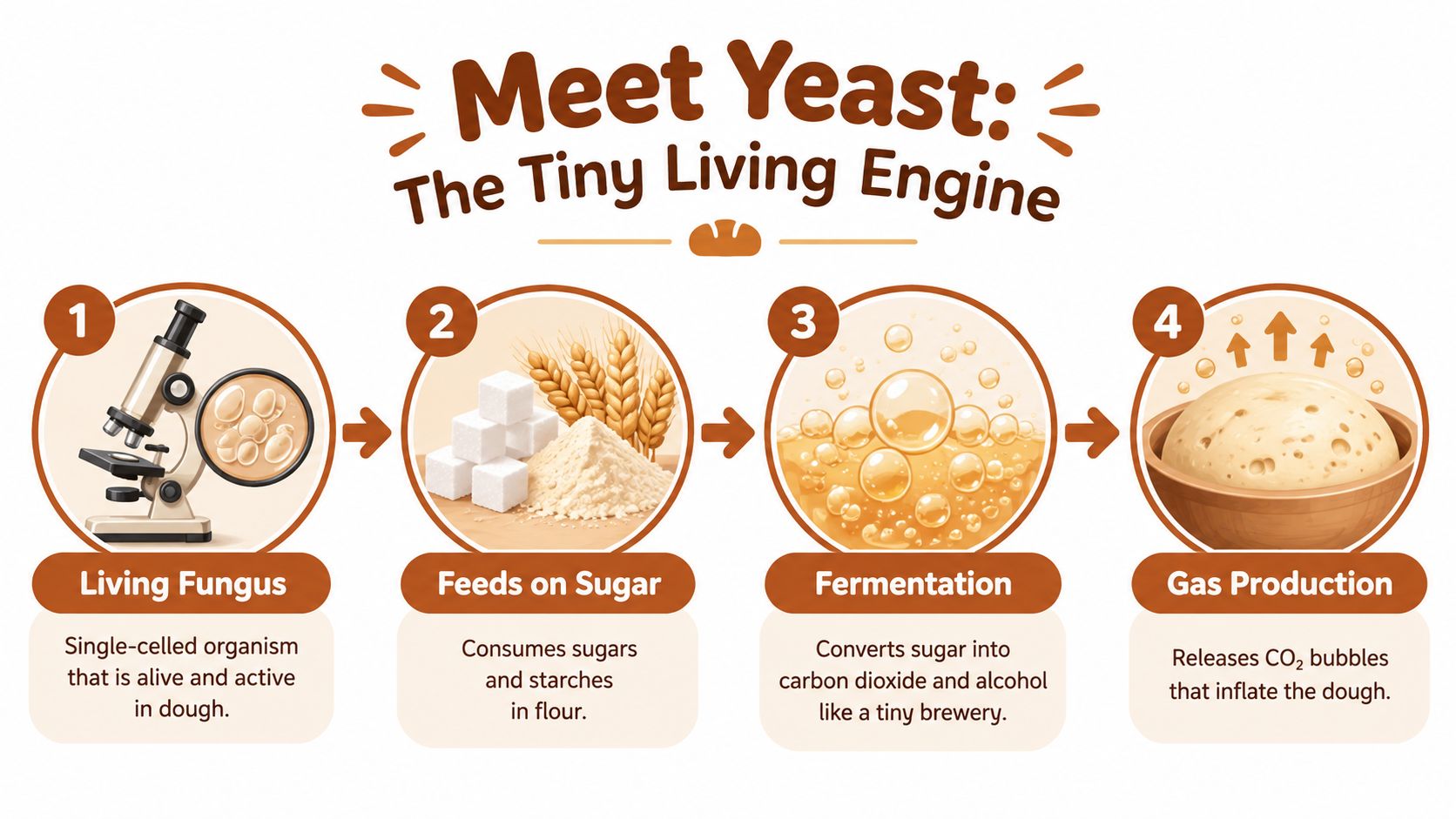
A loaf can look quiet on the counter while a living process is already building its rise. Yeast is a single-celled fungus that becomes active when it has moisture, suitable warmth, and fermentable food. In dough, it works like a microscopic brewery, taking in sugars and releasing carbon dioxide and ethanol. Carbon dioxide supplies the main leavening action in yeasted bread. The Exploratorium's bread science explanation describes the connection among sugar, gas, alcohol, and dough expansion.
Sugar goes in, gas comes out
Flour does not contain a ready-made packet of sugar. Enzymes in the dough help release fermentable sugars from flour starches, and added ingredients may supply more. Yeast uses these sugars as fuel, then ferments in an environment with limited oxygen.
A useful chemical rule of thumb is:
One glucose molecule becomes two molecules of carbon dioxide and two molecules of ethanol.
That conversion explains why carbon dioxide matters so much during the first phase of bread's rise. Ethanol contributes to aroma and flavor chemistry, while much of it evaporates in the oven. Carbon dioxide travels through the dough and enlarges its internal cells, provided the dough can retain it.
Each yeast cell follows a small production line:
- It receives moisture and becomes metabolically active.
- It accesses fermentable sugar.
- It converts that sugar through fermentation.
- It releases carbon dioxide into the surrounding dough.
Yeast is not a chemical powder that reacts once and disappears. It is alive, so its activity changes with temperature, available food, acidity, and the dough's physical condition. Temperature control therefore affects more than timing. Yeast must remain active through fermentation, then tolerate the heat transition long enough for the dough to gain oven spring before its structure sets.
During fermentation, dough pH can drop from about 6.0 to about 5.0, while carbon dioxide becomes the dominant leavening component, as described in this technical discussion of fermentation and bread structure.
If you are comparing active dry and instant yeast, ask whether the yeast is alive and properly hydrated for the recipe. This guide to active dry yeast explains how that form behaves before fermentation begins.
The key correction is simple: yeast does not fill dough with air. It produces carbon dioxide. The dough must then capture that gas, expand around it, and survive enough heat to turn fermentation's gas into a risen loaf.
How Carbon Dioxide and Gluten Work Together to Lift Dough
Set a piece of dough beside a bowl of loose flour paste, then release gas nearby. The gas escapes. A loaf rises only when carbon dioxide enters a structure that can hold it, stretch around it, and later set in the oven.
Hydrated flour proteins form gluten, a viscoelastic matrix that stretches under pressure while retaining some ability to recover its shape. Kneading, folding, hydration, and flour choice affect how this matrix develops. A useful network resembles a flexible net wrapped around many small cells, not a rigid container.
The balloon-in-a-net model
Mixing creates the first air cells. During fermentation, yeast-generated carbon dioxide dissolves in the dough's liquid phase, then diffuses into those existing cells. As gas accumulates, each cell expands. Gluten stretches around the cells, and their combined growth increases the dough's volume.
The process works in stages:
- Yeast ferments sugar: Carbon dioxide enters the dough.
- Gas reaches air cells: Existing bubbles receive more carbon dioxide.
- Gluten stretches: The protein network expands around each bubble.
- The dough gains volume: Many enlarged cells lift the dough together.
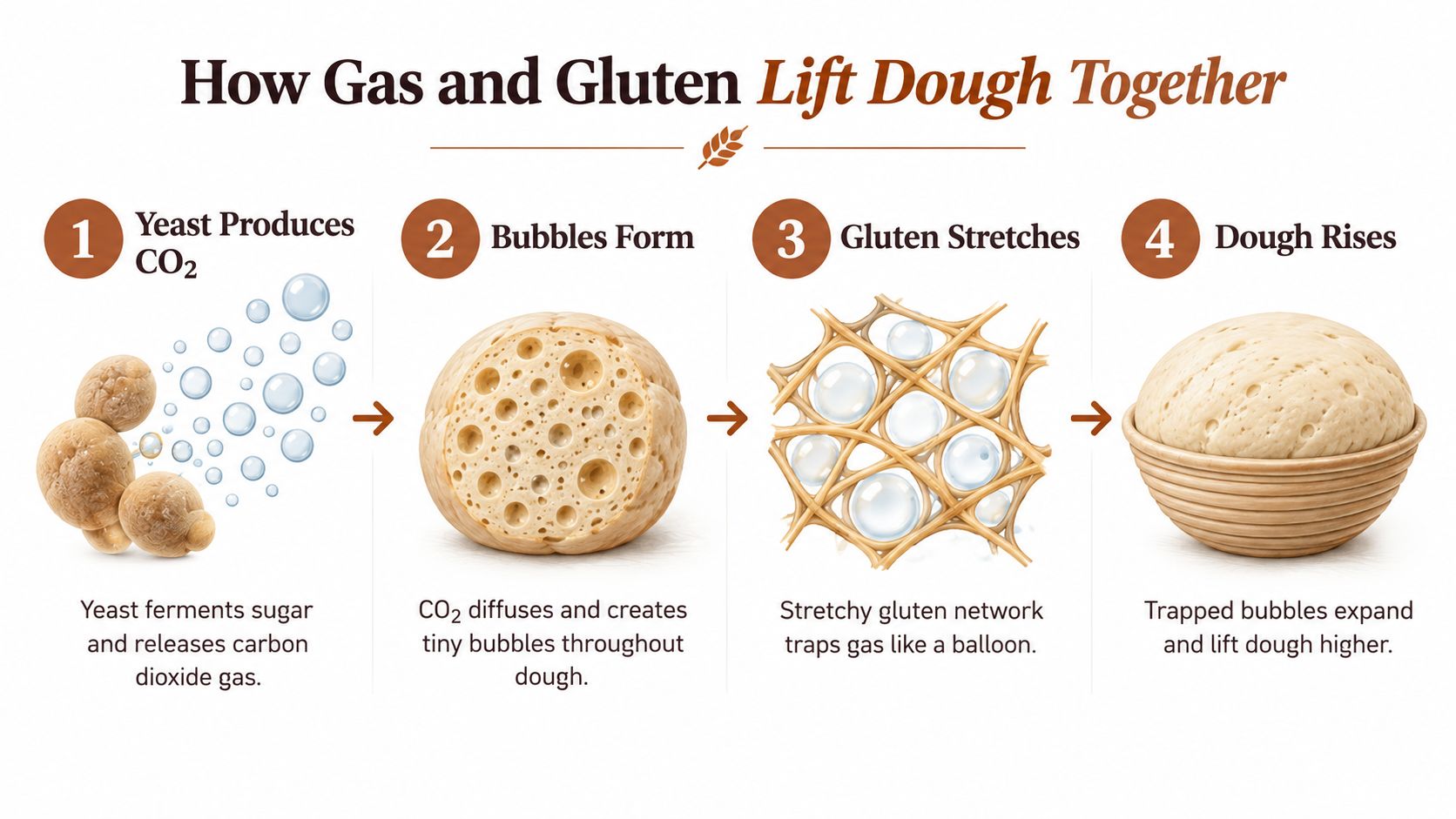
The network needs balance. A rigid dough resists expansion. A weak one tears, lets bubbles merge, or allows gas to escape. The useful target is a structure strong enough to retain gas and flexible enough to stretch.
Gas production and loaf expansion can be measured separately. A comparative study cited by the Exploratorium's bread science resource recorded baker's yeast samples producing up to 163 ± 2 mL of CO2 in 3 hours, while the best-performing bread reached 132 ± 1 cm3 in volume. These values are not a promise for every formula. They show why carbon dioxide production must be paired with dough that retains it.
Why high-protein dough needs more control
High-protein bread makes this partnership harder to manage. Whey, pea, soy, or collagen isolate changes texture, hydration needs, and elasticity. Vital wheat gluten can add structure, but the dough may become stiffer and slightly tacky instead of soft and airy.
Adding more yeast is therefore not a universal fix. Greater fermentation pressure can create more gas, yet an uneven gluten network may fail to stretch. The result can be a tight crumb, ruptures, or collapse. Successful rise matches gas production with gas retention.
The rise also has two phases. Fermentation fills and enlarges the cells before baking. In the oven, yeast remains active briefly, and warming gas expands while the dough's moisture turns to steam. This oven spring can add a final lift, but only if the gluten still holds the expanding cells and the yeast tolerates the heat transition long enough for the structure to set.
A strongly fermented smell with little volume points to a retention problem, not necessarily a lack of yeast activity. Judge both sides of the process: how much gas the yeast produces and how well the dough captures it.
Temperature and Time How Warmth Controls the Rise
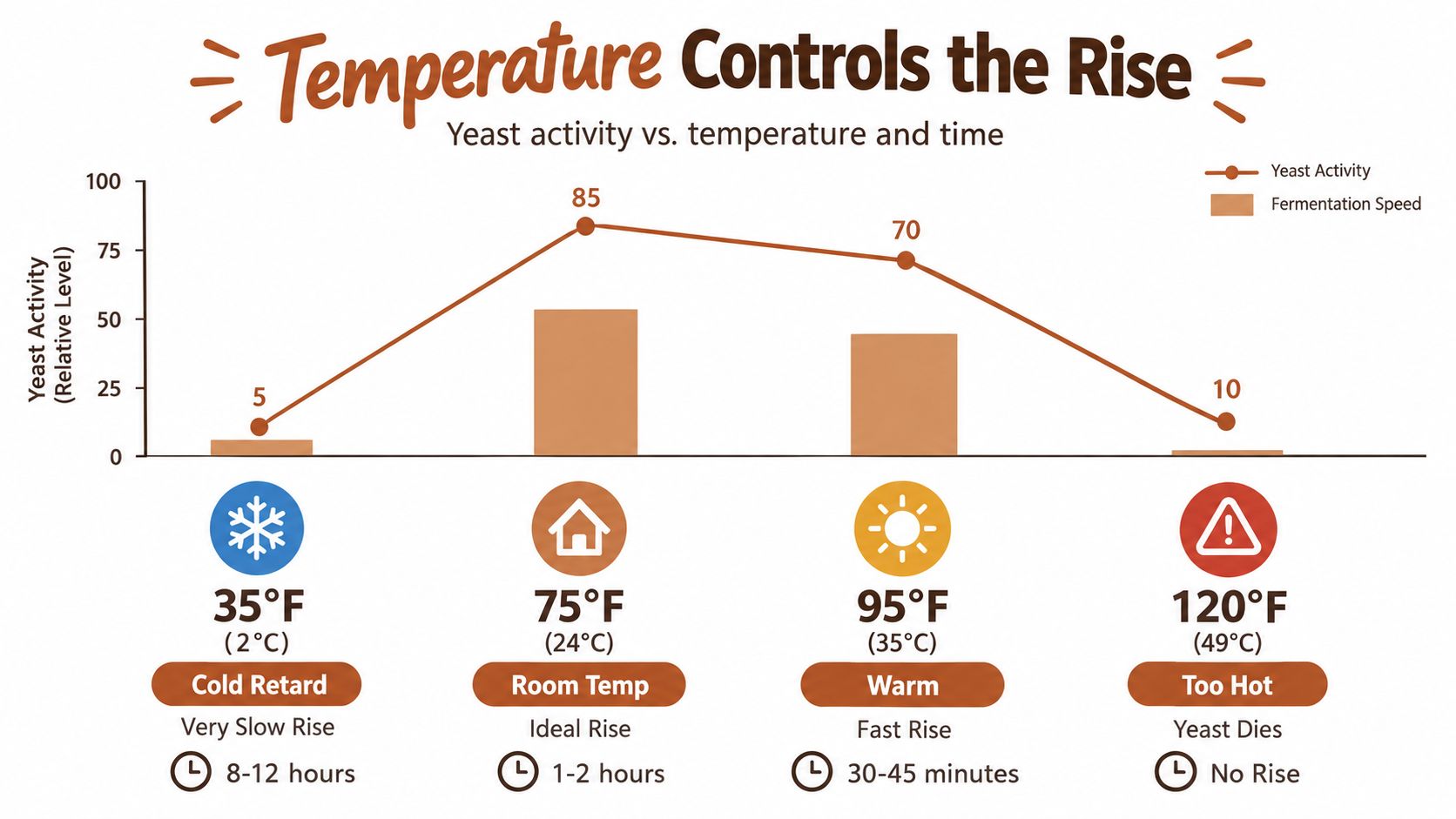
A dough left on a cool counter may barely change for a long while. Move it somewhere warmer, and its bubbles begin expanding sooner. Temperature works like a speed control for yeast, but the warmest setting is not automatically the best. Yeast activity, gluten strength, gas retention, and the final crumb each have their own limits.
Practical baking guidance places peak carbon dioxide production in bread dough around 32–38°C, with a target prover range of 35–40°C for conventional yeasted bread. It treats 40–43°C as an upper ceiling rather than a routine target, since excessive heat can weaken dough stability and reduce the margin for a well-structured rise. This bread technology guide explains proofing temperature and dough behavior.
Small temperature changes can matter
Controlled proving tests show how sensitive fermentation is. Raising dough temperature from 30°C to 33°C increased CO2 release by 7.9% and bread volume by 7.5%. Raising it to 36°C, compared with 33°C, increased bread volume by 17.3% and carbon dioxide concentration by 21.6%. These figures come from bread science data summarized by the Exploratorium.
The practical lesson is not to chase one number blindly. A cool winter kitchen can slow fermentation, while a warm summer kitchen can bring the dough to its target volume sooner. In the warmer room, leaving the dough unattended for the usual time may push it past its best point.
A better habit: watch the dough's volume and resilience, then use temperature to explain why the timing changed.
Below about 70°F, yeast activity can become too slow for practical baking, according to this explanation of yeast leavening science. A dough that barely moves on a cool counter may need a warmer environment or a longer fermentation.
Temperature is also a dough-quality decision
Warmth increases gas production, yet the dough must stretch around those bubbles and keep them contained. If fermentation races ahead of gluten development, the dough can gain volume quickly without gaining enough structural support. A moderate rise gives the network more time to organize, retain gas, and prepare for the later lift in the oven.
Cover the dough so its surface does not dry out. Judge readiness by expansion, a supple feel, and enough surface tension to support shaping, rather than by the clock alone. For bakers who want steadier conditions than a fluctuating countertop, this guide to yeast fermentation temperature explains how temperature management supports repeatable dough development.
The Second Rise You Do Not See Happening in the Oven
Most explanations of bread rise end when proofing ends. That misses a major part of the story. Bread rises once during fermentation and proofing, then often rises again in the oven, where heat rapidly changes gas volume, dough flexibility, and the condition of the yeast cells.
This second stage is called oven spring. The dough enters the oven with a population of gas cells and a partly developed gluten structure. As the temperature rises, gases expand, carbon dioxide moves through the dough, and water and ethanol begin evaporating. Those events add pressure inside the cells before the crumb sets into its final shape.
A 2025 study found dough-height increases of 18.6% to 31.5% during electrical-resistance baking, with a strong positive correlation between loaf expansion and cell viability. The study connected oven rise with yeast thermotolerance in the dough matrix, meaning the ability of yeast cells to remain viable as the dough heats. The published study is available through PubMed.
Why similar proofing can produce different loaves
Two doughs can look nearly identical before baking and still respond differently in the oven. One may contain yeast that tolerates heating well and maintains useful activity longer. Another may have lost more cell viability or may have a less stable bubble network, leaving it with limited oven spring.
Strain selection therefore matters alongside fermentation time. So do dough composition, gluten strength, hydration, shaping, and the temperature path from bowl to oven. A loaf doesn't carry a stopwatch into the oven. It carries a living dough matrix whose behavior changes minute by minute.
The oven also reveals why proofing volume isn't the same as finished volume. During proofing, yeast steadily produces gas. During baking, dissolved gas comes out of solution, trapped bubbles expand, and water and ethanol evaporate, all of which influence the crumb and final height.
For practical troubleshooting, this guide to oven spring is useful because it treats the oven as an active part of the rise rather than merely the place where the already-risen dough is cooked.
Why Some Doughs Rise Tall Then Collapse or Stay Dense
A tall dough isn't automatically a healthy dough. If the gluten network stretches beyond its ability to recover, the cells can merge, rupture, or lose their support. The dough may look impressive before baking and then sink when the structure can no longer hold itself.
A dense loaf presents the opposite-looking problem, but the underlying diagnosis still requires more than checking yeast quantity. Active yeast can produce gas that the dough fails to retain. The dough may be too stiff, underdeveloped, poorly shaped, or fermented at a temperature that pushed gas production faster than structure could adapt.
Match the symptom to the likely mechanism
| What you see | What may be happening |
|---|---|
| The dough barely expands | Yeast activity may be slow, or the dough may be too cold for practical fermentation. |
| The loaf rises unevenly | Gas cells may be distributed poorly, or shaping may have left weak areas. |
| The dough rises and collapses | The structure may have stretched too far and lost the ability to support the cells. |
| The crumb stays tight | Gas production may be limited, or the gluten network may not have expanded effectively. |
| The loaf browns quickly | The formula and surface conditions may be encouraging faster crust color before the interior finishes setting. |
The rise involves several simultaneous mechanisms, not just a single stream of carbon dioxide. Modernist Cuisine's explanation of yeast in bread discusses carbon dioxide production, dissolved gas leaving solution, expansion of trapped bubbles, and evaporation of water and ethanol as contributors to crumb structure and loaf volume.
Why more yeast can make the wrong problem worse
Suppose a dough has weak gas-cell walls. Adding more yeast may increase gas production, but it won't automatically improve the walls. The dough could expand rapidly, develop large unstable pockets, and collapse when heat changes its internal pressure.
High-protein dough makes this especially visible. Protein isolates and vital wheat gluten can produce a stiffer, tackier dough that rises about 50–75% rather than doubling, depending on the recipe and mixing conditions. Expecting the same visual expansion as a classic white loaf can lead to over-proofing, because the baker keeps waiting for a volume target the formula isn't designed to reach.
The better approach is to judge the dough as a system. Ask whether the yeast is active, whether the structure is stretching, whether the bubbles are stable, and whether the temperature is helping or overwhelming the dough.
Putting It All Together for a Reliable Rise Every Time
The complete journey starts with sugar and ends with a set crumb. Yeast consumes fermentable sugars and releases carbon dioxide. Gluten captures that gas in expanding cells. Temperature controls the pace, while the oven adds a second phase of expansion through oven spring and heat-driven changes inside the dough.
A reliable routine focuses on a few physical signals:
- Start with active yeast: Give the organism moisture, food, and a suitable environment.
- Develop the structure: Mix and knead enough to create a flexible gluten network, especially when the formula contains added protein.
- Control warmth: Use a stable proofing environment instead of assuming every kitchen behaves the same way.
- Judge volume thoughtfully: High-protein dough may rise less dramatically than airy white bread while still baking successfully.
- Protect the surface: Cover the dough so drying doesn't create a skin that tears as the interior expands.
- Watch the oven phase: The dough can continue expanding after proofing, but the final result depends on yeast tolerance and bubble stability.
For home bakers who sell loaves locally, fermentation knowledge is only part of the job. You'll also need to understand the rules that apply where you operate, and a Peppery overview for NY home bakers can help you research New York cottage food requirements before planning sales.
D'BakerAid™ is one precision appliance option for this challenge. Its system uses a Stage 1 yeast fermentation bowl, a Stage 2 dough proofing bowl, and a hub that controls temperature and time, with an optional D'Steamer for baking support. That setup is designed to make fermentation and proofing more repeatable, including for high-protein and specialty doughs where gas retention is less forgiving.
D'BakerAid™ helps control the fermentation and proofing stages that determine how yeast-generated gas becomes loaf volume, with dedicated bowls and temperature and time management. Visit DBakerAid™ to explore the system, then see the high-protein recipes for whey, pea, soy, and collagen loaves that bring the science into your kitchen.